


Introduction
This is the fourth piece in our industrial sludge dewatering series, following our guides on dewatering efficiency, decanter vs. filter press economics, and equipment sizing. This time, we're addressing a decision that trips up more chemical plants than it should: whether your process actually needs a 3-phase decanter centrifuge, or whether a simpler, less expensive 2-phase unit will do the job.
Why This Decision Gets Made Wrong More Often Than You'd Expect
Chemical process streams are messier than the textbook diagrams suggest. Many chemical sludges contain trace oils, solvents, or a secondary liquid phase that shows up inconsistently - present in meaningful quantities during some production runs and nearly absent during others. That inconsistency is exactly where sizing mistakes happen in both directions:
Over-specifying a 3-phase unit for a stream that's genuinely just solids-in-water most of the time adds real cost - a more complex mechanical design, a higher price tag, and more components (the adjustable impeller and second discharge line) that require maintenance attention. If your secondary liquid phase is minor and infrequent, that added complexity may never earn its keep.
Under-specifying with a 2-phase unit for a stream that regularly carries a meaningful oil or solvent fraction creates a different problem: the oil ends up either contaminating your water discharge (a compliance risk) or getting lost with the solids (a yield and disposal-cost problem), because a 2-phase machine has no mechanism to separate it out as an independent stream.
Getting this right starts with an honest look at what's actually in your feed - not what the process flow diagram says should be there.
What Actually Separates a 2-Phase From a 3-Phase Decanter
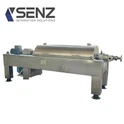
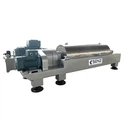
2-phase decanter centrifuge. Separates a feed into exactly two output streams - solids and a single liquid phase - using fixed dam plates to control the liquid discharge level. This is the standard configuration for chemical sludge that's fundamentally a solids-in-water (or solids-in-solvent) suspension with no meaningful second liquid phase to isolate.
3-phase decanter centrifuge (tricanter). Adds an independently adjustable impeller - sometimes called a weir disc - that lets the machine split the liquid discharge into two separate streams by density: a heavier phase (typically water) and a lighter phase (typically oil or solvent), in addition to the solids stream. Critically, this impeller position can be adjusted while the machine is running, letting operators shift the separation cut point as the feed's oil-to-water ratio varies between batches - a genuinely useful feature for chemical processes where feed composition isn't perfectly consistent run to run.
The mechanical complexity of a 3-phase unit isn't just "more parts for the sake of more parts" - it's what makes real-time separation of two liquid phases possible at all. But that complexity is only worth paying for if your process actually generates two liquid phases worth separating.
Chemical Sludge Scenarios: Which Configuration Actually Fits
Reactor bottoms and catalyst recovery sludge. Often solids-in-solvent with no meaningful second liquid phase - typically a 2-phase application, unless the process specifically generates an immiscible byproduct liquid alongside the primary solvent.
Oily wastewater from chemical manufacturing. If oil contamination is a consistent, quantifiable fraction of the waste stream - common in petrochemical intermediates, lubricant production, or certain specialty chemical processes - a 3-phase decanter is usually the right call, since recovering that oil as a separate stream both protects compliance and can offset processing costs through oil recovery value.
Polymer and resin production waste. Frequently solids-heavy with a single aqueous liquid phase - generally a 2-phase scenario, though it's worth confirming with your process engineers whether any solvent carryover creates a genuine second liquid phase.
Multi-product facilities with variable feed. If your plant processes different product lines through the same waste treatment system, and feed composition genuinely varies between solids-only and oil-containing streams depending on what's in production, a 3-phase unit's adjustable impeller offers operational flexibility that a fixed 2-phase configuration can't match - even if some runs technically wouldn't have required it.
Comparing the Two Configurations Directly
| Factor | 2-Phase Decanter Centrifuge | 3-Phase Decanter Centrifuge |
|---|---|---|
| Output streams | Solids + 1 liquid | Solids + 2 liquids (heavy & light phase) |
| Mechanical complexity | Lower - fixed dam plates | Higher - adjustable impeller/weir disc |
| Upfront cost | Lower | Higher |
| Maintenance points | Fewer moving separation components | Additional impeller mechanism to maintain |
| Operational flexibility | Fixed liquid discharge configuration | Real-time adjustable separation cut point |
| Best fit | Solids-in-single-liquid chemical sludge | Feed containing solids + two immiscible liquids (e.g., oil and water) |
| Risk if misapplied | Oil contamination of water discharge or lost yield in cake | Unnecessary cost and complexity for a stream that didn't need it |
A Practical Way to Make the Call
If you're not certain which configuration your chemical sludge actually needs, a reasonable diagnostic approach is to sample your feed across several production runs - not just once - and check for a consistent, separable oil or solvent layer versus an occasional trace that's more noise than signal. A single sample from a single run can be misleading in either direction, especially in multi-product facilities where feed composition shifts with what's being manufactured that week.
If that sampling shows a meaningful, recurring second liquid phase, the 3-phase configuration's added cost is generally justified - both for regulatory compliance and, frequently, for the recovered oil's resale or reuse value. If it doesn't, a 2-phase unit will typically deliver the separation you need at meaningfully lower capital and maintenance cost.
Not sure which side of that line your process falls on?
Share your feed sampling data - or let us help you design a sampling protocol if you don't have it yet - with our application engineering team, and we'll recommend the phase configuration that actually matches your chemical sludge, not a generic industry default. Contact us for a custom sizing consultation and a formal RFQ.