

Decanter Centrifuge vs. Filter Press: What's the Real Total Cost of Ownership?
A filter press quote almost always looks better on the first page of a capital budget request. It's a lower sticker price, a familiar technology, and an easy line item to justify. The problem is that the sticker price is rarely the number that determines whether the equipment was actually the right call - and for plant managers who've owned a filter press through a few years of operation, the follow-up costs tend to tell a very different story than the initial quote did.
This is the companion piece to our guide on optimizing sludge dewatering efficiency with decanter centrifuges, and it goes deeper into the one comparison that comes up in almost every industrial wastewater dewatering equipment decision: decanter centrifuge vs. filter press, evaluated on total cost of ownership rather than upfront price alone.
Why the Filter Press vs. Decanter Decision Is Rarely About the Quote?
Three recurring cost categories separate what a filter press costs to buy from what it costs to run - and they're the same three categories that eventually push many plants toward a decanter centrifuge when it's time to replace aging dewatering equipment.
Labor intensity. A filter press is a batch process. Someone has to cycle it - closing plates, running the press, opening plates, and manually clearing cake from each chamber before the next batch can start. On a multi-shift operation, that's recurring labor cost that a continuous decanter centrifuge, which runs largely unattended once commissioned, simply doesn't carry in the same way.
Filter media replacement. Filter cloths wear, tear, and blind over time, and replacing them is both a direct material cost and a source of unplanned downtime when a cloth fails mid-cycle. A decanter centrifuge has no filter media at all - its only consumables are wear parts on the conveyor and discharge components, which typically last far longer under equivalent operating conditions.
Footprint and building costs. A filter press sized for meaningful throughput takes up significant floor space and, in many retrofits, headroom for plate removal and cake discharge. A decanter centrifuge's enclosed, horizontal design generally delivers more throughput per square foot - which matters directly when a "cheaper" filter press ends up requiring a building expansion that was never in the original capital estimate.
None of this makes a filter press the wrong choice in every case - for lower-volume or batch-oriented operations, its lower upfront cost can genuinely be the better fit. But for continuous, higher-volume industrial wastewater dewatering, the total cost of ownership math frequently tells a different story than the initial capital quote suggests.
The Technical Difference: Batch Pressure Filtration vs. Continuous Centrifugal Force
Understanding why the operating costs diverge starts with understanding how differently the two technologies actually separate solids from liquid.
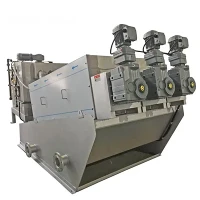
How a filter press works. A filter press forces slurry under pressure through a series of filter cloths stretched across recessed plates. Solids build up against the cloth as a cake while filtrate passes through, and the cycle continues until the chambers are full - at which point the press must stop, open, and discharge the accumulated cake before starting the next batch. Separation quality depends heavily on cloth condition, applied pressure, and cycle time, and because it's a batch process, throughput is inherently limited by how quickly a full cycle - fill, press, open, discharge, close - can be repeated.
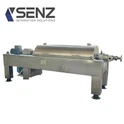
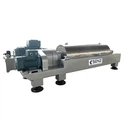
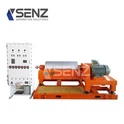
How a decanter centrifuge works. A decanter centrifuge separates continuously inside a spinning horizontal bowl. Centrifugal force - often 1,000 to 4,000 times gravity - drives denser solids to the bowl wall in seconds, while a screw conveyor rotating at a slightly different speed than the bowl continuously moves those solids toward discharge as clarified liquid exits the opposite end. There's no cycle to complete and no media to reload; feed simply keeps flowing in as separated cake and liquid keep flowing out.
What this means for cake solids content. Under the right operating conditions, a well-tuned decanter centrifuge can achieve a comparable or higher cake solids content than a filter press for many sludge types, particularly fine, compressible solids - though a filter press can outperform a centrifuge on extremely fine or hard-to-dewater particles where high pressure filtration has a genuine mechanical advantage. The right answer depends on your specific feed characteristics: particle size distribution, compressibility, and how the material responds to pressure versus centrifugal force are the variables that actually decide which technology gets you to a drier, cheaper-to-dispose-of cake.

Total Cost of Ownership: A Side-by-Side Breakdown
| Factor | Filter Press | Decanter Centrifuge |
|---|---|---|
| Operating mode | Batch - fill, press, discharge cycle | Continuous - no cycle interruption |
| Upfront capital cost | Generally lower | Generally higher |
| Labor requirement | High - manual plate cycling and cake discharge | Low - largely automated once commissioned |
| Consumables | Filter cloths (regular replacement) | Wear parts only (conveyor, discharge components) |
| Footprint per unit throughput | Larger for equivalent capacity | More compact for equivalent capacity |
| Cake solids content | Excellent for very fine, hard-to-dewater particles | Excellent for most sludge types, especially at scale |
| Odor/vapor containment | Open cycle, more prone to release during discharge | Fully enclosed, better containment |
| Downtime risk | Cloth blinding/failure, cycle bottlenecks | Wear-part replacement, bearing/lubrication maintenance |
| Best fit | Lower-volume, batch operations; very fine particle separation | Continuous, higher-volume operations prioritizing labor savings and throughput |
The pattern that shows up across most facilities: filter presses tend to win the initial capital comparison, and decanter centrifuges tend to win the five-year operating cost comparison - with the crossover point arriving faster the higher your throughput and labor costs are.
Where a Filter Press Still Makes Sense?
It's worth being direct about this, because a credible technical comparison shouldn't just build a case for one technology: if your operation processes a low, intermittent volume of sludge, or if your specific solids are extremely fine and genuinely difficult to dewater by centrifugal force alone, a filter press's higher achievable cake dryness on that narrow category of material can outweigh the labor and media costs that would otherwise favor a centrifuge. The honest answer to "which is better" is that it depends on your feed characteristics and your throughput profile - which is exactly why sizing decisions should be based on real feed data, not a generic industry rule of thumb.
Running the Numbers for Your Own Plant
The comparison table above is a useful starting framework, but the numbers that actually matter - your labor rate, your disposal cost per ton, your current cake solids content, and your realistic throughput - are specific to your facility. A filter press that's been running for a decade with steadily increasing cloth replacement and labor costs may already have crossed the total-cost-of-ownership line without anyone running the comparison explicitly.
Not sure which side of that line your plant is on?
Share your current operating costs - labor hours per cycle, cloth replacement frequency, disposal fees, and current cake solids content - with our application engineering team, and we'll build a side-by-side total cost of ownership model comparing your existing filter press against a properly sized decanter centrifuge for your specific feed. Contact us for a custom sizing consultation and a formal RFQ based on your real operating data.