



2-Phase Decanter Centrifuge Manufacturer
Shenzhou's 2-phase decanter centrifuges — also known as solid bowl centrifuges, horizontal bowl centrifuges, or scroll centrifuges — provide continuous, high-efficiency solid-liquid separation for wastewater, chemical, food, and pharmaceutical applications. With bowl sizes from 220mm to 550mm, ISO9001 and CE certification, and 45 years of manufacturing experience, we supply dewatering solutions to customers in over 70 countries.
What Is a 2-Phase Decanter Centrifuge?
A 2-phase decanter centrifuge is a horizontal centrifuge used to continuously separate solid material from a single liquid using high-speed rotation. It is the standard equipment for dewatering sludge, slurries, and suspensions where the goal is a single clarified liquid stream and a drier solid ("cake") output — as opposed to a 3-phase decanter, which additionally separates two liquid phases of different density.
2-phase dewatering is essential across a wide range of industries, from municipal wastewater treatment to chemical, food, and mining processing, wherever solids need to be efficiently and continuously separated from a liquid carrier.


Product Categories
Latest Products




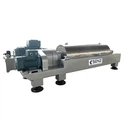
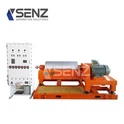
How a 2-Phase Decanter Centrifuge Works
Feed Introduction — Slurry enters through an axial feed tube into the center of the rotating conveyor.
Acceleration/Dispersal — The feed strikes an accelerator and is distributed outward through feed ports, forming a rotating liquid "pond" inside the bowl.
Separation — Under centrifugal force (up to several thousand G), higher-density solids settle against the bowl wall while the clarified liquid remains closer to the center.
Auger Rotation — A differential rotation speed between the conveyor (screw) and the bowl, created by the gearbox, continuously moves settled solids forward.
Sludge Discharge — The conveyor flights push solids up the conical "beach" section and out through the discharge ports.
Fluid Discharge — The clarified liquid rises over adjustable dam plates at the front of the bowl and discharges from the machine.
Key Features & Benefits
Process Adaptability Handles variations in feed flow rate and solids concentration while maintaining consistent separation quality.
Long Service Life Robust bowl and conveyor construction with replaceable wear parts (discharge ports, wear tiles) minimizes downtime over years of operation.
Compact Footprint Smaller installation footprint than belt presses or filter presses of equivalent capacity — suited to space-constrained plants.
Fully Enclosed, Vapor-Tight Design Prevents odor and gas escape into the working environment, important for indoor wastewater treatment installations.
Low Labor Requirement Continuous automated operation requires minimal manual attendance, reducing long-term labor costs.
Lower Operating Cost vs. Filter Media Methods Unlike belt/filter presses, there is no filter cloth or media to replace — only wear parts, reducing consumable costs over time.
Technical Specifications
| Model | Bowl Diameter (mm) | Bowl Speed (rpm) | Separation Factor (G) | Capacity (m³/h) | Main Motor Power (kW) | Material |
|---|---|---|---|---|---|---|
| LW220 | 220 | 4000–6000 | up to 3,500G | 1–5 | 5.5–7.5 | SS304/SS316L |
| LW355 | 355 | 3000–4200 | up to 3,000G | 5–20 | 15–22 | SS304/SS316L |
| LW450 | 450 | 2500–3600 | up to 2,800G | 10–35 | 30–37 | SS304/SS316L |
| LW550 | 550 | 2000–3200 | up to 2,600G | 20–60 | 45–55 | SS304/SS316L |
Note: Actual capacity depends on solids content, particle size, and specific gravity of the feed material. Contact our engineers for application-specific sizing.
Applications by Industry
Municipal & Industrial Wastewater Sludge Dewatering
The most common application — reduces sludge volume before disposal or further treatment at sewage treatment plants.
Chemical Industry
Separates and purifies chemical products and by-products such as acids, alkalis, solvents, polymers, and resins.
Pharmaceutical Industry
Separates and dewaters pharmaceutical intermediates, proteins, enzymes, and products such as heparin sodium.
Food Processing
Clarifies and dewaters milk, juice, purees, cheese, and yogurt production streams; also used for soy protein and starch/gluten separation.
Mining & Mineral Processing
Separates minerals and solids from process water in ore beneficiation operations.
Power Generation
Dewaters coal slurry and other fuel by-products ("clean coal" applications).
Pulp & Paper
Dewaters pulp and paper mill sludge for disposal or reuse.
2-Phase vs 3-Phase Decanter Centrifuge — Which Do You Need?
| 2-Phase Decanter Centrifuge | 3-Phase Decanter Centrifuge (Tricanter) | |
|---|---|---|
| Separates | Solid + 1 liquid | Solid + 2 immiscible liquids |
| Typical feed | Sludge, slurry with single liquid phase | Mixtures containing oil, water, and solids |
| Liquid discharge | Single outlet, fixed dam plates | Two independent outlets (heavy & light phase) |
| Common use case | Municipal/chemical sludge dewatering, food processing | Oil sludge, edible oil, oily wastewater |
| Relative cost | Lower | Higher (additional impeller/discharge system) |
Rule of thumb: if your process only involves solids and a single liquid phase (e.g., sludge and water), a 2-phase decanter is the simpler, more cost-effective choice.
→ Need to separate oil and water as well? See our 3-Phase Decanter Centrifuge page.
Decanter Centrifuge vs. Filter Press / Belt Press — How to Choose
| Decanter Centrifuge | Filter Press | Belt Press | |
|---|---|---|---|
| Operation | Continuous | Batch | Continuous |
| Footprint | Compact | Large | Medium |
| Consumables | Wear parts only | Filter cloth (frequent replacement) | Filter belts |
| Labor requirement | Low (automated) | High (manual cycling) | Medium |
| Best for | High-volume continuous processes | Fine particle, batch dewatering | Medium-volume continuous sludge |
Core Components
Inlet Zone — Accelerates feed slurry to bowl speed while minimizing solids degradation and pond disturbance; multiple feed zone configurations available per process.
Screw Conveyor — Flight pitch, lead angle, and differential speed engineered per application for optimal scrolling of sedimented solids.
Solids Discharge Section — Configurable to handle output consistency from dry powder to paste; wear-resistant components replaceable on-site.
Liquid Discharge Section — Liquid level regulated by adjustable dam plates; centripetal pump discharge available for applications requiring pressurized liquid output.
How to Choose the Right 2-Phase Decanter Centrifuge
Application — Identify your specific material type (municipal sludge, chemical slurry, food product, etc.), as this determines the appropriate bowl configuration.
Throughput — Determine required processing volume per hour to select the correct model size.
Separation Requirements — Consider the solids content, particle size, and specific gravity of your feed material.
Bowl Speed — Higher speeds generally improve separation but increase energy consumption and maintenance needs.
Maintenance Needs — Evaluate ease of maintenance and parts availability to minimize downtime.
Budget — Balance upfront cost against long-term performance and reliability; avoid compromising quality for short-term savings.
Maintenance Guidelines
Thoroughly wash the bowl after each run — incomplete cleaning causes solids buildup that leads to imbalance and vibration on restart.
Ensure dam plates are reinstalled at consistent height (tolerance ±0.25mm) after cleaning to prevent uneven centrifugal force.
Manage supernatant solids content carefully — high solids in the return flow accelerates wear on bolts and counterweights.
Clean the supernatant reflux pipe regularly to prevent blockages that reduce cake dryness and cause vibration.
Schedule sludge screw pump cleaning every 50–100 hours in municipal applications with high fiber/hair content in raw sludge.
Delivery Records
Multiple LW-series units supplied globally across 70+ countries including the U.S., Canada, Australia, Russia, Brazil, and Singapore.
Ongoing distribution partnership with NPP Gidriks LLC (Russia) for sedimentation centrifuge supply.
180+ decanter centrifuge and disc separator series in active use worldwide
Certifications
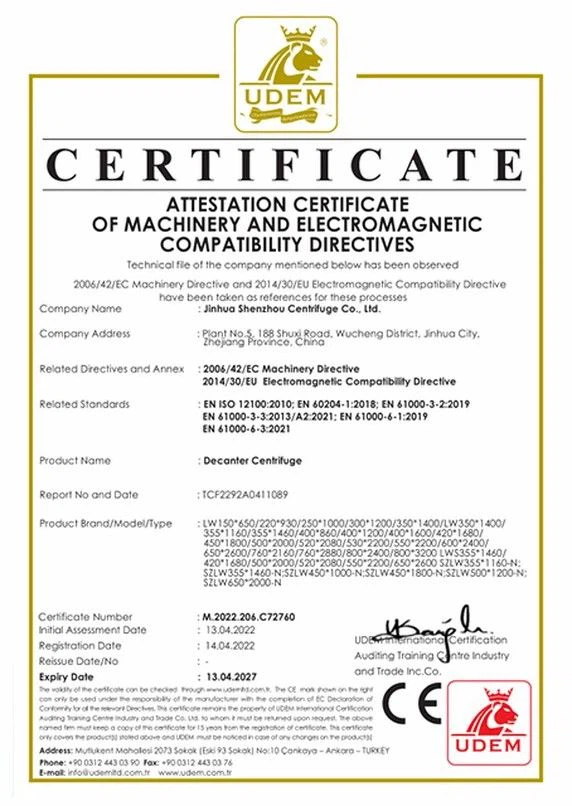
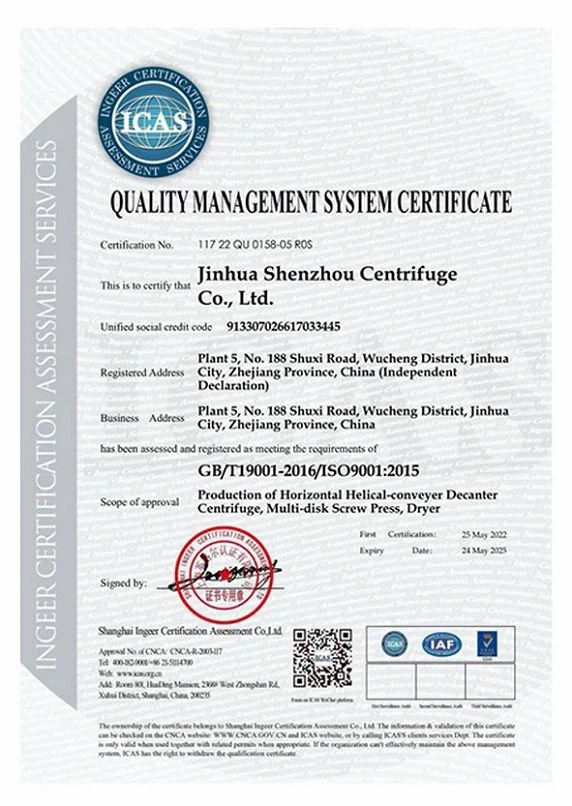
FAQ
Jinhua Shenzhou Centrifuge Co., Ltd. is one of the most professional 2-phase decanter centrifuge manufacturers and suppliers in China, featured by quality products and competitive price. Please rest assured to wholesale cheap 2-phase decanter centrifuge for sale here from our factory. Contact us for customized service.
Beer Yeast Separator, Sludge Dewatering Decanter Centrifuge, Celery juice separation