



Tubular Centrifuge
Why Choose Us
Advanced Equipment
We own various kinds of inspection and testing facilities with value over USD10 million. 18 testing tables, high speed dynamic balancing machine, ultrasonic flaw detection machines.etc.
Advanced testing equipment
We are equipped with complete testing, inspection, analysis control system, advanced testing machines and stimulative working condition test table and automatic control testing system,which guarantees our new product research, processing validation and quality.
Global Market
Now there are over 180 series or decanter centrifuges and disc separators used home and abroad. Including U.S.A, Canada, Australia, Russia, Brazil, Singapore and so on totally 70 countries.
Accept ODM/OEM service
You can discuss your purchasing needs with our customer service center. We also welcome OEM and ODM orders.
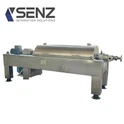
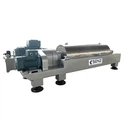
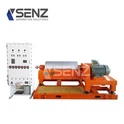
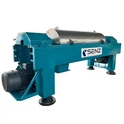
The tubular centrifuge is a kind of centrifuges that is designed to separate fluids based on their density. The centrifuge works by spinning a sample at high speeds, which causes heavier particles to move towards the outside of the tube and lighter particles to move towards the center. This creates a separation of the two fluids. The tubular design of the centrifuge allows for precise control over the separation of fluids. It is commonly used in pharmaceutical, biotech, and chemical industries for processing, purification, and clarifying of various fluids. The device is particularly useful for handling small volumes of sample and provides a quick and efficient separation of complex mixtures.


Product Categories
Latest Products




Benefits of Tubular Centrifuge
High Efficiency
Even in complicated mixtures, the components can be quickly and efficiently separated using their large sedimentation area and high rotational speed.
Compact Design
The machine's small footprint makes it easy to incorporate into preexisting process lines and conserves precious floor space in manufacturing facilities.
Saving Energy
Because of their low initial investment and high potential for future use, numerous sectors highly prized them. You can save money on consumables by washing and reusing the tubular bowl centrifuge tubes.
Ongoing Function
It runs continuously, unlike batch centrifuges, which means more throughput and better product quality every time.
Ease of Maintenance
The machines are easy to operate and maintain because of their simple design with few moving parts. They cut down on operational expenses and downtime thanks to their long service life and low maintenance requirements.
Low Cost
Many industries find them worthwhile investments due to their cost-effectiveness and repeatability. The consumables cost can be reduced because the tubular bowl centrifuge tubes can be easily cleaned and reused.
Types of Tubular Centrifuge
GQ 2-phase tubular centrifuge
GQ series is mainly used for 2-phase separation. A 2-phase tubular bowl centrifuge is a device that can separate a mixture of two different phases: liquid phase and solids phase.The working principle of a 2-phase tubular bowl centrifuge is based on the difference in specific gravity and centrifugal force of the two phases. The suspension is fed into the bottom of a rotating bowl, where it is accelerated to a high speed.The solid phase, which has the heavier specific gravity, is pushed to the inner wall of the bowl and forms a cake layer.
The liquid phase, which has the lower specific gravity, forms an inner layer, and remains closer to the bowl center.The two phases are then discharged separately from different outlets: the solid phase is manually removed from the bowl after stopping the centrifuge; the liquid phase is discharged from the top of the centrifuge.
GF 3-phase tubular centrifuge
GF series is mainly used for 3-phase separation. A 3-phase tubular bowl centrifuge is a device that can separate a mixture of three different phases: a heavy liquid, a light liquid, and a solid.The working principle of a 3-phase tubular bowl centrifuge is based on the difference in specific gravity and centrifugal force of the three phases. The mixture is fed into the bottom of a rotating bowl, where it is accelerated to a high speed.The solid phase, which has the highest specific gravity, is pushed to the inner wall of the bowl and forms a cake layer.The light liquid phase, which has the lowest specific gravity, forms an inner layer near the axis of the bowl.
Application of Tubular Centrifuge
Pharmaceutical & Biotechnology Industry
It is extensively used in the production of vaccines, antibiotics, and other biopharmaceutical products. They help separate cells, cell debris, and other impurities from the product stream, ensuring high quality and purity.
Food & Beverage Industry
In the food and beverage industry, it is commonly used for the clarification of juices, wines, and other products. They help remove solids, such as fruit pulp and yeast, to produce a clear, high-quality product.
Chemical Industry
Tubular centrifuges are used in the chemical industry for the separation of liquid-liquid and liquid-solid mixtures, such as separating water from oil or removing solids from a liquid suspension.
Environmental Applications
The centrifuges are utilized for various environmental applications, such as wastewater treatment and sludge dewatering. They help separate solid contaminants from water, allowing for efficient waste disposal and water recycling.
Bowl Assembly
The heart of the centrifuge, the bowl assembly, is where the magic happens. It consists of a cylindrical bowl with a conical bottom and a spinning rotor inside. The bowl is typically made of high-grade stainless steel, ensuring durability and corrosion resistance.
Drive System
Connected to the bowl assembly is the drive system, which imparts rotational motion to the bowl. This system ensures that the contents within the bowl are subjected to high gravitational forces, promoting efficient separation.
Control Panel
Modern tubular bowl centrifuges come equipped with advanced control panels that allow operators to fine-tune the separation process. These panels enable precise control of rotational speed, feed rates, and discharge settings.

Material and Durability
The first consideration when selecting a Tubular Centrifuge is the material it is made of. Common materials used for manufacturing test tubes include glass, plastic, and glass-reinforced plastic (GRP). Each material has its advantages and disadvantages, so it is important to evaluate your lab's requirements. Glass Tubular Centrifuge are durable, heat-resistant, and virtually inert, making them suitable for a wide range of applications. However, they can be fragile and may break during centrifugation if not handled with care. Plastic test tubes, on the other hand, are more resistant to breakage, but may not be suitable for high-speed centrifugation. GRP test tubes offer a good balance between durability and performance, making them a popular choice for many labs.
Capacity and Dimensions
Tubular Centrifuge come in various sizes and capacities to accommodate different volumes of samples. It is important to choose a test tube size that matches your experimental needs. Consider the volume of the sample you will be working with and ensure that the test tube has enough capacity to hold it without overflowing. Additionally, check the dimensions of the test tube to ensure compatibility with your centrifuge. Some test tubes may be too long or wide to fit into certain centrifuge models, so it is crucial to check the specifications before making a purchase.
Compatibility with Centrifuge Models
Not all Tubular Centrifuge are compatible with all centrifuge models. Different centrifuges have varying rotor designs, which require specific test tube sizes and shapes. Before purchasing test tubes, it is essential to check the compatibility with your centrifuge model. Ensure that the test tube can be securely attached to the rotor without any risk of leakage or detachment during centrifugation. Additionally, consider the maximum speed and g-force that the test tube can withstand to ensure it meets your experimental requirements.
Specialized Features
Depending on your lab's specific needs, you may require specialized features in your Tubular Centrifuge. Some test tubes are designed with screw caps or snap caps, providing a secure seal to prevent sample leakage during centrifugation. Others may have graduations or writing areas for easy sample identification and measurement. Additionally, some test tubes are compatible with automated systems, allowing for streamlined sample processing. Consider these features and determine which ones are essential for your experiments.
The Parts of The Tubular Centrifuge
At the center of the tubular centrifuge is a powerful motor that creates the spin. Attached to this motor is the rotor, in which will rest the containers that hold the tubes containing the material to be centrifuged. These containers may be spun at a 45-degree angle (fixed angle centrifuge), a 90-degree angle (horizontal centrifuge) or no angle (vertical centrifuge). Depending on the centrifuge, the tubes may either be loaded at the angle on which they will rotate (fixed angle is a good example of this) or be loaded into a container that will adjust itself to a different angle upon startup. This second methodology is referred to as swing bucket and is a common functionality in horizontal centrifuges.
Depending on the centrifuge selected, a variety of different controls may be available. Some centrifuges are pre-programmed for one, two, or three processing settings. Some are completely custom programmable with a digital display. Regardless of the control type, when you start the centrifuge, it will run the motor based on the settings provided. During the cycle, the sample in the test tubes will separate into their various components so they are ready for analysis.
How to Maintain Tubular Centrifuge


Avoiding rotor failures
The centrifugal field which accelerates the separation process also exerts large forces on the rotor material. If a rotor fails, the tubular centrifuge is severely damaged as well. For this reason, some simple precautions should be observed.rotors are designed to be run up to their maximum speed with a load of a specific weight. One should never attempt to run a rotor at a speed higher than the one designated by its manufacturer. Also, if high density solutions (greater than 1.2 g/ml, for instance) are used, the run speed must be reduced to prevent undue stress on the rotor. Consult your instruction manual for exact directions.
Tube breakage
Glass tubes can break during centrifugation, due either to improper loading or inherent defects. Any glass fragments must be removed from the buckets, adapters, rubber liners, and rotor chamber before the next run is made. If you find gray dust, which results from sandblasting of the rotor chamber by glass particles, it must be cleaned up too. You should make several dry runs without samples, and clean the chamber between each run to be sure this dust is eliminated from the tubular centrifuge.
Chemical resistance
If you plan to tubular centrifuge any uncommon solvents or solutions, consult your manual to be sure they are compatible with the various plastics and metals comprising the tubular centrifuge, the rotor, the tubes, and other accessories. These same precautions must be observed with any solvents used for sterilization purposes. A table of 19 chemical resistances for common tubular centrifuge materials is available from beckman coulter.
Aerosol generation
If any liquid is spilled on a rotor, it will be dispersed as a particulate mist when the tubular centrifuge is run. Part of this mist will be fine enough to form a relatively stable aerosol which will tend to be dispersed throughout the laboratory. Such spills should be thoroughly cleaned up before running the tubular centrifugee.
Our Factory
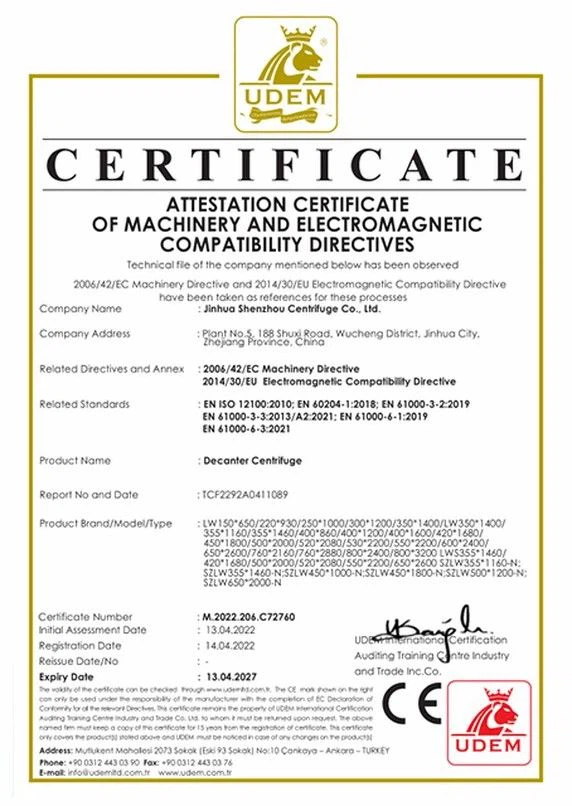
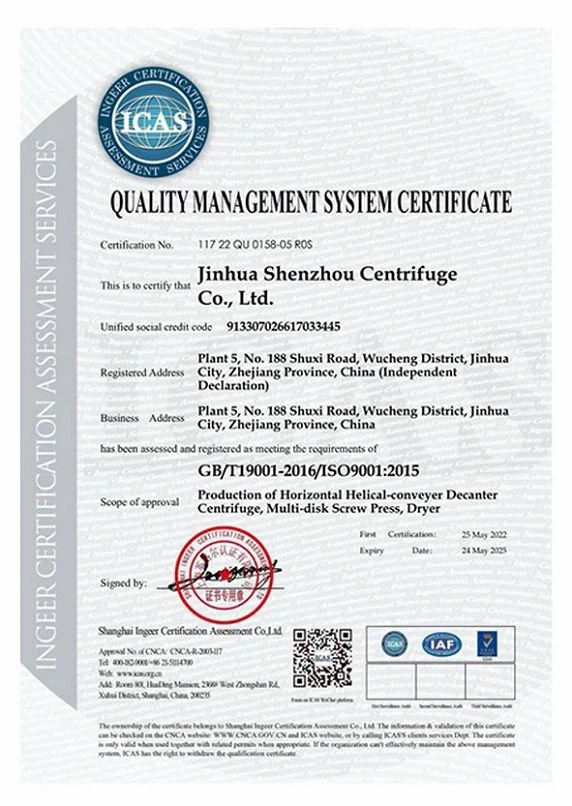
Shenzhou Machinery is a subsidiary of Shenzhou Group.Which was established in 1980, conveying an area of 80000M2 ,there are 2500 staffs and employee in our company.200 of them are technicians and engineers.It has obtained the approvals and certifications of both CE and ISO.Some of our machines gained the new technology invent patent.We are on of the world's leading manufacturers of decanter centrifuge,disc centrifuge,tubular centrifuge,separation systems and drying equipment.Now there are over 180 series or decanter centrifuges and disc separators used home and abroad.Including U.S.A , Canada ,Australia,Russia ,Brazil,Singapore and so on totally 70 countries.We own various kinds of inspection and testing facilities with value over USD10 million .18 testing tables,high speed dynamic balancing machine,ultrasonic flaw detection machines.etc.
Certifications
FAQ
Jinhua Shenzhou Centrifuge Co., Ltd. is one of the most professional tubular centrifuge manufacturers and suppliers in China, featured by quality products and competitive price. Please rest assured to wholesale cheap tubular centrifuge for sale here from our factory. Contact us for customized service.
