




Jinhua Shenzhou Centrifuge Co., Ltd. is one of the leading manufacturers and suppliers of olive oil separator in China. Please feel free to wholesale customized olive oil separator at competitive price from our factory. For more cheap products, contact us now.
Olive Oil Clarification Decanter Centrifuge
The LW series uses a labyrinth seal at both ends of the bowl for a simple, low-maintenance design well suited to continuous olive-mill operation. After the malaxed olive paste enters the bowl, the scroll conveyor carries the separated pomace to the solid discharge port under centrifugal force, while the oil and vegetation water drain out under gravity and centrifugal force through adjustable overflow plates. Because the bowl and scroll geometry are matched to the specific consistency of olive paste - rather than generic sludge or slurry - the LW series maintains stable, continuous throughput even as olive ripeness and moisture content vary across a harvest season.

Olive Oil Separator Operating principle
Separation takes place inside a horizontal bowl fitted with a screw conveyor. Olive paste is fed into the bowl through a stationary inlet tube and smoothly accelerated in the feed zone. Centrifugal force causes the denser pomace solids to settle instantly against the bowl wall, while the screw conveyor - rotating at a slightly different speed than the bowl - continuously moves the settled solids toward the conical discharge end. The lighter oil and water phases are discharged separately through adjustable weir plates at the opposite end of the bowl.


The Role of Centrifugal Separation in Olive Oil Extraction
Modern olive oil mills rely on centrifugal separation at two distinct stages of the extraction process:
Stage 1 - Decanting the Malaxed Paste
After olives are crushed and malaxed (slowly mixed to encourage oil droplets to coalesce), the resulting paste contains oil, vegetation water, and solid pomace all mixed together. A horizontal decanter centrifuge separates this paste continuously at high speed:
3-phase decanter adds a small amount of warm water to the paste, producing three separate outputs: oil, vegetation water (wastewater), and drier pomace. This configuration gives operators more control over oil moisture content but generates more wastewater to manage.
2-phase decanter uses little or no added water, producing only oil and a wetter pomace (with the vegetation water retained in the pomace). This approach reduces water consumption and wastewater treatment costs, and is increasingly preferred in regions with water restrictions or strict environmental discharge rules - though the resulting pomace requires different downstream handling.
Stage 2 - Vertical Separation (Oil Clarification)
The crude oil discharged from the decanter still contains small amounts of residual water and fine solid particles. A vertical disc separator spins this oil at very high speed to remove these remaining impurities, producing clear, ready-to-store olive oil. This clarification step is essential for extending shelf life and preventing off-flavors caused by residual moisture and sediment.
Shenzhou supplies both stages of this process - horizontal decanters for paste separation and vertical disc separators for final oil clarification - allowing mill operators to source a matched, compatible system from a single supplier.
Food-Grade Requirements for Olive Oil Processing
Because the equipment is in direct contact with an edible food product, olive oil decanters and separators require design considerations beyond those of industrial wastewater or chemical processing units:
- All wetted parts are manufactured from 316L food-grade stainless steel to resist the acidity and oxidative properties of olive oil and vegetation water. - Bowl and casing surfaces are polished to a hygienic finish that resists oil residue buildup and simplifies cleaning between batches.
- Processing temperature is closely controlled to stay within the range associated with "cold extraction" - internationally recognized as below 27°C (80.6°F) - helping preserve the polyphenols, aroma compounds, and color that define high-quality extra virgin olive oil.
- Enclosed, low-oxygen processing paths minimize oil oxidation during separation.
Olive Oil Separator Main Features
◇ Vertical base design with a symmetrical motor and bowl arrangement ensures stable operation and minimal vibration - important for consistent oil quality during long processing runs.
◇ The bowl and conveyor are manufactured from corrosion-resistant 316L stainless steel or duplex steel, offering a high maximum bowl speed and strong centrifugal force for efficient oil-pomace separation.
◇ Dual motor drive allows independent adjustment of bowl speed and conveyor speed, so operators can fine-tune separation performance for different olive varieties and ripeness levels.
◇ Screw conveyor flights are fitted with wear-resistant tiles or linings (ceramic, tungsten carbide, or other hard alloys) to withstand the abrasive nature of olive pomace.
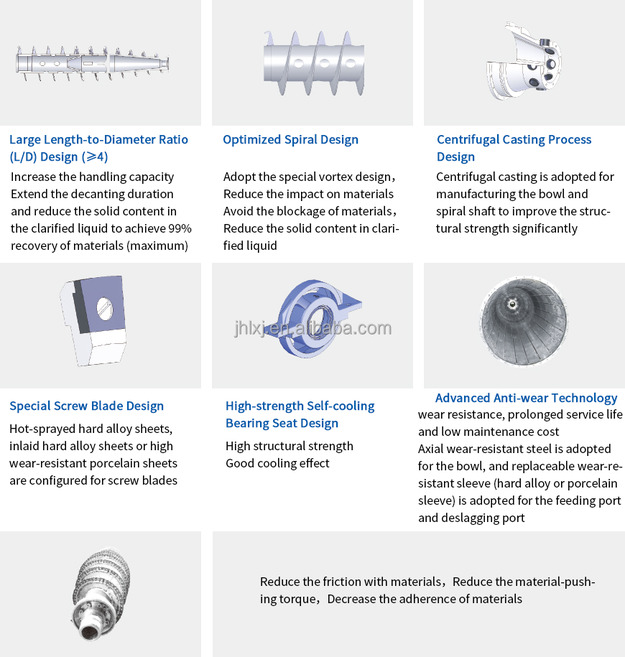
◇ An optional planetary or hydraulic gearbox provides a wide range of differential speed adjustment for fine process control.
◇ Multiple safety protections are built in, including bowl speed and differential speed detection, over-vibration protection, motor overload and overheat protection, bearing temperature monitoring, conveyor torque protection, and gas-tight explosion-proof protection.
◇ JG-type rubber vibration isolators eliminate the need for anchor bolts, simplifying installation and relocation within the mill.
◇ All product-contact surfaces are designed for easy wash-down and CIP (clean-in-place) compatibility between processing batches, supporting food-safety hygiene requirements.
Olive Oil Separator line Flow chart

Our advantage

Food-Grade Reliable Quality
The bowl - the core component in contact with the oil - is manufactured from SAF 2205 duplex stainless steel using a centrifugal casting process, offering greater corrosion and fatigue resistance than conventional 304 or 316 stainless steel. All weld joints undergo flaw detection and heat treatment, with traceable quality certificates available for food-safety audits.

Stable, Low-Vibration Operation
Precision dynamic balancing (≥ Class 2.5) keeps the centrifuge running smoothly at continuous high speed, which helps protect delicate flavor and aroma compounds in the oil from excessive mechanical agitation. Noise stays below 85 dB, and the unit is protected by dual mechanical and electrical overload systems to prevent unplanned shutdowns during a harvest-season production run.

Long Service Life Under Abrasive Conditions
Olive pomace is abrasive, so the screw conveyor and bowl are treated with advanced wear-resistant coatings and structures. All bearings are genuine imported NSK/SKF units, and the electrical control box uses components from established brands such as Siemens and Schneider - reducing the risk of costly downtime during peak olive processing season.

Automated Process Control for Consistent Oil Quality
The system automatically adjusts the screw conveyor's differential speed to prevent overload and blockage as paste consistency varies between olive batches. Bearing temperature and vibration sensors, combined with alarms for motor overload, differential over-torque, and low differential speed, allow operators to catch process deviations before they affect oil quality. A frequency-conversion (flameproof) control cabinet enables one-key automatic start and stop.
Frequently Asked Questions
What's the difference between an olive oil decanter and an olive oil separator?
A decanter is a horizontal centrifuge that separates malaxed olive paste into oil, water, and solid pomace. A separator is a vertical disc-stack centrifuge that follows the decanter, polishing the crude oil by removing residual water and fine sediment. Most modern mills use both machines in sequence.
Can an olive oil separator be used for other oils?
Yes. The same vertical disc-stack design used for olive oil clarification can polish other edible oils such as avocado oil and crude seed oils, though bowl speed and disc spacing may need adjustment for different oil viscosities.
What temperature does an olive oil separator run at?
To qualify as "cold extraction," processing must stay below 27°C (80.6°F) throughout decanting and separation, which helps preserve polyphenols, aroma compounds, and color in the finished oil.
What materials should an olive oil separator be made from?
Wetted parts should be 316L stainless steel at minimum, since olive oil and vegetation water are mildly acidic and oxidative. Higher-end units use SAF 2205 duplex stainless steel bowls for better corrosion and fatigue resistance under continuous operation.
Hot Tags: olive oil separator, China olive oil separator manufacturers, suppliers, factory, Palm Oil Clarifier, high speed centrifuge, Candy Juice separation, Starch centrifuge, centrifuge for sugar industry, large capacity industrial centrifuge price


