How to Optimize Sludge Dewatering Efficiency with Heavy-Duty Decanter Centrifuges
If you run a wastewater treatment plant or a chemical processing facility, sludge dewatering is probably one of the few line items where the pain shows up in three different budgets at once: chemical spend, hauling and disposal fees, and unplanned maintenance labor. Get the dewatering step wrong, and every one of those costs compounds - wetter cake means heavier trucks to the landfill, and heavier trucks mean a bigger invoice every single month.
This guide is written for the people who actually own that invoice: plant managers and process engineers evaluating whether their current dewatering setup is costing them more than it needs to, and what a properly sized decanter centrifuge can do about it.
The Real Operational Headaches Behind Poor Sludge Dewatering
Before getting into the mechanics, it's worth naming the three problems that actually drive most industrial sludge dewatering decisions - because the "best" technology on paper isn't always the one that fixes the problem you actually have.
Polymer cost creep. Flocculant is one of the largest recurring line items in most dewatering operations, and it's also one of the easiest to overspend on. Underperforming equipment often gets "fixed" in the short term by adding more polymer, which temporarily improves cake dryness but permanently inflates the operating budget - and once a plant gets used to running at a higher dosage, walking it back can feel risky even when the root cause is mechanical, not chemical.
Wet cake disposal fees. Landfills and haulers charge by weight, not volume, so every percentage point of residual moisture in the cake is money leaving the plant on a truck. A cake at 18% solids versus 25% solids isn't a minor technical distinction - over a year of continuous operation, that difference can represent a meaningful swing in transport and tipping fees.
Unscheduled downtime. Dewatering equipment that isn't matched to the actual feed characteristics tends to fail in predictable but disruptive ways: conveyor wear, bearing overload, or blockages that force an emergency shutdown during a shift with no backup capacity online. The cost isn't just the repair - it's the sludge that keeps arriving while the line is down.
Industrial sludge dewatering performance ultimately comes down to matching the right equipment, correctly sized and correctly operated, to your specific feed. For high-volume, continuous operations, that increasingly means a heavy-duty decanter centrifuge - but understanding why requires a quick look at what's actually happening inside the machine.
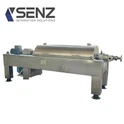
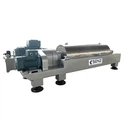
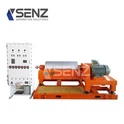
[Image Concept: Wide shot of an industrial plant floor showing a heavy-duty horizontal decanter centrifuge installed inline with sludge feed piping and a discharge conveyor. Alt: Heavy-duty industrial decanter centrifuge installed in a wastewater treatment plant]
The Mechanics of Continuous Solid-Liquid Separation
A decanter centrifuge performs continuous solid-liquid separation by spinning a horizontal bowl fast enough that centrifugal force - not gravity, and not a filter medium - drives the separation. Understanding the two variables that actually control your results, G-force and differential speed, is the difference between operating the machine and just running it.
G-force and cake dryness. Bowl speed determines the centrifugal force applied to the slurry, typically expressed as a multiple of gravity (G). Higher G-force pushes solids against the bowl wall harder and faster, generally improving both cake dryness and capture rate - but only up to a point. Push G-force too high for a given feed, and you risk over-compacting the cake to where it becomes difficult to convey, or generating excess heat and mechanical stress that accelerates wear on bearings and seals. The right G-force setting isn't a fixed number; it's a function of your specific solids' particle size, density, and compressibility.
Differential speed and solids conveying. Inside the bowl, a screw conveyor rotates at a slightly different speed than the bowl itself. This speed difference - the "differential speed" - is what continuously scrapes settled solids toward the discharge end. Run the differential speed too high, and solids move through the machine faster than they can properly dewater, leaving you with a wetter cake despite adequate G-force. Run it too low, and solids accumulate faster than the conveyor clears them, risking overload and blockage. Getting this balance right, specific to your sludge's conveying characteristics, is usually where the largest untapped gains in cake dryness are hiding on plants that have never had their differential speed properly tuned to current feed conditions.
Pond depth as the third lever. Adjustable weir plates control how deep the liquid "pond" sits inside the bowl. A deeper pond increases retention time and typically improves liquid clarity; a shallower pond shifts the balance toward drier cake at some cost to centrate clarity. Most heavy-duty decanter centrifuges allow this adjustment without stopping the machine, which matters because feed characteristics - especially in industrial chemical slurry separation, where upstream process variability is often higher than in municipal sludge - can shift meaningfully from batch to batch.
[Image Concept: Cross-section diagram of a decanter centrifuge bowl showing the liquid pond, settled solids layer, and screw conveyor path. Alt: Industrial decanter centrifuge bowl working principle diagram showing G-force separation]
None of these three variables work in isolation - G-force, differential speed, and pond depth interact, which is exactly why a decanter centrifuge that's merely "installed" rather than properly commissioned and tuned so often underperforms its rated capacity.
Chemical Slurry Separation: Where Decanters Earn Their Keep
Municipal sludge gets most of the attention in dewatering discussions, but chemical slurry separation is where equipment selection mistakes tend to be the most expensive. Chemical process streams are frequently more corrosive, more abrasive, or more variable in solids content than municipal sludge, which means the margin for error in bowl material selection and wear protection is much smaller.
For chemical slurry separation specifically, three specification decisions matter more than they do in a standard wastewater application:
Bowl and conveyor material. Standard 304/316L stainless steel handles most municipal and light industrial applications, but aggressive chemical media may require duplex stainless steel, titanium, or high-nickel alloys to avoid premature corrosion failure.
Wear protection on the conveyor flights. Abrasive chemical slurries accelerate conveyor wear far faster than typical municipal sludge. Tungsten carbide tiles or ceramic inserts on the flights aren't an upsell - for genuinely abrasive feeds, they're the difference between a multi-year service interval and a costly mid-year rebuild.
Seal and gas-tight design. Where the process stream involves volatile or hazardous chemicals, a fully enclosed, gas-tight bowl design isn't optional from a safety and environmental compliance standpoint.
Getting chemical slurry separation right starts with an honest characterization of the feed - particle size distribution, solids concentration, corrosivity, and abrasiveness - shared with your equipment supplier before, not after, a machine is sized and ordered.
Decanter Centrifuge vs. Belt Press: Which Actually Costs Less to Run?
This is usually the real decision plant managers are weighing, and the honest answer is: it depends on your operating profile, but for continuous, high-volume operations, the total cost of ownership case for a decanter centrifuge is usually stronger than the upfront price tag suggests.
| Factor | Decanter Centrifuge | Belt Press |
|---|---|---|
| Operating mode | Continuous, minimal manual attendance | Continuous, but requires closer operator attention |
| Footprint | Compact - vertical, enclosed design | Larger footprint for equivalent capacity |
| Typical cake dryness | Higher for most sludge types, especially fine solids | Generally lower; more sensitive to sludge characteristics |
| Consumables | Wear parts only (no filter media) | Filter belts require periodic replacement |
| Labor requirement | Low - automated, enclosed operation | Higher - belt tracking, washing, and tensioning need regular oversight |
| Odor/vapor containment | Fully enclosed, better containment | Open belt design, more prone to odor release |
| Upfront capital cost | Higher | Generally lower |
| Best fit | High-volume, continuous operations prioritizing cake dryness and low labor | Lower-volume operations where upfront cost outweighs long-term operating savings |
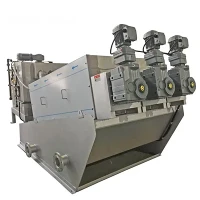
The decanter centrifuge vs belt press decision usually comes down to this: a belt press typically wins on lower upfront capital cost, which matters for smaller or intermittent operations. A decanter centrifuge typically wins on total operating cost at scale - lower labor, no filter media to replace, a smaller footprint, and, critically, a materially drier cake in most applications, which is the single biggest lever on your ongoing disposal costs. If your facility processes sludge continuously and disposal fees are a significant line item, the cake-dryness advantage alone often pays back the capital cost difference well within the equipment's service life.
[Image Concept: Side-by-side comparison photo or illustration of a decanter centrifuge and a belt filter press installation. Alt: Decanter centrifuge vs belt press comparison for industrial sludge dewatering]
Sizing It Right: Why "Bigger" Isn't the Same as "Better"
A common and costly mistake is oversizing a decanter centrifuge on the assumption that more capacity is always safer. In practice, a decanter centrifuge running well below its rated throughput doesn't achieve better cake dryness - it often achieves worse, because the machine's differential speed and pond depth settings are tuned for a design flow rate, and running significantly under that rate can leave solids in the bowl longer than optimal without actually improving separation.
Proper sizing starts with real feed data: solids concentration, particle size distribution, expected flow rate variability, and target cake dryness - not a generic industry benchmark. This is also where the polymer cost conversation circles back: a correctly sized and tuned decanter centrifuge frequently allows facilities to reduce polymer dosage while maintaining or improving cake dryness, because the mechanical separation is doing more of the work that was previously being compensated for chemically.
Getting the Sizing and ROI Numbers Right for Your Plant
Every plant's sludge is different, and the gap between a generic spec sheet and the right machine for your specific chemical slurry separation or municipal dewatering application is where most of the value - and most of the risk - sits. Rather than sizing equipment off assumptions, the fastest path to an accurate ROI picture is sharing your actual feed data with an applications engineer who can model expected cake dryness, throughput, and total operating cost against your current system.
Ready to see what a properly sized decanter centrifuge would do for your polymer costs, disposal fees, and uptime?
Contact our application engineering team for a custom sizing consultation and request a formal quote (RFQ) based on your specific feed characteristics and throughput requirements. We'll work from your real operating data - not a generic spec sheet - to size equipment that's matched to your process from day one.