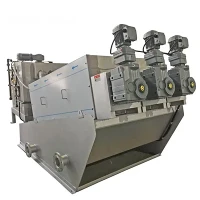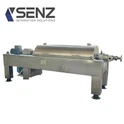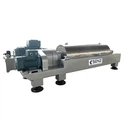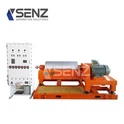



A decanter centrifuge is a solid-bowl separation machine that uses centrifugal sedimentation and an internal screw conveyor, called a scroll, to separate suitable suspended solids from liquid. Feed enters the rotating bowl, denser particles move toward the bowl wall, and the scroll transports deposited solids to a separate discharge.
Decanters are used for duties such as sludge thickening, slurry dewatering, liquid clarification and selected product-recovery processes. The appropriate design depends on the feed and required outlet quality. A decanter is not a universal wastewater treatment system and does not remove dissolved substances simply by producing clearer liquid.
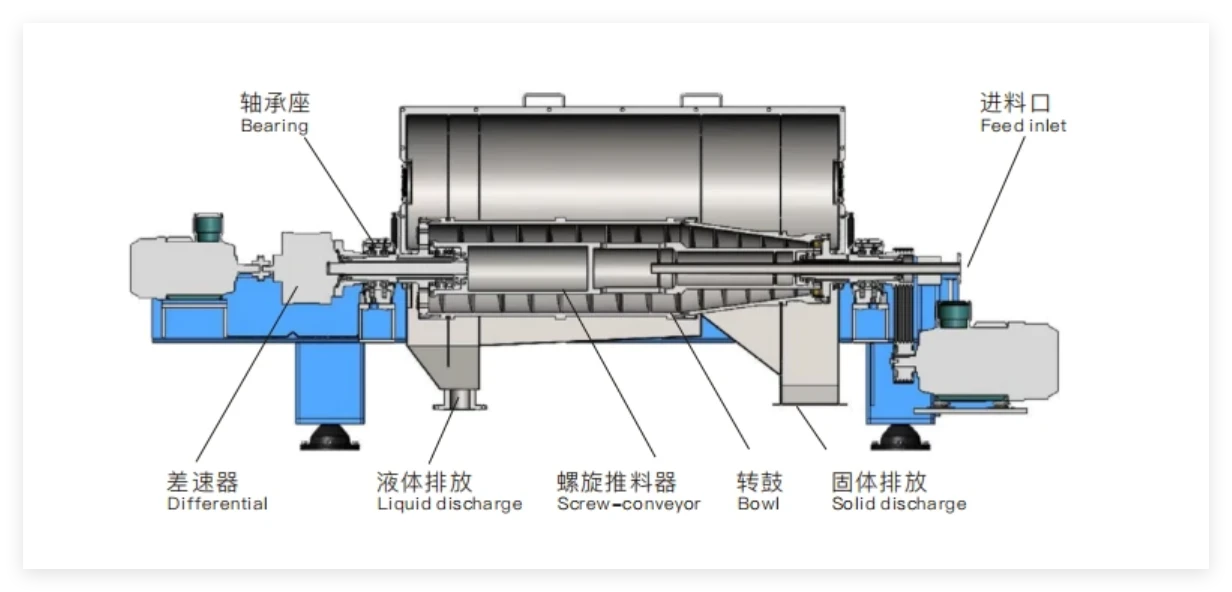
The main components and their roles
| Component | Role in separation |
|---|---|
| Feed pipe and feed zone | Introduce and distribute the prepared slurry into the rotating assembly. |
| Rotating bowl | Provide the centrifugal settling space and contain the liquid pond and deposited solids. |
| Scroll conveyor | Move settled solids toward discharge through relative motion with the bowl. |
| Drive arrangement | Provide bowl rotation and the differential motion and torque required for solids conveying. |
| Liquid and solids outlets | Collect the separated streams according to the selected configuration. |
| Casing and controls | Support collection, monitoring and the protective functions specified for the machine. |
Exact drive, outlet and protective arrangements vary. A general component description should not be treated as the specification for every model.
How does the separation happen?
Prepared feed is accelerated inside the bowl. In a conventional suitable solid–liquid duty, particles denser than the liquid move outward and form a deposited layer. The liquid occupies the inner region, while the scroll conveys solids toward the discharge zone.
The bowl and scroll rotate at different speeds. This differential speed creates the relative motion needed to transport solids. Pond depth, settling space, solids residence time and the discharge geometry work together to influence the result.
Unlike a filtering centrifuge, a conventional solid-bowl decanter does not use filter cloth as its primary separation mechanism. For the detailed sequence, see the decanter working principle.
What do two-phase and three-phase mean?
A common two-phase decanter separates suspended solids from one liquid stream. A suitable three-phase configuration separates solids and two sufficiently immiscible liquids of different densities, such as an oil-rich and a water-rich stream.
Counting ingredients is not enough to select the configuration. Emulsions, liquid-density difference, phase proportions and required products determine whether three-phase separation is feasible and useful. Running interface or pond-depth adjustment is a model-specific capability.
Compare two-phase and three-phase decanters, or explore configuration types and process duties.
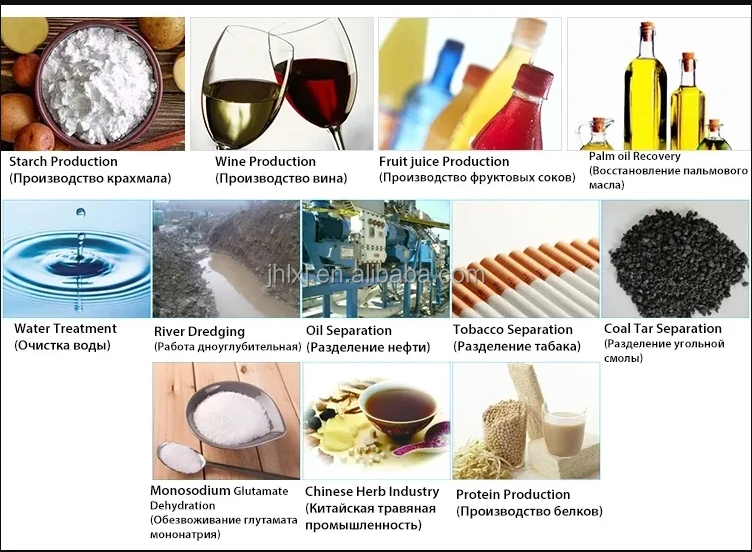
Where are decanter centrifuges used?
- Wastewater treatment: thickening or dewatering suitable sludge within a wider treatment process.
- Food and beverage processing: selected clarification, solids removal and ingredient-recovery duties.
- Minerals and construction: prepared tailings, wash fines or excavation slurry where testing supports suitability.
- Oil and industrial residues: solids removal or recovery of separable liquid phases from suitable prepared feeds.
- Chemical processing: separation of compatible process suspensions, with materials and containment matched to the duty.
These are application areas rather than a guarantee that one machine handles all feeds in each industry. Food-contact, corrosive, abrasive and hazardous duties need their own equipment review.
What determines performance and capacity?
Feed flow and dry solids load are separate sizing requirements. Particle size, density difference, viscosity, temperature and chemistry also influence separation. Bowl geometry, conveying capability, outlet design and conditioning can affect achievable performance.
Assess liquid quality, solids capture, cake condition and throughput together. A drier cake is not necessarily a better overall result if capture or operating stability becomes unacceptable. Generic bowl-size, RPM or solids-percentage tables cannot establish the capacity of an unspecified feed.
Representative trials should state feed conditions, operating settings, conditioning and sampling methods. The decanter selection checklist explains the data needed for a technical enquiry.
Benefits, limitations and maintenance
For a suitable duty, continuous feed and scroll-driven solids discharge can support integration into a production line. A solid bowl avoids filter-cloth management within the primary separation mechanism, and an enclosed assembly can support controlled collection of the streams.
These benefits do not mean uninterrupted or maintenance-free operation. Fine particles, small density differences, high viscosity or sticky solids may be challenging. Abrasion, corrosion, cleaning, lubrication and service access must be considered. Dissolved contaminants and stable emulsions may require other treatment.
Compare benefits and limitations and other centrifuge designs. When evaluating manufacturers in China, ask each factory or supplier to document the proposed duty, operating limits, materials and maintenance requirements.
Frequently asked questions
What is the difference between a decanter and a filter centrifuge?
A conventional decanter separates by sedimentation in a solid bowl; a filtering centrifuge passes liquid through a medium while retaining a cake.
Does a decanter remove dissolved salts?
No. Dissolved salts generally remain in the liquid and need a different treatment if removal is required.
What is centrate?
Centrate is the liquid leaving the centrifuge. Its quality depends on the feed and separation conditions.
Is a three-phase machine always better?
No. Select the configuration from separability and the required outlet streams, rather than a universal ranking.
Can a decanter process abrasive slurry?
Potentially, with a suitable design and wear-management plan. Representative testing and application-specific assessment remain necessary.
How dry will the solids be?
There is no universal cake dryness. Feed properties, geometry, conditioning and operating conditions determine the result.
Is it better than a disc-stack separator or a press?
The appropriate technology depends on the duty, required products, solids handling and complete-system cost.
How often does it need maintenance?
Follow the installed model's manual and approved maintenance plan, informed by operating hours, feed conditions and equipment history.