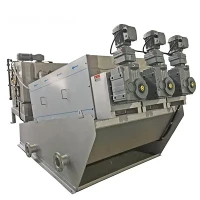


Two-phase and three-phase decanter centrifuges belong to the same broad solid-bowl separation family. Both use centrifugal sedimentation and a scroll to convey suitable solids. Their principal difference is the liquid separation duty and the corresponding outlet configuration.
Tricanter® is a Flottweg brand name associated with three-phase separation. This comparison uses the generic terms two-phase and three-phase decanter rather than treating a brand term as a separate SENZ technology.

Compare the required outlet streams
| Question | Common two-phase duty | Suitable three-phase duty |
|---|---|---|
| Target outlets | Solids and one liquid stream. | Solids, light liquid and heavy liquid streams. |
| Feed assessment | Particle settling and solids conveying. | Particle behavior plus liquid immiscibility, density difference and emulsion behavior. |
| Liquid controls | Liquid level and clarification balance. | Liquid level and separation of the two liquid layers, using the supplied outlet design. |
| Trial results | Cake, liquid quality, capture and throughput. | Quality and recovery of both liquids, cake, capture and throughput. |
These descriptions identify the intended duty. Exact controls, adjustment methods and performance depend on the model and feed.
Oil in the feed is not the whole selection rule
A feed containing oil, water and solids is not automatically suitable for three-phase decanting. The liquids need to be separable under the proposed conditions. Stable emulsions, fine dispersions, low density differences and high viscosity can limit performance.
Consider the required process route. Some duties need only solids removal at this stage, with liquid treatment elsewhere. Others justify separate oil and water outlets. Compare the full treatment train rather than counting ingredient names.
Both configurations need a balanced process target
Clarification, cake dryness, capture and throughput interact in both arrangements. Bowl speed, differential speed, pond depth and conditioning should be assessed within the approved design range. A universal RPM or G-force range cannot establish the better configuration.
Very fine or soft biological material may be challenging, but it should not be declared impossible to separate without examining the actual duty. Representative tests and appropriate technology selection are more useful than blanket exclusions.

Review outlets, materials and auxiliary scope
Three-phase liquid discharge arrangements vary. An adjustable impeller or running interface control is not universal. Confirm pressure requirements, permitted adjustments and the method used to maintain the desired liquid separation.
For either configuration, assess corrosion, abrasion, cleaning, containment and the installation environment. Include feed preparation, pumping, conditioning, cake handling and liquid collection. A machine footprint or phase count does not establish the complete installed cost.
Specify comparable trials
Provide normal and peak flow, solids loading, particle data, liquid proportions, temperature, viscosity and chemistry. State the destination and quality requirement for every outlet.
Measure phase quantity and composition, cake handling, conditioning, power and operating stability. An oil-rich outlet must be evaluated for water and solids content, while a water-rich outlet may still need treatment. More recovered liquid volume is not necessarily higher useful product recovery.
Choose the configuration from the process objective
When comparing decanter manufacturers in China, ask each factory or supplier to explain why its proposed phase arrangement meets the actual duty. Do not assume three-phase is always better, or two-phase always cheaper to operate, without a common performance and cost basis.
See three-phase decanter functions, configuration options and the selection data checklist.
Frequently asked questions
Is a three-phase decanter a different centrifuge family?
It is a decanter configuration designed for an additional liquid-phase separation duty.
Does occasional oil always justify three-phase equipment?
No. Evaluate separability, phase proportions, product targets and alternative process routes.
Can every three-phase model adjust the interface while running?
No. Confirm the capability and permitted procedure for the proposed design.
Which configuration produces better cake?
There is no universal answer. Feed properties, geometry, operating conditions and the agreed process objective determine the result.