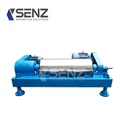

Accurately measuring the separation efficiency of a yeast separator is crucial for both producers and users. As a yeast separator supplier, I've encountered numerous customers asking about the best ways to gauge how well these machines work. In this blog, I'll share some practical methods and considerations for getting an accurate measurement of separation efficiency.
Understanding the Basics of Yeast Separation
Before we dive into the measurement techniques, it's important to understand what yeast separation entails. Yeast separators are designed to separate yeast cells from a liquid medium, like fermentation broth. The goal is to achieve a high - quality separation where the yeast is concentrated, and the remaining liquid is as free of yeast cells as possible.
The separation efficiency is typically defined as the ratio of the amount of yeast successfully separated to the total amount of yeast present in the initial mixture. A higher separation efficiency means more yeast is being recovered, which is economically beneficial as it reduces waste and increases product yield.
Key Factors Affecting Separation Efficiency
Several factors can influence the separation efficiency of a yeast separator. These include the design and operation of the separator itself, the properties of the yeast suspension, and the environmental conditions.


The design of the separator plays a significant role. Different types of separators, such as centrifugal separators or membrane - based separators, have different working principles and efficiencies. For example, a Centrifugal Thickening Of Sludge system uses centrifugal force to separate components based on their density. The speed of rotation, the size of the centrifuge, and the design of the separation chamber can all affect how well the yeast is separated from the liquid.
The properties of the yeast suspension also matter. The concentration of yeast cells, their size, shape, and the viscosity of the liquid medium can impact the separation process. If the yeast cells are clumped together or if the liquid is too viscous, it can be more difficult for the separator to achieve a high - efficiency separation.
Environmental conditions, such as temperature and pH, can also have an effect. Yeast cells may behave differently under different temperature and pH conditions, which can influence their separation from the liquid.
Measuring Separation Efficiency
There are several methods to measure the separation efficiency of a yeast separator. Let's take a look at some of the most common ones.
Gravimetric Analysis
Gravimetric analysis is a classic method for measuring separation efficiency. It involves weighing the samples before and after separation. First, you take a known volume of the initial yeast suspension and measure its mass. After the separation process, you collect the separated yeast and the remaining liquid separately and measure their masses.
The separation efficiency can be calculated using the following formula:
[ \text{Separation Efficiency} (%)=\frac{m_{yeast - separated}}{m_{yeast - initial}}\times100% ]
where (m_{yeast - separated}) is the mass of the yeast collected after separation, and (m_{yeast - initial}) is the mass of the yeast in the initial suspension.
This method is relatively simple and straightforward, but it can be time - consuming, especially if you need to dry the samples to get accurate mass measurements.
Optical Density Measurement
Optical density (OD) measurement is another popular method. Yeast cells scatter light, and the amount of light scattered is proportional to the concentration of yeast cells in the suspension. You can use a spectrophotometer to measure the optical density of the initial yeast suspension and the remaining liquid after separation.
The separation efficiency can be estimated based on the change in optical density. A lower optical density in the remaining liquid after separation indicates a higher separation efficiency. However, this method has some limitations. It assumes that all yeast cells scatter light equally, which may not always be the case, especially if the yeast cells have different sizes or shapes.
Microscopic Counting
Microscopic counting involves counting the number of yeast cells in a known volume of the initial suspension and the remaining liquid after separation using a microscope. You can use a hemocytometer, which is a specialized slide with a grid for counting cells.
The separation efficiency can be calculated based on the change in the number of yeast cells. This method provides a direct measurement of the number of yeast cells, but it is labor - intensive and requires some skill in using the microscope and counting the cells accurately.
Best Practices for Accurate Measurement
To get the most accurate measurement of separation efficiency, there are some best practices you should follow.
First, make sure to take representative samples. The samples you take for measurement should accurately reflect the composition of the entire yeast suspension. This may involve mixing the suspension thoroughly before taking the samples.
Second, calibrate your measurement equipment regularly. Whether you're using a spectrophotometer, a balance, or a microscope, accurate calibration is essential for getting reliable results.
Third, repeat the measurements multiple times. Taking multiple measurements and calculating the average can help reduce the error and give you a more accurate estimate of the separation efficiency.
Other Separation Technologies and Their Relevance
Apart from the traditional yeast separators, there are other separation technologies that can be relevant in the context of yeast separation. For example, a Clarifying Decanter Centrifuge can be used for continuous separation of yeast from the liquid. It offers high - throughput and can be more efficient in some cases.
A Volute Screw Press is another option. It works by using a screw to compress the yeast suspension and separate the liquid from the yeast. These alternative technologies may have different separation efficiencies and measurement methods, but the basic principles of measuring separation efficiency remain similar.
Conclusion
Accurately measuring the separation efficiency of a yeast separator is essential for ensuring the quality and productivity of the yeast separation process. By understanding the key factors that affect separation efficiency, using appropriate measurement methods, and following best practices, you can get a reliable estimate of how well your yeast separator is working.
If you're in the market for a high - quality yeast separator or need more information on how to measure separation efficiency, don't hesitate to reach out. We're here to help you find the best solution for your specific needs. Contact us for a detailed discussion and to start the procurement process.
References
- Smith, J. (2018). Separation Techniques in Biotechnology. Elsevier.
- Jones, A. (2020). Yeast Fermentation and Separation. Wiley.