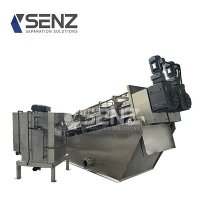

Hey there! As a supplier of Manure Decanter Centrifuges, I've had my fair share of experiences and insights into how different factors can impact the operation of these machines. One of the most critical factors that often gets overlooked is the feed rate. In this blog, I'll break down how the feed rate affects the operation of a manure decanter centrifuge, and why it matters so much.
What is Feed Rate?
First things first, let's clarify what feed rate means. The feed rate is simply the amount of manure that is introduced into the decanter centrifuge per unit of time. It's usually measured in liters per minute (L/min) or cubic meters per hour (m³/h). This rate can vary depending on a variety of factors, such as the size and capacity of the centrifuge, the characteristics of the manure, and the desired output.
How Feed Rate Affects Separation Efficiency
One of the primary functions of a manure decanter centrifuge is to separate the solid and liquid components of the manure. The feed rate plays a crucial role in this process. When the feed rate is too high, the centrifuge may not have enough time to effectively separate the solids from the liquids. This can result in a higher moisture content in the solids and a lower solids concentration in the separated liquid.
On the other hand, if the feed rate is too low, the centrifuge may be underutilized, leading to lower throughput and increased energy consumption. The optimal feed rate is the one that allows the centrifuge to achieve the highest possible separation efficiency while maintaining a reasonable throughput.
Let's say you're using a Centrifuge Machine For Sludge Dewatering. If you overload it with a high feed rate, the machine will struggle to separate the sludge properly. The solids may not be compacted enough, and you'll end up with wetter solids and a less clear liquid phase. This can be a real headache, especially if you're trying to use the separated solids for composting or the liquid for irrigation.
Impact on Centrifuge Wear and Tear
The feed rate also has a significant impact on the wear and tear of the centrifuge. A high feed rate means that more manure is passing through the machine at a faster pace. This can put additional stress on the components of the centrifuge, such as the conveyor, the bowl, and the bearings. Over time, this increased stress can lead to premature wear and damage to these parts, resulting in more frequent maintenance and replacement costs.
For example, if the feed rate is too high, the conveyor may have to work harder to move the solids out of the centrifuge. This can cause excessive wear on the conveyor blades, leading to reduced performance and eventually, failure. Similarly, the bowl of the centrifuge may experience more abrasion from the high-speed movement of the manure, which can also shorten its lifespan.
Effect on Energy Consumption
Energy consumption is another important aspect to consider when it comes to the feed rate. A higher feed rate generally means that the centrifuge has to work harder to process the manure. This requires more energy, which can translate into higher operating costs.
If you're looking to optimize energy efficiency, finding the right feed rate is crucial. By adjusting the feed rate to match the capacity of the centrifuge, you can ensure that the machine is operating at its most efficient level. This not only saves on energy costs but also reduces the environmental impact of your operations.
Adjusting the Feed Rate
So, how do you determine the optimal feed rate for your manure decanter centrifuge? Well, it's not an exact science, but there are a few things you can consider. First, you need to understand the characteristics of your manure. Factors such as the solids content, particle size, and viscosity can all affect the feed rate.
For instance, if your manure has a high solids content, you may need to reduce the feed rate to allow the centrifuge enough time to separate the solids. On the other hand, if the manure is more liquid and has a low solids content, you may be able to increase the feed rate without sacrificing separation efficiency.
Another important consideration is the capacity of your centrifuge. Different models have different maximum feed rates, so it's important to consult the manufacturer's specifications. You can also conduct some tests to find the optimal feed rate for your specific application. Start with a low feed rate and gradually increase it while monitoring the separation efficiency and other performance indicators.


Other Applications of Decanter Centrifuges
Decanter centrifuges aren't just used for manure separation. They have a wide range of applications in various industries. For example, a Heparin Sodium Treatment Centrifuge is used in the pharmaceutical industry to separate heparin sodium from other substances. In the food industry, a Fruit Pulp Decanter Centrifuge is used to separate fruit pulp from juice.
The principles of feed rate and its impact on centrifuge operation are similar across these different applications. Whether you're separating manure, heparin sodium, or fruit pulp, finding the right feed rate is essential for achieving optimal performance.
Conclusion
In conclusion, the feed rate is a critical factor that can significantly affect the operation of a manure decanter centrifuge. It impacts separation efficiency, wear and tear, and energy consumption. By understanding how the feed rate works and adjusting it to match the characteristics of your manure and the capacity of your centrifuge, you can ensure that your machine is operating at its best.
If you're in the market for a manure decanter centrifuge or need more information about how to optimize its operation, feel free to reach out. We're here to help you find the right solution for your needs. Whether you're a small farm or a large agricultural operation, we've got the expertise and the products to support you.
References
- Some widely - recognized agricultural machinery textbooks
- Manufacturer's manuals for manure decanter centrifuges