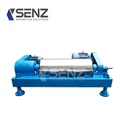

As a supplier of decanter machines, I am often asked about how these remarkable pieces of equipment work. Decanter machines, also known as decanter centrifuges, are widely used in various industries for separation processes. In this blog post, I will delve into the working principles of decanter machines, their applications, and the benefits they offer.
Basic Components of a Decanter Machine
Before we explore how a decanter machine works, let's first understand its key components. A typical decanter centrifuge consists of the following parts:
- Rotating Bowl: This is the main body of the decanter machine. It is a cylindrical or conical vessel that rotates at high speeds. The rotation creates a centrifugal force that is crucial for the separation process.
- Screw Conveyor: Located inside the rotating bowl, the screw conveyor rotates at a slightly different speed than the bowl. Its primary function is to transport the separated solids towards the discharge end of the machine.
- Drive System: The drive system provides the power necessary to rotate the bowl and the screw conveyor. It usually consists of electric motors, belts, and gears.
- Feed Inlet: This is where the mixture to be separated is introduced into the decanter machine. The feed inlet is designed to ensure a smooth and even distribution of the feed material inside the bowl.
- Liquid Discharge Outlet: After the separation process, the liquid phase exits the decanter machine through the liquid discharge outlet.
- Solid Discharge Outlet: The separated solids are discharged from the machine through the solid discharge outlet, which is located at the opposite end of the liquid discharge outlet.
Working Principle of a Decanter Machine
The working principle of a decanter machine is based on the principle of centrifugal force. When a mixture of solids and liquids is introduced into the rotating bowl of the decanter machine, the centrifugal force causes the denser solids to settle towards the inner wall of the bowl, while the lighter liquid phase remains in the center.
Here is a step-by-step breakdown of the separation process:
- Feed Introduction: The mixture to be separated is pumped into the decanter machine through the feed inlet. The feed material enters the rotating bowl and is immediately subjected to the centrifugal force generated by the high-speed rotation of the bowl.
- Separation of Solids and Liquids: Due to the centrifugal force, the denser solids in the mixture are forced towards the inner wall of the bowl, forming a solid layer. The lighter liquid phase, on the other hand, remains in the center of the bowl.
- Transport of Solids: The screw conveyor, which rotates at a slightly different speed than the bowl, transports the settled solids towards the solid discharge outlet. The difference in rotational speed between the bowl and the screw conveyor creates a relative motion that allows the solids to be continuously pushed towards the discharge end.
- Discharge of Solids and Liquids: The separated solids are discharged from the machine through the solid discharge outlet, while the liquid phase exits through the liquid discharge outlet. The separation efficiency of the decanter machine depends on various factors, such as the speed of rotation, the design of the bowl and the screw conveyor, and the properties of the feed material.
Applications of Decanter Machines
Decanter machines are used in a wide range of industries for various separation processes. Some of the common applications include:


- Wastewater Treatment: Decanter centrifuges are widely used in wastewater treatment plants to separate solids from liquids. They can effectively remove suspended solids, sludge, and other contaminants from wastewater, making it suitable for reuse or discharge into the environment. For more information on decanter centrifuge separation of wastewater, you can visit Decanter Centrifuge Separation Wastewater.
- Food and Beverage Industry: In the food and beverage industry, decanter machines are used for processes such as clarification, dewatering, and separation of solids from liquids. They can be used to separate fruit pulp from juice, clarify wine and beer, and remove impurities from dairy products.
- Chemical Industry: Decanter centrifuges are used in the chemical industry for the separation of various chemical compounds. They can be used to separate solids from liquids in chemical reactions, purify chemical products, and recover valuable materials from waste streams.
- Mining and Minerals Processing: In the mining and minerals processing industry, decanter machines are used to separate minerals from ore, dewater tailings, and recover valuable metals. They can effectively separate different types of minerals based on their density, allowing for the efficient extraction of valuable resources.
- Biotechnology and Pharmaceutical Industry: Decanter centrifuges are used in the biotechnology and pharmaceutical industry for the separation of cells, proteins, and other biological materials. They can be used to purify vaccines, antibiotics, and other pharmaceutical products, as well as to separate different types of cells in cell culture processes.
Benefits of Using Decanter Machines
There are several benefits of using decanter machines for separation processes. Some of the key advantages include:
- High Separation Efficiency: Decanter machines can achieve high separation efficiency, even for difficult-to-separate mixtures. They can effectively separate solids from liquids, resulting in a clear liquid phase and a dry solid phase.
- Continuous Operation: Decanter machines are designed for continuous operation, which means they can handle large volumes of feed material without the need for frequent stops and starts. This makes them suitable for industrial applications where high throughput is required.
- Low Maintenance: Decanter machines are relatively easy to maintain, with few moving parts and simple design. They require minimal lubrication and can be easily cleaned and serviced, reducing downtime and maintenance costs.
- Versatility: Decanter machines can be used for a wide range of separation processes, making them a versatile solution for various industries. They can handle different types of feed materials, including slurries, suspensions, and emulsions.
- Automation: Many modern decanter machines are equipped with advanced automation systems that allow for precise control of the separation process. This ensures consistent performance and reduces the need for manual intervention.
Conclusion
In conclusion, decanter machines are powerful and versatile pieces of equipment that play a crucial role in various industries. Their working principle, based on centrifugal force, allows for efficient separation of solids from liquids, making them an essential tool for many separation processes. Whether you are in the wastewater treatment, food and beverage, chemical, mining, or biotechnology industry, a decanter machine can help you achieve your separation goals.
If you are interested in learning more about our decanter machines or would like to discuss your specific separation needs, please feel free to contact us. We are a leading supplier of decanter machines and can provide you with the best solutions for your application. You can also explore our other products, such as Tea Extraction Decanter Centrifuge and Clarifying Decanter Centrifuge, to find the right equipment for your needs.
References
- Stokes, R. H. (1966). An Introduction to Fluid Dynamics. Cambridge University Press.
- Perry, R. H., & Green, D. W. (1997). Perry's Chemical Engineers' Handbook. McGraw-Hill.
- Svarovsky, L. (1990). Solid-Liquid Separation. Butterworth-Heinemann.