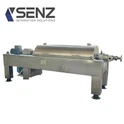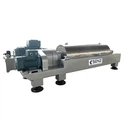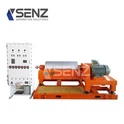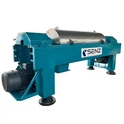


A. Inspection before decanter centrifuge
- check the fastening of all bolts, whether there is loosening, breakage, shortage and other phenomena.
- Check whether the electric steering is correct, whether the belt tightness is appropriate, and whether the belt pulley is intact
- check whether the bearing seat oil standard oil level meets the requirements
- use the hand disc to move the drum, should be easy and flexible, no friction.
B. decanter centrifuge no-load test
1. Debugging of the speed regulating motor (remove the transmission belt) put the speed regulating potentiometer in the zero position, close the power brake, and open the power switch of the speed regulating motor controller. Press the start button to start the asynchronous motor, and immediately press the stop button to observe the motor turning. Looking forward from the rear end of the motor, the anticlockwise direction of the motor blade is correct. If the induction motor turns correctly, you can re-press the start button to make the induction motor run. After 1min, start to rotate and adjust the multi-turn potentiometer to start the speed regulating motor. The speed regulating knob is required to rotate slowly, and the speed regulating motor is not less than 2min from 0 to 1350r/min to ensure a smooth start. Observe the operation of the motor, if normal, you can press the work button to read the no-load motor current. To measure the speed of the speed-regulating motor, the speed of the speed-regulating motor is 1350r/min (obtained by adjusting the feedback potentiometer on the controller of the speed-regulating motor) when the multi-turn potentiometer is rotated to the maximum position (about 10 turns), and the tachometer is corrected accordingly.
2. After the adjustment of the speed regulating motor is completed, the transmission triangle belt can be installed to carry out no-load operation of the main engine. Reset the speed regulating potentiometer to zero (this should be done before each drive) press the start button, after the asynchronous motor reaches full speed (about 1min), start to slowly rotate the multi-turn potentiometer, requiring the speed regulating motor to increase from 0 to 1350r/min, and the growth time is not less than 2min. When the main engine starts, the operation should be observed. If there is excessive vibration or rubbing noise, press the stop button immediately to stop the machine to check the cause and eliminate it. If everything is normal, the speed of the main engine is increased to 3200r/min (at this time, the speed regulating motor is 1350r/min), press the work button (ammeter begins to indicate, overload protection circuit is put into work), watch the no-load current, after the normal operation of the empty car 1~2h, stop the car to check all fasteners and parts, and confirm that it is normal. Check the bearing temperature, are not greater than room temperature 30 degrees, differential housing temperature is less than 70 degrees.
3. decanter centrifuge load test
After the no-load test is qualified, the load test can be carried out according to the operating procedures, the load test time is not less than 8h.1, start the sequence speed regulation potentiometer to zero (if it is no longer zero, the potentiometer and the main motor control switch interlock, the motor cannot start) close the power brake, press the start button, and the asynchronous motor starts. And observe whether the current stabilizer oil mark oil to open the speed controller power switch, slowly rotate the speed regulator potentiometer knob, so that the host start, from 0 to the working speed growth time of not less than 2min press the work button, so that the overload protection circuit into work. Feeding sequence: After the empty car runs at normal speed, rinse with water for 5min, and then feed for continuous production. If stopping, after stopping the feed, rinse with water for 10min, and then stop the main engine. The feeding rate should be strictly controlled, which is one of the important factors to determine the solid content of filtrate and the moisture content of slag. The temperature of the two main bearings should be measured after the end of the operation. The temperature of the main bearing at the feed end is allowed to be +25 degrees, the temperature of the main bearing at the other end is 65 degrees, and the temperature of the differential housing is 70 degrees (all measured at the housing position). The vibration at the two main bearing seats is measured during operation, and the vibration intensity is not more than 11.2mm/s to measure whether the production capacity meets the requirements.