
Hey there! I'm a supplier of DDGS dewatering centrifuges, and I often get asked which type is more suitable for large - scale production. In this blog, I'll break down the different types of DDGS dewatering centrifuges and help you figure out the best fit for your large - scale needs.
First off, let's understand what DDGS is. Distillers Dried Grains with Solubles (DDGS) is a by - product of the ethanol production process. It's rich in protein, fiber, and other nutrients, and it's commonly used as animal feed. But before it can be used, it needs to be dewatered to increase its shelf life and reduce transportation costs. That's where dewatering centrifuges come in.


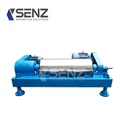
One of the popular types of dewatering centrifuges is the decanter centrifuge. Decanter centrifuges work on the principle of centrifugal force. They separate the solid and liquid components of the DDGS mixture by spinning at high speeds. The heavier solids are forced to the outer wall of the centrifuge bowl, while the lighter liquid phase moves towards the center and is discharged.
For large - scale production, decanter centrifuges have several advantages. They can handle a high volume of DDGS feedstock continuously. Their high - speed operation means they can dewater a large amount of material in a relatively short time. Also, they are quite efficient in separating the solids from the liquid, which is crucial for getting high - quality DDGS products.
However, there are also some drawbacks. Decanter centrifuges can be quite energy - intensive. The high - speed rotation requires a significant amount of power, which can add to the operational costs in the long run. They also need regular maintenance to keep them running smoothly. The moving parts inside the centrifuge can wear out over time, and if not maintained properly, it can lead to breakdowns and production delays.
Another option is the Volute Screw Press. The volute screw press uses a screw conveyor inside a tapered housing. As the screw rotates, it compresses the DDGS material, squeezing out the liquid. This type of centrifuge is known for its simple design and low energy consumption.
In large - scale production, the volute screw press can be a great choice. Its simple design means there are fewer parts that can break down, reducing maintenance requirements. The low energy consumption also helps in keeping the operational costs down. However, it may not be as efficient as the decanter centrifuge in terms of the separation efficiency. The final moisture content of the dewatered DDGS may be slightly higher compared to what you can achieve with a decanter centrifuge.
There's also the Waste Dewatering centrifuge. This type of centrifuge is designed to handle various types of waste materials, including DDGS. It combines different dewatering mechanisms to achieve effective separation.
For large - scale DDGS production, the waste dewatering centrifuge offers good flexibility. It can handle different types of DDGS with varying characteristics. It can also be adjusted to achieve different levels of dewatering depending on your specific requirements. But similar to the decanter centrifuge, it may have relatively high energy consumption, and it can be a bit more complex to operate and maintain.
Then we have the Mining Decanter Centrifuge. Although it's mainly designed for mining applications, it can also be used for DDGS dewatering in some cases. Mining decanter centrifuges are built to be robust and can handle high - density materials.
In large - scale DDGS production, the mining decanter centrifuge's robustness can be an advantage. It can withstand the continuous operation and the wear and tear associated with large - volume processing. However, it may be over - engineered for DDGS dewatering in some cases, and it can be more expensive to purchase and operate compared to other types of centrifuges.
So, which type is more suitable for large - scale production? Well, it depends on several factors. If you have a high - volume production line and need high - efficiency separation with relatively consistent DDGS characteristics, a decanter centrifuge might be the best choice. But if you're looking to reduce energy costs and have a simpler maintenance routine, the volute screw press could be a better option.
If you need flexibility in handling different types of DDGS and want to adjust the dewatering level, the waste dewatering centrifuge could be worth considering. And if you have a very large - scale operation and need a centrifuge that can handle tough conditions, the mining decanter centrifuge might be suitable, although you need to weigh the cost - benefit carefully.
As a DDGS dewatering centrifuge supplier, I've seen different customers with different needs. Some are more concerned about the initial investment, while others focus on long - term operational costs. Some need high - quality dewatered products, while others are more interested in a simple and reliable solution.
I understand that choosing the right centrifuge for your large - scale production is a big decision. That's why I'm here to help. If you're in the process of setting up or upgrading your DDGS production line, I'd love to have a chat with you. We can discuss your specific requirements, production volume, budget, and other factors to find the most suitable dewatering centrifuge for you.
Don't hesitate to reach out if you have any questions or want to start a conversation about purchasing a DDGS dewatering centrifuge. Let's work together to find the best solution for your large - scale production needs.
References:
- General knowledge of centrifuge technology and DDGS production processes.
- Industry reports on the use of different types of centrifuges in large - scale production.