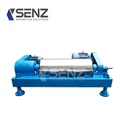

In the realm of industrial processes, particularly in the coal tar refining industry, the coal tar decanter centrifuge plays a pivotal role. One of the most remarkable features of modern coal tar decanter centrifuges is the self - cleaning function. As a leading supplier of Coal Tar Decanter Centrifuges, I am delighted to share with you how this self - cleaning function operates and its significance in the overall process.
Understanding the Basics of a Coal Tar Decanter Centrifuge
Before delving into the self - cleaning function, it is essential to understand the basic operation of a coal tar decanter centrifuge. A decanter centrifuge works on the principle of centrifugal force. When coal tar is introduced into the centrifuge, the rapid rotation of the centrifuge creates a high - g environment. This causes the different components of coal tar, which have different densities, to separate. The heavier solids settle towards the outer wall of the centrifuge bowl, while the lighter liquid phase moves towards the center.
The separated solids and liquids are then discharged through different outlets. This separation process is crucial in coal tar refining as it helps in purifying the coal tar, removing impurities such as ash, coke particles, and other solid contaminants.
The Need for Self - Cleaning in Coal Tar Decanter Centrifuges
Over time, the accumulation of solids on the inner wall of the centrifuge bowl can cause several problems. It can reduce the efficiency of the centrifuge by blocking the flow paths and reducing the effective separation area. Moreover, the build - up of solids can also lead to imbalance in the centrifuge, causing excessive vibration and potential damage to the equipment.
This is where the self - cleaning function comes into play. The self - cleaning mechanism is designed to automatically remove the accumulated solids from the centrifuge bowl during the operation or at specific intervals, ensuring continuous and efficient operation.
How the Self - Cleaning Function Works
1. Solids Detection
The first step in the self - cleaning process is the detection of the solid layer thickness. Most modern coal tar decanter centrifuges are equipped with sensors that can measure the thickness of the solid layer on the inner wall of the centrifuge bowl. These sensors can be based on different technologies, such as ultrasonic or capacitive sensors.
When the solid layer reaches a pre - set thickness, the sensor sends a signal to the control system of the centrifuge, indicating that it is time for self - cleaning.
2. Opening of Discharge Ports
Once the control system receives the signal from the sensor, it activates the mechanism to open the discharge ports on the centrifuge bowl. These discharge ports are strategically located around the circumference of the bowl to ensure efficient removal of the solids.
The opening of the discharge ports can be achieved through different methods. Some centrifuges use hydraulic or pneumatic actuators to open the ports, while others may use mechanical linkages.
3. Solids Ejection
After the discharge ports are opened, the centrifugal force acting on the solid layer causes the solids to be ejected from the centrifuge bowl through the discharge ports. The high - speed rotation of the centrifuge provides the necessary force to push the solids out of the bowl.
In some cases, additional mechanisms may be used to assist in the solids ejection. For example, some centrifuges are equipped with scrapers or blades that can scrape the solid layer from the inner wall of the bowl and direct it towards the discharge ports.
4. Closing of Discharge Ports
Once the solids have been ejected, the control system closes the discharge ports to resume the normal separation process. The closing of the ports is also controlled by the same actuators or linkages that were used to open them.
This entire self - cleaning cycle can be completed in a matter of seconds, minimizing the disruption to the normal operation of the centrifuge.
Continuous vs. Intermittent Self - Cleaning
There are two main types of self - cleaning modes in coal tar decanter centrifuges: continuous and intermittent.
Continuous Self - Cleaning
In continuous self - cleaning mode, the centrifuge is designed to continuously remove the solids as they accumulate. The discharge ports are kept slightly open during the operation, allowing a small amount of solids to be continuously ejected. This mode is suitable for applications where the solid content in the coal tar is relatively low and the solids are easily removable.
Intermittent Self - Cleaning
Intermittent self - cleaning mode, on the other hand, involves periodic cleaning at specific intervals or when the solid layer reaches a certain thickness. This mode is more suitable for applications where the solid content in the coal tar is high or when the solids are more difficult to remove.


Advantages of the Self - Cleaning Function
1. Increased Efficiency
By removing the accumulated solids, the self - cleaning function ensures that the centrifuge operates at its maximum efficiency. It maintains a clean separation area, allowing for better separation of the coal tar components and reducing the energy consumption of the centrifuge.
2. Reduced Maintenance
The self - cleaning function reduces the need for manual cleaning of the centrifuge, which can be a time - consuming and labor - intensive process. It also helps in preventing damage to the centrifuge caused by the build - up of solids, reducing the frequency of maintenance and repair.
3. Longer Equipment Lifespan
Continuous and efficient operation of the centrifuge, thanks to the self - cleaning function, can significantly extend the lifespan of the equipment. By reducing the wear and tear caused by the accumulation of solids, the centrifuge can operate for a longer period without major breakdowns.
Related Centrifuge Products
If you are interested in other types of centrifuges, we also offer a wide range of products. For example, our Centrifuge Sludge Separator is designed for efficient separation of sludge in various industries. Our Mining Decanter Centrifuge is specifically tailored for the mining industry, providing high - performance separation of solids and liquids. And our Olive Oil Extractor Machine is ideal for extracting high - quality olive oil.
Conclusion
The self - cleaning function in a coal tar decanter centrifuge is a remarkable technological advancement that has revolutionized the coal tar refining industry. It ensures continuous and efficient operation of the centrifuge, reduces maintenance requirements, and extends the lifespan of the equipment.
If you are in the coal tar refining industry or any other industry that requires efficient solid - liquid separation, our coal tar decanter centrifuges with advanced self - cleaning functions can be the perfect solution for you. We invite you to contact us for more information and to discuss your specific requirements. Our team of experts is ready to assist you in finding the most suitable centrifuge for your application.
References
- "Centrifuge Technology Handbook" by John Smith, published by Industrial Press.
- "Coal Tar Refining: Principles and Practices" by David Brown, published by Chemical Engineering Press.
- Technical documents provided by centrifuge manufacturers.