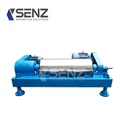

As a trusted supplier of 3 - Phase Decanter Centrifuges, I often encounter inquiries regarding the differences between horizontal and vertical 3 - Phase Decanter Centrifuges, especially in terms of installation and operation. In this blog, I'll delve into these aspects to help you make an informed decision when considering these centrifuges for your industrial needs.
Installation Differences
Horizontal 3 - Phase Decanter Centrifuges
Horizontal 3 - Phase Decanter Centrifuges are known for their relatively straightforward installation process. First and foremost, they require a flat and stable surface. This is crucial because the centrifuge operates at high speeds, and any unevenness can lead to vibration, which may not only reduce the efficiency of the machine but also cause premature wear and tear.
The space requirements for horizontal models are also an important consideration. They typically have a larger footprint due to their horizontal orientation. This means that you need to allocate sufficient floor space in your facility. However, this also allows for easier access to the various components of the centrifuge for maintenance and inspection purposes.
When it comes to connecting the horizontal centrifuge to the power supply and the feed and discharge pipes, the process is generally more accessible. The connections are usually located at the sides or the ends of the machine, making it convenient for technicians to carry out the installation. Additionally, the horizontal design often allows for better integration with existing industrial pipelines, as the flow of materials can follow a more natural horizontal path.
Vertical 3 - Phase Decanter Centrifuges
Vertical 3 - Phase Decanter Centrifuges, on the other hand, have a more compact design. They require less floor space compared to their horizontal counterparts, which can be a significant advantage in facilities where space is limited. However, the installation of vertical centrifuges is more complex in some aspects.
The vertical orientation means that they need to be installed on a sturdy and level base that can support the weight of the machine and withstand the forces generated during operation. Special attention must be paid to the alignment of the centrifuge to ensure that it is perfectly vertical. Any deviation from the vertical axis can cause imbalances, leading to excessive vibration and potential damage to the machine.
Connecting the power supply and the pipes to a vertical centrifuge can be more challenging. The connections are often located at the top or the bottom of the machine, which may require technicians to use ladders or other equipment to reach them. Moreover, the vertical flow of materials in the centrifuge may require more careful planning of the pipeline layout to ensure smooth operation.
Operation Differences
Horizontal 3 - Phase Decanter Centrifuges
In terms of operation, horizontal 3 - Phase Decanter Centrifuges are well - suited for applications where a large volume of materials needs to be processed continuously. The horizontal design allows for a longer settling path for the different phases (solid, liquid, and sometimes a second liquid phase), which can result in better separation efficiency.
The horizontal centrifuge operates at a relatively lower rotational speed compared to some vertical models. This lower speed can be beneficial in applications where the materials being processed are sensitive to high - speed agitation. It also reduces the wear and tear on the machine components, leading to longer service life and lower maintenance costs.
The horizontal orientation also makes it easier to monitor the operation of the centrifuge. Operators can visually inspect the machine during operation, and it is generally easier to access the control panels and sensors. This allows for more precise adjustment of the operating parameters, such as the rotational speed, the feed rate, and the discharge settings.
Vertical 3 - Phase Decanter Centrifuges
Vertical 3 - Phase Decanter Centrifuges are often preferred for applications where a high - G force is required for efficient separation. The vertical design allows for a higher rotational speed, which can generate a stronger centrifugal force. This makes them ideal for separating fine particles or materials with a small difference in density.
The vertical centrifuge can achieve a faster separation process due to the shorter settling path and the higher G force. This can be advantageous in industries where time is of the essence, such as in the treatment of industrial waste oil. Industrial Waste Oil Centrifuge
However, the high - speed operation of vertical centrifuges also means that they require more careful monitoring and maintenance. The higher rotational speed can cause more wear on the bearings and other moving parts, and the machine may be more prone to vibration - related issues. Operators need to be well - trained to handle the operation of vertical centrifuges and to adjust the parameters correctly to ensure optimal performance.
Applications and Suitability
Horizontal Centrifuges
Horizontal 3 - Phase Decanter Centrifuges are commonly used in industries such as wastewater treatment, food processing, and chemical manufacturing. In wastewater treatment, they can effectively separate sludge from the water, and the separated sludge can be further processed in a Sludge Dewatering Unit. In food processing, they can separate different components of food products, such as oil and water in dairy products.


Vertical Centrifuges
Vertical 3 - Phase Decanter Centrifuges are often used in applications where high - precision separation is required, such as in the pharmaceutical industry and the refining of precious metals. They are also well - suited for the treatment of industrial waste oil, where the high - G force can help to separate impurities from the oil more effectively. Tricanter Centrifuge
Conclusion
In conclusion, both horizontal and vertical 3 - Phase Decanter Centrifuges have their own unique installation and operation characteristics. The choice between the two depends on various factors, including the available space in your facility, the nature of the materials to be processed, the required separation efficiency, and the budget.
If you are in the process of selecting a 3 - Phase Decanter Centrifuge for your industrial application, I encourage you to reach out to us. Our team of experts can provide you with detailed information and guidance to help you make the best decision. Whether you need a horizontal or vertical centrifuge, we have a wide range of high - quality products to meet your needs. Contact us today to start the procurement discussion and find the perfect centrifuge solution for your business.
References
- Perry, R. H., & Green, D. W. (Eds.). (2008). Perry's Chemical Engineers' Handbook. McGraw - Hill.
- Svarovsky, L. (1990). Solid - Liquid Separation. Butterworth - Heinemann.