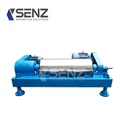

In the dynamic landscape of fish oil production, the role of decanter centrifuges has become increasingly pivotal. These machines are at the heart of separating impurities from fish oil, ensuring a high - quality end - product. As a leading supplier of Fish Oil Decanter Centrifuges, we are constantly on the lookout for new technologies that can enhance the performance, efficiency, and sustainability of our equipment. In this blog, we will explore some of the latest technologies being applied in fish oil decanter centrifuges.
Advanced Material Technologies
One of the most significant advancements in fish oil decanter centrifuges is the use of advanced materials. Traditional centrifuge components were often made from standard metals that could be prone to corrosion, especially when dealing with the harsh chemical environment of fish oil processing.
Modern fish oil decanter centrifuges are now incorporating high - grade stainless steels with enhanced corrosion resistance. For example, duplex stainless steels are being used in critical parts such as the bowl and the screw conveyor. These steels have a two - phase microstructure that combines austenite and ferrite, providing excellent mechanical properties and resistance to pitting and crevice corrosion. This not only extends the lifespan of the centrifuge but also reduces the risk of contamination of the fish oil product.
Another emerging material technology is the use of ceramic coatings. Ceramic coatings can be applied to the internal surfaces of the centrifuge to provide an extra layer of protection against wear and corrosion. These coatings are extremely hard and have low friction coefficients, which can improve the efficiency of the separation process by reducing the energy required to rotate the centrifuge components.
Intelligent Control Systems
The integration of intelligent control systems is revolutionizing the operation of fish oil decanter centrifuges. These systems use sensors and advanced algorithms to monitor and adjust the centrifuge's performance in real - time.
For instance, sensors can be installed to measure parameters such as the flow rate of the fish oil feed, the density of the separated phases, and the temperature inside the centrifuge. The control system can then analyze this data and make automatic adjustments to the speed of the centrifuge, the differential speed between the bowl and the screw conveyor, and the feed rate. This ensures that the centrifuge is always operating at its optimal efficiency, regardless of variations in the input materials.
In addition, intelligent control systems can also provide predictive maintenance capabilities. By continuously monitoring the performance of the centrifuge components, the system can detect early signs of wear or malfunction and alert the operators. This allows for timely maintenance and reduces the risk of unexpected breakdowns, which can be costly in terms of production downtime.
Energy - Saving Technologies
Energy consumption is a major concern in fish oil production, and new technologies are being developed to make decanter centrifuges more energy - efficient.
Variable Frequency Drives (VFDs) are now commonly used in fish oil decanter centrifuges. These drives allow the speed of the centrifuge motor to be adjusted according to the actual requirements of the separation process. Instead of running the motor at a fixed speed, the VFD can reduce the speed when the load is low, thereby saving energy.


Another energy - saving technology is the use of regenerative braking systems. When the centrifuge is decelerating, the regenerative braking system can convert the kinetic energy of the rotating components into electrical energy and feed it back into the power grid. This not only reduces the energy consumption of the centrifuge but also helps to lower the overall energy costs of the fish oil production facility.
Enhanced Separation Technologies
Improving the separation efficiency is the primary goal of any fish oil decanter centrifuge, and new technologies are being applied to achieve this.
One such technology is the development of optimized bowl and screw conveyor designs. Computational Fluid Dynamics (CFD) simulations are used to analyze the flow patterns inside the centrifuge and to design the bowl and screw conveyor geometries that can maximize the separation efficiency. These designs can ensure a more uniform distribution of the fish oil feed, reduce the mixing of the separated phases, and increase the residence time of the materials inside the centrifuge, all of which contribute to a better separation result.
In addition, some fish oil decanter centrifuges are now equipped with multi - stage separation systems. These systems can perform multiple separation steps within a single centrifuge, allowing for a more thorough removal of impurities from the fish oil. For example, a two - stage separation system can first separate the coarse impurities and then further refine the separation to remove the fine particles and water droplets.
Applications in Related Industries
While our focus is on fish oil decanter centrifuges, it's worth noting that similar technologies are also being applied in other industries. For example, the Centrifuge Sludge Separator uses many of the same advanced materials and control systems to separate sludge from liquids in wastewater treatment plants. The Coal Tar Decanter Centrifuge is designed to separate coal tar from impurities in the coal processing industry, and the Palm Oil Clarifier Decanter Centrifuge is used to clarify palm oil by removing solids and water.
Conclusion
The fish oil decanter centrifuge industry is experiencing rapid technological advancements. From advanced materials and intelligent control systems to energy - saving and enhanced separation technologies, these innovations are improving the performance, efficiency, and sustainability of fish oil production.
As a supplier of Fish Oil Decanter Centrifuges, we are committed to incorporating these new technologies into our products to provide our customers with the best - in - class equipment. If you are in the fish oil production industry and are looking for a reliable and high - performance decanter centrifuge, we invite you to contact us for a detailed discussion on how our products can meet your specific needs. Our team of experts is ready to assist you in finding the most suitable solution for your fish oil processing requirements.
References
- "Advanced Materials in Centrifuge Technology" - Journal of Separation Science
- "Intelligent Control Systems for Industrial Centrifuges" - IEEE Transactions on Industrial Electronics
- "Energy - Saving Strategies in Centrifuge Operations" - International Journal of Energy Research