
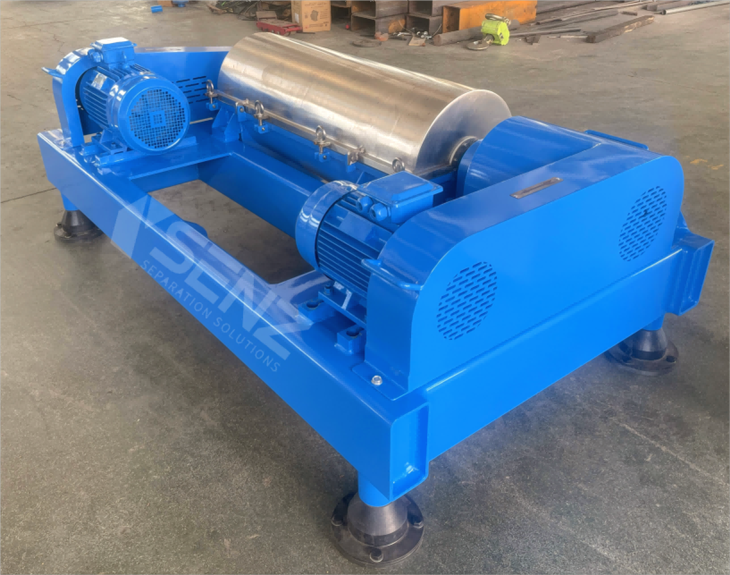
Hey there! I'm a supplier of small decanter centrifuges, and today I wanna chat about the various materials these nifty machines can process. Small decanter centrifuges are super versatile, and they're used in a bunch of industries. Let's dive right in and explore the different materials they can handle.
Food and Beverage Industry
In the food and beverage world, small decanter centrifuges play a crucial role. One of the popular applications is in the production of olive oil. Olive oil extraction requires separating the oil from the solid and liquid components of the olive paste. That's where an Olive Oil Separator comes in. The centrifuge spins at high speeds, using centrifugal force to separate the oil, which has a lower density, from the water and solid particles. This process ensures a high - quality olive oil with minimal impurities.
Another area in the food industry is starch extraction. Starch is widely used in food products, and a Starch Extraction Decanter Centrifuge can efficiently separate the starch from the other components in the raw materials, like potatoes or corn. The centrifuge helps in removing the fibrous and liquid parts, leaving behind a concentrated starch product.
When it comes to dairy, small decanter centrifuges are used to separate cream from milk. Cream has a lower density than milk, so when the milk is put into the centrifuge, the cream rises to the top and can be easily collected. This is an important step in the production of various dairy products such as butter, ice cream, and cream cheese.
Biotechnology and Pharmaceutical Industry
In the biotech and pharma sectors, small decanter centrifuges are essential for separating biological materials. For example, in protein purification, a Protein Centrifuge is used. Proteins are often present in a complex mixture of cells, cell debris, and other biomolecules. The centrifuge can separate the proteins based on their size, shape, and density. This is crucial for the production of biopharmaceuticals, where pure proteins are needed for drugs and vaccines.
Cell harvesting is another important application. In cell culture processes, cells are grown in a medium. Once they reach the desired density, a small decanter centrifuge can be used to separate the cells from the culture medium. This is necessary for further processing, such as cell lysis to extract intracellular proteins or other biomolecules.
Chemical Industry
The chemical industry also benefits from small decanter centrifuges. In the production of polymers, the centrifuge can be used to separate the polymer particles from the reaction mixture. Polymers are used in a wide range of products, from plastics to synthetic fibers. By separating the polymer particles, the quality and purity of the final product can be improved.

In the production of pigments and dyes, small decanter centrifuges help in separating the solid pigment particles from the liquid solvents. This ensures that the pigments are in a concentrated and pure form, which is important for achieving the desired color and quality in the final products, such as paints and inks.
Environmental and Waste Management
Small decanter centrifuges are also used in environmental and waste management applications. In wastewater treatment, they can be used to separate the sludge from the water. The sludge contains solid particles and organic matter, and by using a centrifuge, the sludge can be dewatered. This reduces the volume of the sludge, making it easier and more cost - effective to dispose of.
In the oil and gas industry, small decanter centrifuges are used to separate oil from drilling mud. Drilling mud is used to lubricate the drill bit and carry the cuttings to the surface. After use, the mud needs to be cleaned and reused. The centrifuge helps in separating the oil and other contaminants from the mud, allowing the mud to be recycled.
Mining and Mineral Processing
In the mining industry, small decanter centrifuges are used for mineral separation. For example, in the processing of gold ore, the centrifuge can be used to separate the gold particles from the other minerals and rock fragments. Gold has a relatively high density, so it can be separated from the lighter materials using centrifugal force.
Similarly, in the processing of other minerals like coal, the centrifuge can be used to separate the coal particles from the impurities. This improves the quality of the coal and makes it more suitable for use in power generation and other applications.
Advantages of Using Small Decanter Centrifuges
One of the main advantages of small decanter centrifuges is their compact size. They don't take up a lot of space, which is great for small - scale operations or facilities with limited space. They're also relatively easy to operate and maintain. Most modern small decanter centrifuges come with user - friendly controls and automated features, which reduce the need for highly skilled operators.
These centrifuges are also energy - efficient. They use less power compared to larger industrial centrifuges, which can result in significant cost savings over time. Additionally, they can achieve high separation efficiency, which means they can effectively separate the materials with a high degree of purity.
Considerations When Choosing a Small Decanter Centrifuge
When choosing a small decanter centrifuge, there are a few things to consider. First, you need to think about the type of material you'll be processing. Different materials have different properties, such as density, viscosity, and particle size, and these properties will affect the performance of the centrifuge.
The throughput is another important factor. You need to know how much material you need to process per hour or per day. This will help you determine the appropriate size and capacity of the centrifuge.
The quality and reliability of the centrifuge are also crucial. You want a centrifuge that is built to last and can operate continuously without frequent breakdowns. Look for a centrifuge from a reputable manufacturer with a good track record.
Conclusion
As you can see, small decanter centrifuges are incredibly versatile machines that can process a wide variety of materials across different industries. Whether you're in the food and beverage, biotech, chemical, environmental, mining, or any other industry, there's a good chance that a small decanter centrifuge can meet your separation needs.
If you're interested in learning more about our small decanter centrifuges or if you're thinking about making a purchase, I'd love to have a chat with you. Just reach out, and we can discuss your specific requirements and find the perfect centrifuge for your business.
References
- Perry, R. H., & Green, D. W. (Eds.). (2008). Perry's Chemical Engineers' Handbook. McGraw - Hill.
- Coulson, J. M., & Richardson, J. F. (1999). Chemical Engineering. Butterworth - Heinemann.
- Malhorta, O. P. (2004). Handbook of Separation Process Technology. John Wiley & Sons.