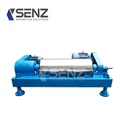

Hey there! As a supplier of Small Decanter Centrifuges, I've seen firsthand how crucial bearings are in these machines. So, let's dive into why bearings are so important in a small decanter centrifuge.
1. Basics of a Small Decanter Centrifuge
First off, a small decanter centrifuge is a nifty piece of equipment. It's used in various industries like mining, wastewater treatment, and food processing. In simple terms, it separates different components of a liquid - solid mixture by using centrifugal force. The centrifuge spins at high speeds, and the heavier solids settle to the outer part, while the lighter liquid stays in the middle. This separation process is super efficient and helps in getting clean liquids and dry solids. You can check out more about our Small Decanter Centrifuge on our website.
2. Role of Bearings in a Small Decanter Centrifuge
Smooth Rotation
The most obvious role of bearings in a small decanter centrifuge is to enable smooth rotation. The centrifuge bowl and the screw conveyor inside it need to spin at high speeds. Bearings act as the interface between the rotating parts and the stationary parts of the machine. They reduce friction, which means less energy is wasted in the form of heat. Without good - quality bearings, the rotation would be jerky, and the machine would consume more power to achieve the same speed.
For example, imagine trying to spin a wheel with rough surfaces. It would be hard to get it going, and it would stop quickly. But if you put some well - lubricated bearings between the wheel and its axle, it spins smoothly and easily. The same principle applies to a small decanter centrifuge. The bearings ensure that the bowl and the conveyor can rotate at high speeds with minimal resistance.
Load Support
A small decanter centrifuge has to handle different types of loads. There are the static loads from the weight of the rotating parts themselves, and then there are the dynamic loads that occur during operation. When the centrifuge is separating solids from liquids, the solids build up on the walls of the bowl, creating an uneven load distribution. Bearings are designed to support these loads without getting damaged.
They are engineered to withstand radial loads (forces acting perpendicular to the axis of rotation) and axial loads (forces acting along the axis of rotation). In a small decanter centrifuge, the bearings have to support the weight of the bowl filled with solids and liquids, as well as the forces generated by the high - speed rotation. If the bearings can't handle these loads, they will wear out quickly, leading to machine breakdowns.


Precision Alignment
Precision is key in a small decanter centrifuge. The bowl and the screw conveyor need to be perfectly aligned for efficient separation. Bearings help in maintaining this alignment. They ensure that the rotating parts stay in the correct position relative to each other and the stationary parts of the machine.
If the alignment is off, the centrifuge won't work as effectively. There could be uneven wear on the parts, and the separation efficiency will decrease. For instance, if the screw conveyor is not aligned properly with the bowl, it won't be able to push the separated solids out of the centrifuge efficiently. Bearings play a vital role in keeping everything in place, so the centrifuge can operate at its best.
3. Impact of Bearing Quality on Centrifuge Performance
Efficiency
High - quality bearings can significantly improve the efficiency of a small decanter centrifuge. As mentioned earlier, they reduce friction, which means the machine uses less energy to operate. This not only saves on electricity costs but also allows the centrifuge to run for longer periods without overheating.
A centrifuge with good bearings can achieve higher separation efficiencies because it can maintain a more consistent rotation speed. This leads to better separation of solids and liquids, resulting in drier solids and cleaner liquids. In industries like Tailings Dewatering Decanter Centrifuge applications, where the goal is to remove as much water as possible from the tailings, the efficiency of the centrifuge can have a big impact on the overall process.
Reliability
Reliability is another important aspect. A small decanter centrifuge is often a critical part of a production process. If it breaks down, it can cause delays and losses. Good - quality bearings are more reliable. They have a longer service life and are less likely to fail unexpectedly.
They are made from high - grade materials and are designed to withstand the harsh operating conditions in a centrifuge. For example, they are resistant to corrosion, which is important in applications where the centrifuge is handling corrosive liquids. By using reliable bearings, you can reduce the maintenance costs and downtime of the centrifuge.
Noise and Vibration
Poor - quality bearings can cause excessive noise and vibration in a small decanter centrifuge. When the bearings are worn out or not properly installed, they can create uneven forces, leading to vibrations. These vibrations can not only be annoying but also cause damage to other parts of the machine over time.
On the other hand, high - quality bearings are designed to operate quietly and with minimal vibration. This makes the working environment more comfortable for the operators and also helps in extending the lifespan of the centrifuge. In applications like Municipal Sewage Treatment, where the centrifuge is often located in or near populated areas, low noise levels are important.
4. Choosing the Right Bearings for a Small Decanter Centrifuge
Operating Conditions
When choosing bearings for a small decanter centrifuge, you need to consider the operating conditions. If the centrifuge is used in a high - temperature environment, you need bearings that can withstand these temperatures without losing their properties. Similarly, if it's handling corrosive liquids, the bearings should be made from corrosion - resistant materials.
The speed of rotation is also an important factor. High - speed centrifuges require bearings that are designed for high - speed applications. They need to have low friction and good heat dissipation properties to prevent overheating.
Load Capacity
As mentioned earlier, the bearings need to support the loads in the centrifuge. You need to calculate the static and dynamic loads accurately and choose bearings with an appropriate load capacity. Overloading the bearings can lead to premature failure, so it's important to get this right.
Lubrication Requirements
Bearings need proper lubrication to work effectively. Different types of bearings have different lubrication requirements. Some require oil lubrication, while others can use grease. You need to choose bearings that are compatible with the lubrication system in your centrifuge.
5. Maintenance of Bearings in a Small Decanter Centrifuge
Regular Inspections
Regular inspections are crucial for the maintenance of bearings in a small decanter centrifuge. You should check for signs of wear, such as excessive play, noise, or vibration. If you notice any of these signs, it could indicate that the bearings are starting to fail.
Inspections should also include checking the lubrication levels. If the lubricant is dirty or low, it can cause increased friction and wear on the bearings. You may need to replace the lubricant at regular intervals to ensure optimal performance.
Cleaning and Lubrication
Cleaning the bearings is an important part of maintenance. Over time, dirt, debris, and contaminants can accumulate on the bearings, which can affect their performance. You should clean the bearings according to the manufacturer's instructions.
Proper lubrication is also essential. As mentioned earlier, the type of lubricant depends on the type of bearings. You need to make sure that the lubricant is applied in the right amount and at the right intervals.
6. Conclusion
In conclusion, bearings are an essential part of a small decanter centrifuge. They enable smooth rotation, support the loads, and maintain precision alignment. The quality of the bearings has a big impact on the efficiency, reliability, and noise levels of the centrifuge. Choosing the right bearings based on the operating conditions, load capacity, and lubrication requirements is crucial. And proper maintenance of the bearings can extend their service life and keep the centrifuge running smoothly.
If you're in the market for a small decanter centrifuge or need help with bearing selection and maintenance, don't hesitate to contact us. We're here to help you make the best choices for your application.
References
- Handbook of Centrifugal Separation Technology
- Bearing Design and Application Manual