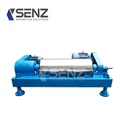

Hey there! As a supplier of DDGS Dewatering Centrifuges, I've been getting a lot of questions lately about how feed pressure affects the performance of these machines. So, I thought I'd take a deep dive into this topic and share my insights with you all.
First off, let's quickly go over what a DDGS dewatering centrifuge does. DDGS, or Dried Distillers Grains with Solubles, is a by - product of the ethanol production process. The dewatering centrifuge is used to separate the liquid and solid components of DDGS, reducing the moisture content of the solids and making them easier to handle, store, and transport.
Now, let's talk about feed pressure. Feed pressure refers to the force at which the DDGS mixture is pumped into the centrifuge. It plays a crucial role in the overall performance of the dewatering centrifuge, and here's how.
1. Separation Efficiency
One of the most important aspects of a dewatering centrifuge's performance is its separation efficiency. This is basically how well it can separate the solid and liquid phases of the DDGS mixture. A proper feed pressure is essential for achieving high separation efficiency.
When the feed pressure is too low, the DDGS mixture may not be evenly distributed inside the centrifuge bowl. This can lead to poor separation, as some of the solids may not be subjected to enough centrifugal force to be separated from the liquid. In other words, you might end up with a higher moisture content in the solids and a higher solids content in the liquid, which is not ideal.
On the other hand, if the feed pressure is too high, it can cause the centrifuge to become overloaded. The high - pressure stream can disrupt the normal flow pattern inside the centrifuge, and the solids may not have enough time to settle properly. This can also result in reduced separation efficiency and an increase in the moisture content of the dewatered solids.


So, finding the right feed pressure is like finding the sweet spot. It ensures that the DDGS mixture is evenly distributed in the centrifuge bowl, allowing the centrifugal force to work effectively and separate the solid and liquid phases efficiently.
2. Throughput
Throughput is another key performance indicator of a dewatering centrifuge. It refers to the amount of DDGS mixture that the centrifuge can process in a given period of time. Feed pressure has a direct impact on throughput.
A higher feed pressure generally means that more DDGS mixture can be pumped into the centrifuge per unit of time, which can increase the throughput. However, as I mentioned earlier, if the pressure is too high, it can cause problems with separation efficiency. So, you need to balance the feed pressure to optimize both throughput and separation.
If you're looking to increase the throughput of your DDGS dewatering centrifuge, you can gradually increase the feed pressure, but you need to monitor the separation results closely. You might also want to consider the design and capacity of your centrifuge. Some centrifuges are better able to handle higher feed pressures and throughputs than others.
3. Wear and Tear
The feed pressure can also affect the wear and tear of the centrifuge components. High feed pressure can put additional stress on the centrifuge's internal parts, such as the bowl, scroll, and bearings. Over time, this can lead to increased wear and a shorter lifespan for these components.
For example, the high - pressure stream can cause erosion of the bowl and scroll surfaces. This can affect the centrifuge's performance and may require more frequent maintenance and replacement of parts. On the other hand, a lower, more stable feed pressure can help reduce the wear and tear on the centrifuge, saving you money on maintenance and replacement costs in the long run.
4. Energy Consumption
Energy consumption is an important consideration for any industrial equipment, and DDGS dewatering centrifuges are no exception. Feed pressure can have an impact on the energy consumption of the centrifuge.
Higher feed pressures typically require more energy to pump the DDGS mixture into the centrifuge. If the pressure is too high, the centrifuge may also have to work harder to process the over - loaded mixture, further increasing energy consumption. By optimizing the feed pressure, you can reduce the energy required to operate the centrifuge, which can lead to significant cost savings over time.
Finding the Optimal Feed Pressure
So, how do you find the optimal feed pressure for your DDGS dewatering centrifuge? Well, it depends on several factors, such as the characteristics of the DDGS mixture (e.g., solids concentration, particle size), the design and capacity of the centrifuge, and the desired separation efficiency and throughput.
In general, it's a good idea to start with a relatively low feed pressure and gradually increase it while monitoring the centrifuge's performance. You can use sensors and monitoring systems to measure the moisture content of the dewatered solids, the clarity of the separated liquid, and other performance indicators. This will help you determine the feed pressure that gives you the best balance between separation efficiency, throughput, wear and tear, and energy consumption.
Other Considerations
It's also important to note that the feed pressure is not the only factor that affects the performance of a DDGS dewatering centrifuge. Other factors, such as the rotational speed of the centrifuge, the type of scroll design, and the temperature of the DDGS mixture, can also have an impact.
For example, a higher rotational speed can increase the centrifugal force, which can improve separation efficiency. However, it also increases the energy consumption and the wear and tear on the centrifuge components. So, you need to consider all these factors together when optimizing the performance of your centrifuge.
Related Centrifuge Products
If you're interested in other types of centrifuges, we also offer a range of products with different functions. Check out our Palm Oil Clarifier Decanter Centrifuge, which is designed for the efficient separation of palm oil. We also have the Centrifuge Sludge Separator for separating sludge from liquids, and the Tea Extraction Decanter Centrifuge for the tea extraction process.
Contact Us for Purchase
If you're in the market for a DDGS dewatering centrifuge or any of our other centrifuge products, I'd love to hear from you. We can provide you with detailed information about our products, help you choose the right centrifuge for your needs, and discuss the best feed pressure settings for optimal performance. Don't hesitate to reach out and start a conversation about your procurement needs.
References
- Smith, J. (2018). "Centrifuge Technology in Industrial Applications." Industrial Press.
- Johnson, A. (2020). "Optimizing Feed Pressure in Dewatering Centrifuges." Journal of Separation Science.