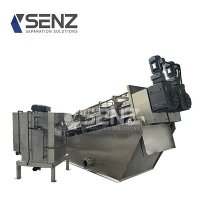

Hey there! As a supplier of Coal Tar Decanter Centrifuges, I often get asked about the difference between horizontal and vertical coal tar decanter centrifuges. So, I thought I'd take a moment to break it down for you.
1. How They Look and Are Built
First off, let's talk about the physical differences. A horizontal coal tar decanter centrifuge, as the name suggests, lies horizontally. It's got a long, cylindrical shape, and it usually has a conveyor screw inside that runs parallel to the axis of the centrifuge bowl. This setup allows for a continuous flow of coal tar through the centrifuge.
On the other hand, a vertical coal tar decanter centrifuge stands upright. It has a more compact design compared to the horizontal one. The components are arranged vertically, and the flow of coal tar is directed from the top down.
2. How They Work
The working principles of these two types of centrifuges are similar in the sense that they both use centrifugal force to separate the components of coal tar. But there are some key differences in the way they achieve this.


In a horizontal centrifuge, the coal tar enters the centrifuge bowl through an inlet. As the bowl spins at high speed, the heavier components of the coal tar, like solids and some heavy oils, are forced to the outer wall of the bowl. The conveyor screw then moves these solids towards the discharge end of the centrifuge. Meanwhile, the lighter components, such as light oils and water, form an inner layer and are discharged through a separate outlet. This continuous process allows for efficient separation of coal tar components.
In a vertical centrifuge, the coal tar is fed into the top of the centrifuge. The centrifugal force causes the solids to settle on the inner wall of the bowl, while the liquid phase moves towards the center. The separated solids are then removed from the bottom of the centrifuge, and the liquid is discharged from the top. The vertical design allows for a shorter retention time of the coal tar in the centrifuge, which can be an advantage in some applications.
3. Separation Efficiency
When it comes to separation efficiency, both types of centrifuges can do a great job. However, the horizontal centrifuge is often preferred for applications where a high degree of separation is required. The longer retention time of the coal tar in the horizontal centrifuge allows for more thorough separation of the components. This is especially important when dealing with coal tar that has a high solids content or when very pure products are needed.
The vertical centrifuge, on the other hand, is more suitable for applications where a quick separation is needed. The shorter retention time means that the centrifuge can process a larger volume of coal tar in a shorter period. This can be beneficial in industries where high throughput is a priority.
4. Maintenance and Operation
Maintenance and operation are also important factors to consider when choosing between a horizontal and vertical coal tar decanter centrifuge.
The horizontal centrifuge is generally easier to access for maintenance. The components are more spread out, making it easier to clean and replace parts. The conveyor screw, which is a critical component in the horizontal centrifuge, can be easily removed and serviced. However, the horizontal centrifuge requires a larger footprint, which can be a limitation in some facilities.
The vertical centrifuge has a more compact design, which means it takes up less space. This can be an advantage in facilities where space is limited. However, the vertical design can make it more difficult to access some components for maintenance. The components are stacked vertically, and some parts may be located deep inside the centrifuge, making them harder to reach.
5. Applications
Both horizontal and vertical coal tar decanter centrifuges have a wide range of applications in the coal tar processing industry.
The horizontal centrifuge is commonly used in applications where high-quality separation is required. It is often used in the production of coal tar pitch, which is a key ingredient in the manufacturing of electrodes for the aluminum industry. The horizontal centrifuge can effectively separate the solids and heavy oils from the coal tar, producing a high-quality pitch.
The vertical centrifuge is often used in applications where a large volume of coal tar needs to be processed quickly. It is commonly used in the initial stages of coal tar processing, where the goal is to remove the majority of the solids and water from the coal tar. This can help to reduce the load on downstream processing equipment.
6. Cost
Cost is always a factor when making a purchasing decision. The cost of a coal tar decanter centrifuge can vary depending on a number of factors, including the size, capacity, and features of the centrifuge.
In general, horizontal centrifuges tend to be more expensive than vertical centrifuges. This is because they are more complex in design and require more materials to manufacture. However, the higher cost of the horizontal centrifuge may be justified by its higher separation efficiency and longer service life.
Vertical centrifuges are usually less expensive, making them a more affordable option for some businesses. They are also more energy-efficient, which can result in lower operating costs over time.
7. Conclusion
So, to sum it up, the main differences between a horizontal and vertical coal tar decanter centrifuge lie in their design, working principle, separation efficiency, maintenance, applications, and cost. When choosing between the two, it's important to consider your specific needs and requirements. If you need a high degree of separation and have the space and budget for it, a horizontal centrifuge may be the best choice. If you need to process a large volume of coal tar quickly and have limited space, a vertical centrifuge may be more suitable.
If you're in the market for a coal tar decanter centrifuge, or if you have any questions about our products, don't hesitate to reach out. We're here to help you find the right centrifuge for your needs. And if you're interested in other applications of our centrifuges, you can check out our Water Treatment Sludge Dewatering, Wastewater Treatment Sludge Dewatering, and Decanter Machine pages for more information.
References
- "Centrifuge Technology Handbook" by John Smith
- "Coal Tar Processing: Principles and Applications" by Jane Doe