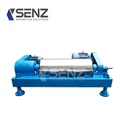

Hey there! As a supplier of 2 - Phase Decanter Centrifuges, I've been getting a lot of questions lately about how the liquid level in these machines affects separation. So, I thought I'd take a deep dive into this topic and share some insights with you all.
First off, let's quickly go over what a 2 - Phase Decanter Centrifuge is. It's a powerful piece of equipment that uses centrifugal force to separate two immiscible liquids or a liquid and a solid. It's widely used in various industries like food and beverage, chemical, and wastewater treatment.
Now, the liquid level in a 2 - Phase Decanter Centrifuge plays a crucial role in the separation process. Think of it as the stage where all the action happens. If the liquid level is too high, it can cause a bunch of problems. For starters, the retention time of the materials inside the centrifuge decreases. Retention time is the amount of time the mixture spends inside the centrifuge, and it's super important for effective separation. When the liquid level is high, the mixture rushes through the centrifuge too quickly, and there isn't enough time for the heavier components to settle out properly. This can lead to poor separation efficiency, meaning you won't get a clear distinction between the two phases.


On the other hand, if the liquid level is too low, it can also mess things up. The centrifuge might not be able to operate at its optimal capacity. The flow of the liquid through the centrifuge can become uneven, which can cause vibrations and instability. These vibrations can not only damage the centrifuge over time but also affect the quality of the separation. Additionally, a low liquid level can lead to the formation of dry spots inside the centrifuge. Dry spots can cause the solid particles to stick to the walls of the centrifuge, reducing its performance and increasing the risk of blockages.
Let's talk about some real - world examples. In the food and beverage industry, Industrial Large Capacity Centrifuge is often used for separating different components. For instance, in the production of fruit juices, a 2 - Phase Decanter Centrifuge is used to separate the pulp from the juice. If the liquid level in the centrifuge is not properly adjusted, the juice might still contain a lot of pulp, which can affect the taste and quality of the final product. Similarly, in the dairy industry, these centrifuges are used to separate cream from milk. An improper liquid level can result in cream with a lower fat content or milk that still contains some cream, which is not ideal for production.
Another industry where the liquid level matters a great deal is the chemical industry. Chemical processes often require precise separation of different substances. Horizontal Beverage Centrifuge can be used for separating different chemical compounds. If the liquid level is incorrect, it can lead to contamination of the separated components. This can be a huge problem, especially in industries where purity is of the utmost importance.
In the agricultural sector, specifically in the Retrieval Of Starch in Potatoes, a 2 - Phase Decanter Centrifuge is used to separate the starch from the potato slurry. The liquid level in the centrifuge has a direct impact on the yield and quality of the starch. If the liquid level is too high, a lot of the starch might be lost in the waste stream. If it's too low, the separation might not be complete, and the starch might still contain impurities.
So, how do you determine the right liquid level? Well, there's no one - size - fits - all answer. It depends on several factors, such as the type of materials being separated, the flow rate of the mixture, and the design of the centrifuge. Most modern 2 - Phase Decanter Centrifuges come with sensors and control systems that can help you monitor and adjust the liquid level. These systems can detect changes in the liquid level and make automatic adjustments to ensure optimal separation.
However, it's still important to have a basic understanding of how the liquid level affects the process. Regular maintenance and calibration of the centrifuge are also essential. This includes checking the sensors, cleaning the centrifuge, and ensuring that all the components are working properly.
In conclusion, the liquid level in a 2 - Phase Decanter Centrifuge is a critical factor that can significantly affect the separation process. Whether you're in the food and beverage industry, chemical industry, or any other industry that uses these centrifuges, getting the liquid level right is key to achieving high - quality separation and efficient production.
If you're in the market for a 2 - Phase Decanter Centrifuge or have any questions about how to optimize the liquid level for your specific application, don't hesitate to reach out. We're here to help you make the most of your centrifuge and ensure that you get the best results possible.
References
- "Centrifugal Separation Technology" by Peter A. Schweitzer
- "Handbook of Industrial Separation Processes" edited by Norman N. Li