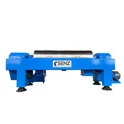

Hey there! As a supplier of 2 - Phase Decanter Centrifuges, I often get asked if these machines can be used for separating different types of gases from liquids. Let's dive into this topic and find out.
First off, let's understand what a 2 - Phase Decanter Centrifuge is. It's a powerful piece of equipment that uses centrifugal force to separate two immiscible phases, typically a solid and a liquid. But can it handle gas - liquid separation? Well, it's a bit more complicated than that.
How a 2 - Phase Decanter Centrifuge Works
The basic principle of a 2 - Phase Decanter Centrifuge is to spin the mixture at high speeds. The centrifugal force causes the denser phase to move towards the outer wall of the centrifuge bowl, while the less dense phase stays closer to the center. In most common applications, we're talking about separating solids from liquids. For example, in the Soy Protein Decanter Centrifuge, it's used to separate soy protein solids from the liquid part of the soy mixture.
Gas - Liquid Separation Challenges
When it comes to separating gases from liquids, there are some unique challenges. Gases are much less dense than liquids, and they have a tendency to expand and fill the available space. In a 2 - Phase Decanter Centrifuge, the design is mainly optimized for solid - liquid separation. The centrifugal force that works so well for separating solids and liquids might not be as effective for gases.
Gases can also be highly compressible. This means that they can change their volume easily under different pressures. In a centrifuge, the pressure and flow conditions are designed for liquid and solid phases. The gas phase might not respond in the same way as the liquid or solid phases to the centrifugal forces.
Potential Applications
However, there are some scenarios where a 2 - Phase Decanter Centrifuge could potentially be used for gas - liquid separation. For instance, in some industrial processes where there are small amounts of gas entrained in a liquid, the centrifuge might be able to separate the gas to some extent.
Let's say in a chemical manufacturing process, a liquid might have some dissolved or entrained gases. The high - speed rotation of the centrifuge could cause the gas bubbles to coalesce and rise to the surface of the liquid, allowing for a partial separation. But this is not a perfect solution, and the efficiency of separation would depend on many factors such as the type of gas, the properties of the liquid, and the operating conditions of the centrifuge.
Factors Affecting Gas - Liquid Separation in a 2 - Phase Decanter Centrifuge
- Density Difference: The greater the density difference between the gas and the liquid, the easier it is to separate them. But since gases have very low densities compared to liquids, this can be a significant challenge.
- Gas Solubility: If the gas is highly soluble in the liquid, it will be much harder to separate. The centrifuge might not be able to break the chemical bonds between the gas and the liquid molecules.
- Centrifuge Design: The design of the centrifuge, including the shape of the bowl, the speed of rotation, and the flow rate, all play a role in the separation process. For gas - liquid separation, a different design might be required compared to solid - liquid separation.
Real - World Examples
In the Centrifuge Sludge Dewatering process, the main goal is to separate water from sludge. But sometimes, there might be some small amounts of gas in the sludge. The centrifuge can help in removing some of this gas along with the water. However, it's not the primary purpose of the centrifuge, and the separation of gas is not as efficient as the separation of solids and liquids.
In the food and beverage industry, a Horizontal Beverage Centrifuge is used to clarify beverages by removing solids. But there could be some dissolved gases in the beverage. The centrifuge might be able to remove a small amount of these gases, but it's not designed specifically for gas - liquid separation.
Conclusion
So, can a 2 - Phase Decanter Centrifuge be used for separating different types of gases from liquids? The answer is yes, but with limitations. It can work in some specific scenarios where there are small amounts of gas entrained in a liquid, but it's not a one - size - fits - all solution for gas - liquid separation.


If you're in an industry where you think a 2 - Phase Decanter Centrifuge could potentially be used for gas - liquid separation, or if you have any other applications in mind, we'd love to hear from you. Our team of experts can help you determine if our centrifuge is the right fit for your needs. Whether it's for soy protein separation, sludge dewatering, or beverage clarification, we have the experience and the technology to provide you with the best solution.
If you're interested in learning more or discussing a potential purchase, don't hesitate to reach out. We're here to assist you in finding the perfect 2 - Phase Decanter Centrifuge for your business.
References
- Perry, R. H., & Green, D. W. (1997). Perry's Chemical Engineers' Handbook. McGraw - Hill.
- Schweitzer, P. A. (1997). Handbook of Separation Techniques for Chemical Engineers. McGraw - Hill.