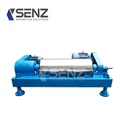

The operation of a decanter centrifuge is a complex process influenced by numerous factors, with sludge composition being one of the most critical. As a supplier of Sludge Decanter Centrifuges, I have witnessed firsthand how different sludge compositions can significantly impact the performance and efficiency of these machines. In this blog, we will delve into the various aspects of sludge composition and explore their effects on the operation of a decanter centrifuge.


Particle Size Distribution
The particle size distribution in sludge plays a vital role in the decanter centrifuge's operation. Sludge with a wide range of particle sizes can pose challenges to the separation process. Larger particles tend to settle more quickly under the influence of centrifugal force, while smaller particles may remain suspended in the liquid phase for longer periods. This can lead to uneven sedimentation and reduced separation efficiency.
For instance, if the sludge contains a significant amount of fine particles, they may not be easily separated from the liquid phase. These fine particles can cause issues such as increased turbidity in the separated liquid and clogging of the centrifuge's discharge ports. On the other hand, sludge with predominantly large particles may require a higher centrifugal force to achieve effective separation. Our Scroll Discharge Decanter Centrifuge is designed to handle a variety of particle sizes, with adjustable speed and differential settings to optimize the separation process based on the sludge's characteristics.
Density Difference
The density difference between the solid and liquid phases in sludge is another crucial factor. A larger density difference makes it easier for the centrifuge to separate the two phases, as the solid particles will sediment more rapidly towards the bowl wall. Conversely, when the density difference is small, the separation process becomes more challenging.
In cases where the density difference is minimal, the centrifuge may need to operate at a higher speed to generate sufficient centrifugal force for separation. However, this can also increase energy consumption and mechanical stress on the centrifuge components. Our decanter centrifuges are engineered to be highly efficient in handling sludges with different density differences. By carefully adjusting the bowl speed and other operating parameters, we can ensure optimal separation even in challenging density conditions.
Viscosity
The viscosity of sludge can significantly affect the flow characteristics within the decanter centrifuge. Highly viscous sludge can impede the movement of the solid particles towards the bowl wall, reducing the separation efficiency. It can also cause blockages in the centrifuge's flow channels, leading to increased wear and tear on the machine.
To address the issue of high - viscosity sludge, our decanter centrifuges are equipped with features such as specially designed screw conveyors and adjustable conveyor speeds. The screw conveyor helps to move the viscous sludge along the bowl and enhance the separation process. Additionally, pre - treatment methods such as chemical conditioning can be used to reduce the sludge's viscosity, making it more manageable for the centrifuge.
Chemical Composition
The chemical composition of sludge can have far - reaching effects on the decanter centrifuge's operation. Certain chemicals in the sludge can cause corrosion of the centrifuge components, reducing their lifespan and performance. For example, acidic or alkaline sludge can react with the materials of the centrifuge bowl and screw conveyor, leading to pitting and erosion.
Moreover, the presence of chemical flocculants or coagulants in the sludge can improve the separation efficiency by promoting the aggregation of fine particles. However, the dosage and type of these chemicals need to be carefully controlled. Over - dosing can result in excessive foaming and blockages in the centrifuge, while under - dosing may not achieve the desired level of particle aggregation. Our team of experts can provide guidance on the appropriate chemical treatment based on the sludge's chemical composition for optimal centrifuge performance.
Solids Concentration
The solids concentration in sludge is a key parameter that affects the decanter centrifuge's operation. Higher solids concentrations require more energy and a longer residence time in the centrifuge for effective separation. If the solids concentration is too high, the centrifuge may become overloaded, leading to reduced separation efficiency and potential mechanical failures.
On the other hand, lower solids concentrations may result in a less efficient use of the centrifuge, as the machine may need to process a larger volume of liquid to achieve the same amount of solid separation. Our decanter centrifuges are designed to handle a wide range of solids concentrations, and we can customize the operating parameters based on the specific solids content of the sludge.
Impact on Operating Parameters
The sludge composition directly impacts the operating parameters of the decanter centrifuge. For example, the bowl speed needs to be adjusted according to the particle size, density difference, and solids concentration. Higher bowl speeds are generally required for sludges with finer particles, smaller density differences, and higher solids concentrations.
The differential speed between the bowl and the screw conveyor also needs to be optimized. A proper differential speed ensures that the separated solids are efficiently conveyed out of the centrifuge while preventing excessive wear on the conveyor. Additionally, the feed rate of the sludge into the centrifuge must be carefully controlled to match the machine's capacity and the characteristics of the sludge.
Case Studies
We have encountered many cases where the sludge composition has had a significant impact on the centrifuge operation. In one project, a customer had sewage sludge with a high content of fine organic particles. The initial operation of the centrifuge resulted in poor separation efficiency, with a high level of turbidity in the separated liquid. By adjusting the operating parameters and using a suitable chemical flocculant, we were able to improve the separation performance and achieve satisfactory results.
In another case, a dairy farm used our Manure Decanter Centrifuge to separate solid and liquid phases in manure. The manure had a relatively high solids concentration and a complex mixture of organic and inorganic particles. Through careful optimization of the centrifuge's speed and differential settings, we were able to efficiently separate the solids from the liquid, reducing the volume of manure waste and generating valuable end - products.
Conclusion
In conclusion, sludge composition has a profound impact on the operation of a decanter centrifuge. Particle size distribution, density difference, viscosity, chemical composition, and solids concentration all play crucial roles in determining the separation efficiency, energy consumption, and lifespan of the centrifuge. As a leading supplier of Sludge Decanter Centrifuges, we understand these challenges and are committed to providing solutions that are tailored to the specific characteristics of the sludge.
Our Decanter Centrifuge Separator is designed to offer high - performance and reliable separation for a wide range of sludge types. If you are facing challenges in sludge separation or are looking to optimize your existing centrifuge operation, our team of experts is ready to assist you. We can provide in - depth analysis of your sludge composition and recommend the most suitable centrifuge model and operating parameters. Contact us today to start a discussion on how we can meet your sludge separation needs.
References
- Bradley, D. (Ed.). (2007). Encyclopedia of Separation Science. Elsevier.
- Dick, R., & Etnier, E. L. (2007). Dewatering of Wastewater Sludges. CRC Press.
- Schubert, H. (1998). Solid - Liquid Separation. Springer - Verlag.