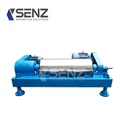

When it comes to mining operations, the efficiency and effectiveness of separation processes are crucial. A mining decanter centrifuge plays a vital role in separating solids from liquids, and one key factor that significantly impacts its separation effect is the bowl diameter. As a mining decanter centrifuge supplier, I've seen firsthand how this variable can make a world of difference. So, let's dive into how the bowl diameter influences the separation effect of a mining decanter centrifuge.
Understanding the Basics of a Mining Decanter Centrifuge
Before we get into the nitty - gritty of bowl diameter, it's important to have a basic understanding of how a mining decanter centrifuge works. A decanter centrifuge uses centrifugal force to separate solid particles from a liquid suspension. The mixture is fed into the rotating bowl, and due to the high - speed rotation, the denser solid particles are forced to the outer wall of the bowl, while the lighter liquid phase moves towards the center. A conveyor screw then transports the separated solids towards one end of the bowl for discharge, while the clarified liquid is removed from the other end.
The Impact of Bowl Diameter on Separation Efficiency
Settling Time and Particle Separation
The bowl diameter has a direct impact on the settling time of solid particles within the centrifuge. A larger bowl diameter provides a larger surface area for sedimentation. When the surface area is increased, the solid particles have more space and time to settle under the influence of centrifugal force. This means that even smaller particles have a better chance of being separated from the liquid phase.
For example, in a mining operation where fine mineral particles need to be separated from a slurry, a larger - diameter bowl can effectively capture these tiny particles. On the other hand, a smaller bowl diameter reduces the available settling area, which may lead to incomplete separation, especially for fine particles. As a result, the separated liquid may still contain a significant amount of suspended solids, reducing the overall separation efficiency.
Centrifugal Force Distribution
The distribution of centrifugal force also varies with the bowl diameter. The centrifugal force acting on a particle is proportional to the distance from the axis of rotation. In a larger - diameter bowl, particles at the outer edge experience a higher centrifugal force compared to those in a smaller - diameter bowl. This stronger force can accelerate the settling process of solid particles, making the separation more efficient.
However, it's important to note that the increased centrifugal force in a large - diameter bowl also requires more power to rotate the bowl. This can lead to higher energy consumption, which is a factor that needs to be considered when choosing the right bowl diameter for a specific mining application.
Bowl Diameter and Throughput Capacity
Higher Throughput with Larger Diameters
The bowl diameter is closely related to the throughput capacity of a mining decanter centrifuge. A larger - diameter bowl can handle a higher volume of the feed mixture. This is because the larger cross - sectional area allows for more fluid to flow through the centrifuge at any given time.


In large - scale mining operations, where large volumes of slurry need to be processed, a centrifuge with a larger bowl diameter can significantly increase the overall throughput. This means that more material can be processed in a shorter period, improving the productivity of the mining process.
Limitations of Smaller Diameters
Conversely, a smaller - diameter bowl has a lower throughput capacity. If a mining operation tries to force a large volume of feed into a centrifuge with a small bowl diameter, it can lead to overloading. Overloading causes the centrifuge to operate inefficiently, as the solid particles may not have enough time to settle properly, and the liquid may carry more solids out of the centrifuge.
Considerations for Different Mining Applications
Fine Particle Separation
In applications where fine particle separation is critical, such as in the recovery of precious metals from ore slurries, a larger - diameter bowl is often preferred. The increased settling time and higher centrifugal force at the outer edge of the bowl help to capture even the smallest particles, ensuring a higher recovery rate. For example, in gold mining, where the gold particles can be extremely fine, a centrifuge with a larger bowl diameter can improve the separation of gold from the surrounding rock and soil.
Coarse Particle Separation
For applications involving the separation of relatively coarse particles, a smaller - diameter bowl may be sufficient. Coarse particles settle more quickly under centrifugal force, so the need for a large settling area is reduced. Additionally, a smaller - diameter bowl may be more energy - efficient for these applications, as it requires less power to rotate.
Our Product Range
As a mining decanter centrifuge supplier, we offer a wide range of centrifuges with different bowl diameters to meet the diverse needs of our customers. If you're looking for a Small Decanter Centrifuge, we have models that are perfect for small - scale mining operations or for applications where space is limited. Our Beer Yeast Centrifuge Separator also utilizes the principle of centrifugal separation, and we can customize the bowl diameter according to your specific requirements. And for those in the oil field, our Oil Field Centrifuge is designed to handle the unique challenges of oil - based drilling fluids, with options for different bowl diameters to optimize separation efficiency.
Making the Right Choice
Choosing the right bowl diameter for a mining decanter centrifuge is not a one - size - fits - all decision. It depends on several factors, including the particle size distribution of the feed material, the required throughput capacity, and the available power supply. Our team of experts is always ready to help you analyze your specific needs and recommend the most suitable centrifuge with the appropriate bowl diameter.
Let's Talk
If you're in the market for a mining decanter centrifuge and want to learn more about how the bowl diameter can affect your separation process, don't hesitate to get in touch. We're here to answer all your questions and guide you through the selection process. Whether you're a small - scale miner or part of a large - scale operation, we have the solutions to meet your needs.
References
- Smith, J. (2018). Centrifugal Separation in Mining Processes. Mining Journal.
- Johnson, A. (2020). The Impact of Bowl Design on Decanter Centrifuge Performance. Separation Science Review.