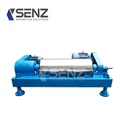

Yo, what's up everyone! I'm a supplier of small decanter centrifuges, and today I wanna talk about something super important in our line of work - the effect of particle size on the separation performance of these nifty machines.
Let's start by getting a basic understanding of what a small decanter centrifuge is. It's a piece of equipment that uses centrifugal force to separate different components in a mixture. You can think of it like a high - tech washing machine that spins really fast to separate dirt from clothes, but instead, it separates solids from liquids or different types of liquids from each other.
Now, particle size is a big deal when it comes to how well these centrifuges work. When the particles in the mixture are large, they're easier to separate. Large particles have more mass, so they experience a greater centrifugal force. This means they'll move towards the outer wall of the centrifuge bowl faster. For example, if you're using a Manure Decanter Centrifuge to separate solid manure from liquid waste, the larger chunks of manure will quickly settle at the outer part of the centrifuge bowl. The centrifuge can then easily remove these solids, leaving behind a cleaner liquid.
On the flip side, small particles are a real pain in the butt. They don't respond as well to the centrifugal force. They tend to stay suspended in the liquid for longer because they're so light. It's like trying to catch a bunch of tiny dust particles in the air. You can wave your hand around all you want, but it's really hard to grab them. In a small decanter centrifuge, these small particles might not make it to the outer wall of the bowl in time to be separated. This can lead to a less efficient separation process and a lower - quality end product.
Another thing to consider is the shape of the particles. Even if the particles are small, if they have an irregular shape, they might clump together. These clumps can then act like larger particles and be separated more easily. But if the particles are smooth and spherical, they're more likely to stay apart and be difficult to separate.
When it comes to the performance of a Decanter Centrifuge Separator, the ideal particle size range can vary depending on the specific application. For some industrial processes, particles in the range of 100 - 500 micrometers might be perfect. They're big enough to be separated efficiently but not so large that they cause clogging in the centrifuge.
But what if you're dealing with a mixture that has a wide range of particle sizes? Well, that's where things get tricky. The centrifuge has to work harder to separate all the different particles. You might end up with some large particles being separated quickly, while the small ones are still floating around. This can result in a less - than - perfect separation. To deal with this, some centrifuge models have adjustable settings. You can change the speed of the centrifuge or the angle of the bowl to optimize the separation for different particle sizes.
Now, let's talk about the impact of particle size on the wear and tear of the centrifuge. Large particles can be abrasive. As they move towards the outer wall of the bowl, they can scratch and damage the surface. Over time, this can lead to leaks and reduced efficiency. Small particles, on the other hand, can get stuck in the small gaps and crevices of the centrifuge. This can cause blockages and also affect the performance of the machine.
In some industries, like the coal tar industry, the Coal Tar Decanter Centrifuge has to deal with a complex mixture of different - sized particles. Coal tar contains a variety of substances, from large chunks of coal to tiny carbon particles. The centrifuge has to separate the solids from the liquid tar. If the particle size is not properly managed, it can lead to problems like low - quality tar products or frequent breakdowns of the centrifuge.
So, as a small decanter centrifuge supplier, I know how important it is to understand the relationship between particle size and separation performance. When customers come to me, I always ask them about the nature of the mixture they're dealing with, especially the particle size. This helps me recommend the right centrifuge model and settings for their needs.
If you're in the market for a small decanter centrifuge, don't underestimate the role of particle size. It can make or break the success of your separation process. Whether you're in the manure, coal tar, or any other industry that requires separation, choosing the right centrifuge for your specific particle - size requirements is crucial.


If you have any questions or want to discuss your separation needs, feel free to reach out. We can have a chat about how our small decanter centrifuges can help you achieve the best separation performance. Let's work together to get the most out of your separation processes.
References
- Perry, R. H., & Green, D. W. (1997). Perry's Chemical Engineers' Handbook. McGraw - Hill.
- Svarovsky, L. (1990). Solid - Liquid Separation. Butterworth - Heinemann.