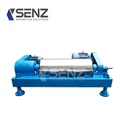

Hey there! As a supplier of DDGS Dewatering Centrifuges, I often get asked about how to adjust the differential speed in these machines. It's a crucial aspect that can significantly impact the efficiency and performance of the dewatering process. So, let's dive right in and explore this topic in detail.
First off, let's understand what differential speed means in a DDGS dewatering centrifuge. The differential speed refers to the difference in rotational speed between the bowl and the screw conveyor inside the centrifuge. This difference is what allows the centrifuge to separate the solid and liquid components of the DDGS mixture effectively.
The right differential speed is super important. If it's too high, the solids might not have enough time to settle properly, and you'll end up with a higher moisture content in the separated solids. On the other hand, if the differential speed is too low, the solids can build up inside the centrifuge, leading to blockages and reduced throughput.
So, how do you adjust the differential speed? Well, most modern DDGS dewatering centrifuges come with a variable frequency drive (VFD). This nifty little device allows you to control the speed of the motor that drives the screw conveyor, which in turn adjusts the differential speed.


Here's a step - by - step guide on how to use the VFD to adjust the differential speed:
- Understand the initial settings: Before you start making any adjustments, it's essential to know the default settings of your centrifuge. Check the user manual that came with your machine. It'll give you a good starting point for the differential speed based on the type of DDGS you're processing.
- Monitor the process: Keep an eye on the output of the centrifuge. Look at the moisture content of the separated solids and the clarity of the separated liquid. If the solids are too wet, you might need to decrease the differential speed. If the liquid has a lot of solids in it, you may need to increase the differential speed.
- Make small adjustments: Don't go crazy and make big changes all at once. Instead, make small adjustments to the differential speed using the VFD. For example, you can increase or decrease the speed by 1 - 2 RPM (revolutions per minute) at a time. After each adjustment, let the centrifuge run for a few minutes to stabilize and then check the output again.
- Record your changes: Keep a record of the differential speed settings and the corresponding output results. This will help you understand how different settings affect the dewatering process and make more informed adjustments in the future.
Another factor to consider when adjusting the differential speed is the feed rate of the DDGS into the centrifuge. If you increase the feed rate, you might need to increase the differential speed to ensure proper separation. Conversely, if you decrease the feed rate, you can probably lower the differential speed.
It's also important to note that the properties of the DDGS can vary. Factors like the particle size distribution, density, and viscosity of the DDGS can all affect the optimal differential speed. For example, if the DDGS has a higher proportion of fine particles, you might need a lower differential speed to allow these particles to settle properly.
Now, let's talk about some common mistakes to avoid when adjusting the differential speed. One big mistake is not giving the centrifuge enough time to stabilize after making an adjustment. As I mentioned earlier, you should let the centrifuge run for a few minutes to see the real - time effects of the adjustment.
Another mistake is ignoring the other components of the centrifuge. The differential speed is just one part of the equation. You also need to make sure that the bowl speed, the feed rate, and the flocculant dosage (if used) are all properly optimized.
If you're still having trouble adjusting the differential speed, don't hesitate to reach out to the manufacturer's technical support team. They have a wealth of knowledge and can provide you with more specific advice based on your centrifuge model and the type of DDGS you're processing.
In addition to DDGS dewatering centrifuges, we also offer a range of other centrifuge products. For example, if you're in the fruit pulp processing industry, you might be interested in our Fruit Pulp Decanter Centrifuge. It's designed to efficiently separate the pulp from the juice in fruit processing.
If you're involved in sunflower seed oil production, our Sunflower Seed Oil Decanter Centrifuge can help you achieve high - quality oil separation. And for those in the agricultural sector dealing with manure management, our Manure Decanter is a great solution for separating the solid and liquid components of manure.
If you're interested in any of our centrifuge products or need more information on adjusting the differential speed in our DDGS dewatering centrifuges, we'd love to hear from you. Whether you're a small - scale operator or a large - scale industrial plant, we can provide you with the right centrifuge solution to meet your needs. Just reach out to us, and we'll start a conversation about how we can help you optimize your dewatering process.
References
- Centrifuge Operation Manuals
- Industry - specific research on centrifuge dewatering processes