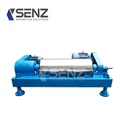
Hey there! As a supplier of 2 - Phase Decanter Centrifuges, I often get asked about how these machines handle high - density materials. Well, let's dive right into it.
First off, what exactly is a 2 - Phase Decanter Centrifuge? In simple terms, it's a piece of equipment that uses centrifugal force to separate two phases of a mixture, usually a solid and a liquid. The centrifuge spins at high speeds, creating a force that pushes the denser phase (in our case, high - density materials) towards the outer wall of the centrifuge bowl.
When it comes to high - density materials, the 2 - Phase Decanter Centrifuge has some pretty nifty features that make it a great choice. One of the key aspects is its powerful motor. A high - performance motor allows the centrifuge to reach high rotational speeds, which in turn generates a strong centrifugal force. This force is crucial for separating high - density materials from the rest of the mixture. For example, if you're dealing with a slurry that contains heavy minerals, the high centrifugal force will quickly push these minerals to the outer edge of the bowl, while the lighter liquid phase stays closer to the center.
Another important feature is the design of the centrifuge bowl. Our 2 - Phase Decanter Centrifuges have a carefully engineered bowl shape that helps in efficient separation. The bowl is designed to have a large surface area, which allows for more contact between the mixture and the bowl wall. This increased contact helps in better separation of the high - density materials. Additionally, the bowl has a specific angle that aids in the movement of the separated phases. The high - density solids are directed towards the discharge port at the end of the bowl, while the liquid phase is collected from a different outlet.
Now, let's talk about the conveyor system inside the centrifuge. The conveyor plays a vital role in handling high - density materials. It rotates at a slightly different speed than the bowl, which creates a differential speed. This differential speed allows the conveyor to scrape the high - density solids that have accumulated on the bowl wall and move them towards the discharge port. The conveyor is also designed to be robust and durable, as it has to withstand the abrasive nature of high - density materials. For instance, if you're separating sand from a liquid, the conveyor needs to be able to handle the constant abrasion caused by the sand particles.
One of the advantages of our 2 - Phase Decanter Centrifuges is their ability to handle a wide range of high - density materials. Whether you're dealing with industrial waste that contains heavy metals, or you're in the food industry and need to separate high - density proteins from a liquid, our centrifuge can do the job. For more information on how our centrifuge can be applied in the soy protein industry, check out Centrifugal Decanter Applied To Soy Protein.


In addition to handling different types of high - density materials, our centrifuge also offers flexibility in terms of processing capacity. We have models that can handle small - scale laboratory applications, like the Mini Laboratory Decanter Centrifuge. This model is perfect for research and development purposes, where you might need to test the separation of high - density materials on a small scale. On the other hand, if you're in a large - scale industrial operation, we have the Big Bowl Centrifuge that can handle high - volume processing.
Maintenance is also an important aspect when it comes to handling high - density materials. Our 2 - Phase Decanter Centrifuges are designed with easy maintenance in mind. The components that come into contact with the high - density materials, such as the bowl and the conveyor, are made from high - quality materials that are resistant to wear and tear. This means that you can expect a long service life from your centrifuge, even when dealing with abrasive high - density materials. Additionally, we provide detailed maintenance guides and support to ensure that your centrifuge operates at its best.
When it comes to the control system of our centrifuge, it's state - of the - art. You can easily adjust the rotational speed, the differential speed of the conveyor, and other parameters to optimize the separation process for high - density materials. This level of control allows you to fine - tune the centrifuge according to the specific characteristics of the high - density materials you're dealing with. For example, if the materials have a particularly high density, you can increase the rotational speed to generate a stronger centrifugal force.
In conclusion, our 2 - Phase Decanter Centrifuges are well - equipped to handle high - density materials. With their powerful motors, well - designed bowls, efficient conveyor systems, and advanced control systems, they offer a reliable and effective solution for separating high - density materials from mixtures. Whether you're in a small laboratory or a large industrial plant, we have a centrifuge model that can meet your needs.
If you're interested in learning more about how our 2 - Phase Decanter Centrifuges can handle high - density materials in your specific application, or if you're looking to purchase a centrifuge, don't hesitate to get in touch. We're here to answer all your questions and help you find the best solution for your business.
References
- General knowledge of centrifuge technology and design principles.
- Internal product documentation of 2 - Phase Decanter Centrifuges.