


Quick Answer: Choose a multi-disc screw press when your plant is small to mid-size, your sludge is low to medium concentration, oily, or sticky, and you want low power, low noise, and unattended operation. Choose a decanter centrifuge when flows are large, floor space is tight, you need an enclosed machine, or a drier cake on difficult sludge saves meaningful disposal cost. Neither wins everywhere, and the decision should rest on a test with your own sludge.
This article is the third in a set with our lists of the Top 10 Multi-Disc Screw Press Manufacturers in the World and the Top 10 Chinese Multi-Disc Screw Press Manufacturers. Those articles tell you who makes the machines. This one helps you decide which type of machine to buy.
Disclosure: Jinhua Shenzhou Centrifuge Co., Ltd. makes both multi-disc screw presses (SZ series) and decanter centrifuges (LW series). We have tried to describe the trade-offs evenly, and figures below are typical or vendor-stated values, not guarantees.
How the two machines work, in brief
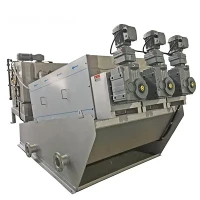
A multi-disc screw press squeezes sludge slowly between stacked fixed and moving rings as a screw shaft turns. The ring gaps and screw pitch narrow along the way, so pressure builds gradually and filtrate escapes through the gaps. The moving rings sweep the gaps clean as the shaft turns.
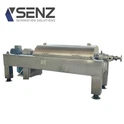
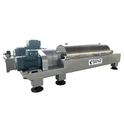
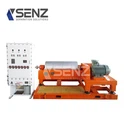
A decanter centrifuge spins sludge in a horizontal bowl at high speed. Centrifugal force pushes solids to the bowl wall, and a screw rotating at a slightly different speed conveys them out as cake while clarified liquid leaves the other end.
One works by gentle mechanical pressure at low speed. The other works by high G-force. Almost every practical difference follows from that.
Side-by-Side Comparison
| Factor | Multi-Disc Screw Press | Decanter Centrifuge |
|---|---|---|
| Principle | Slow mechanical pressing between rings | High-speed centrifugal settling |
| Power use | Low | Higher |
| Noise and vibration | Low | Higher; needs proper foundation |
| Capacity range | Small to mid-size per unit; add units for more | Small to very large per unit |
| Footprint per capacity | Larger at high capacity | Compact |
| Feed solids | Low to medium concentration, tolerant of oily or sticky sludge | Medium to higher concentration is typical |
| Cake dryness | Depends heavily on sludge and polymer; test required | Often drier on difficult biological sludge; test required |
| Enclosure and odor | Varies by design | Fully enclosed |
| Wash water | Needed for ring cleaning | Needed for flushing |
| Wear parts | Rings and screw | Conveyor tiles, discharge parts, bearings, gearbox |
| Operator skill | Low | Moderate |
| Typical buyer | Small and mid-size plants, food and oily sludge | Larger plants, tight space, high flows |
Where a multi-disc screw press tends to win
Low power and quiet operation. Slow, low-torque machines draw far less electricity and are easy to run in a plant that has no dedicated operator on every shift.
Low-concentration and oily sludge. Many designs can take sludge straight from an aeration or secondary clarifier without a separate thickener, and the self-cleaning rings resist blinding with oily or sticky material.
Simple operation and maintenance. Operators can generally learn it quickly, and maintenance is mostly ring, screw, and wash system care.
Scalability by modules. You can add units as flows grow rather than buying one large machine up front.
Where a decanter centrifuge tends to win
Large flows. A single decanter handles throughput that would need many presses.
Compact footprint. More capacity in less space, which matters when you are retrofitting.
Fully enclosed operation. Easier odor control and less operator exposure.
Drier cake on difficult sludge. On some biological sludges a well-run decanter can reach a drier cake, which lowers hauling and disposal cost. This depends on the sludge and polymer program, so it must be tested.
Flexibility. The same decanter can thicken or dewater, and a three-phase version can also separate oil.
An illustrative power comparison from our own data
Our brochure gives installed power figures for both machine types, which allows a rough comparison. These are installed (nameplate) values, not measured consumption, and the two machines are not interchangeable at all feed concentrations, so treat this only as an illustration of scale.
For sludge at 10,000 mg/L (about 1% solids), our SZ-304 multi-disc press is rated at 20 m³/h, or 200 to 280 kg of dry solids per hour, with a total installed power of 4.1 kW. Our LW450 decanter handles 4 to 20 m³/h, with a 37 kW main drive and 11 kW back drive.
In other words, at this thin feed concentration the press needs a fraction of the installed power. At higher feed solids or larger flows the picture shifts, because a decanter's capacity rises quickly while a press needs more units. Ask any supplier to quote power for your specific feed.
Cake dryness, polymer, and the test you should insist on
Suppliers quote cake solids ranges, and some state wide ranges for multi-disc presses depending on sludge type. Treat every figure as a vendor claim until it is measured on your sludge.
When you test, compare the machines on the same feed and record:
- Cake solids at a fixed polymer dose, and polymer dose needed for a target dryness
- Solids capture rate, which tells you how much solids return in the filtrate or centrate
- Throughput in kg of dry solids per hour at your feed concentration
- Wash water consumption
- Power draw and noise at the working point
Polymer cost often outweighs the equipment price over time, so a machine that reaches the same dryness with less polymer can win even if it costs more to buy.
Capacity: compare dry solids, not just cubic meters
Multi-disc presses are usually rated in kg of dry solids per hour at a stated feed concentration, and capacity in m³/h falls quickly as feed gets thicker. Decanters are often rated in m³/h. To compare fairly, convert both to dry solids per hour at your actual feed concentration.
Combining the two
Some plants use both. A multi-disc press can thicken waste activated sludge directly, and a decanter can then dewater the combined sludge, or a press can handle the oily or sticky stream while a decanter handles the main stream. If your plant has two very different sludge types, ask suppliers to quote both options.
A simple way to decide
- Flow and solids. Large flows or high feed solids point toward a decanter. Small to mid-size flows and low-concentration feed point toward a press.
- Sludge character. Oily, sticky, or fibrous sludge deserves a press test. Fine biological sludge deserves a decanter test.
- Space and enclosure. Tight space or strict odor rules favor a decanter. Spacious sites with low-power priorities favor a press.
- Staffing. Limited operator time favors a press.
- Disposal cost. If each point of cake dryness is worth a lot, test the decanter carefully.
- Test both. If the budget allows, run both on your sludge and compare total cost, not purchase price.
FAQ
Is a multi-disc screw press cheaper than a decanter centrifuge?
Often it costs less to buy at small capacities and less to run in power, but costs depend on size, materials, and the supporting system. Compare total cost including polymer, power, wash water, maintenance, and disposal.
Which gives a drier cake?
It depends on the sludge. Decanters often do better on difficult biological sludge, while presses can perform well on sludge they are well matched to. Only a test on your sludge gives a real answer.
Can a screw press handle high flows?
Capacity per unit is limited, so high flows usually need multiple presses or a decanter.
Do both need polymer?
Usually yes. Polymer dose and conditioning strongly affect results for both machines.
What information should I give a supplier?
Sludge type, flow, solids concentration, target cake dryness, available space and power, and any oil, fiber, or hazardous-area requirements.
Send us your sludge data and we will quote both a multi-disc press and a decanter configuration so you can compare them side by side.