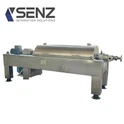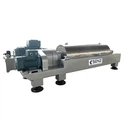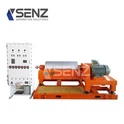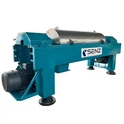


The Decanter Centrifuge
When it comes to separating solid/liquid mixes with a high solids content, decanter centrifuges are the way to go. These solid-shell scroll centrifuges or decanters, unlike chamber filter presses, run continuously. The finely distributed solid particles are separated from the suspension by strong centrifugal forces.
Decanters are useful in a wide variety of industries throughout the world. The centrifuges are optimally adapted for the specific application. Applications range from sludge dewatering to classification or wet classification to the sorting of solids.
To obtain optimum results, solid bowl decanter centrifuges must be custom designed to suit specific separation processes.

How Does Decanter Centrifuges Actually Work?
The operating principle of a decanter centrifuge is based on separation via buoyancy. Naturally, a component with a higher density would fall to the bottom of a mixture, while the less dense component would be suspended above it. A decanter centrifuge increases the rate of settling through the use of continuous rotation, producing a G-force equivalent to between 1000 and 4000 G's. This reduces the settling time of the components by a large magnitude, whereby mixtures previously having to take hours to settle can be settled in a matter of seconds using a decanter centrifuge. This form of separation enables more rapid and controllable results. it can be divided into two- phase decanter centrifuge (solid-liquid separation) and three-phase decanter centrifuge (liquid-liquid-solid separation).
The feed product is pumped into the decanter centrifuge through the inlet. Feed goes into a horizontal bowl, which rotates. The bowl is composed of a cylindrical part and a conical part. The separation takes place in the cylindrical part of the bowl. Under these forces, the solid particles with higher density are collected and compacted on the wall of the bowl. A scroll (also screw or screw conveyor) rotates inside the bowl at a slightly different speed. This speed difference is called the differential speed. This way the scroll is transporting the settled particles along the cylindrical part of the bowl and up to the end conical part of the bowl. At the smallest end of the conical part of the bowl, the dewatered solids leave the bowl via discharge opening. The clarified liquid leaves through a paring disc (internal centripetal pump).

Types Of Decanters
There are several types of decanter centrifuges currently utilized in the industry, the most widely recognized are vertical, horizontal and conveyor centrifuges. The principle behind a decanter centrifuge is based on the theory of gravitational separation. For example, if you fill a vessel with a mixture of mud and water, over time the weight of the mud will cause it to settle down at the base of the vessel. With the mud congealed at the bottom, the water will be forced upwards, creating a clear separation between the two.