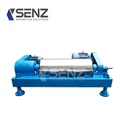

Separation efficiency is a crucial parameter when it comes to fish oil decanter centrifuges. As a supplier of high - quality fish oil decanter centrifuges, I have in - depth knowledge and practical experience regarding this topic. In this blog, we will explore what the separation efficiency of a fish oil decanter centrifuge is, its influencing factors, and why it matters in the fish oil production process.
Understanding Separation Efficiency
Separation efficiency in a fish oil decanter centrifuge refers to the ability of the centrifuge to separate different components of a fish oil mixture effectively. When processing fish, the raw material contains fish oil, water, and solid particles such as fish meal residues. The main goal of the decanter centrifuge is to separate the fish oil from the water and solid impurities to obtain pure fish oil with high quality.
Mathematically, separation efficiency can be expressed as the ratio of the amount of pure fish oil obtained after separation to the total amount of fish oil in the original mixture. For example, if we start with a mixture that theoretically contains 100 liters of fish oil, and after running through the decanter centrifuge, we obtain 90 liters of pure fish oil, the separation efficiency is 90%.
Factors Affecting Separation Efficiency
Centrifuge Design
The design of the fish oil decanter centrifuge plays a vital role in determining its separation efficiency. The bowl geometry, for instance, affects the flow pattern of the mixture inside the centrifuge. A well - designed bowl can ensure a smooth and stable flow, which allows for better separation of the components. The length - to - diameter ratio of the bowl is also important. A longer bowl provides more residence time for the mixture, enabling more thorough separation.
The screw conveyor design is another key factor. The pitch and shape of the screw blades influence how the solid particles are transported out of the centrifuge. If the screw conveyor is not designed properly, it may cause the solid particles to mix back with the separated fish oil, reducing the separation efficiency.
Rotational Speed
The rotational speed of the centrifuge is directly related to the centrifugal force generated. Higher rotational speeds result in greater centrifugal forces, which can more effectively separate the components based on their density differences. Fish oil, water, and solid particles have different densities. The centrifugal force pushes the denser solid particles towards the outer wall of the bowl, while the lighter fish oil moves towards the center. However, there is a limit to the rotational speed. Excessive speed may cause the formation of emulsions, where the fish oil and water mix together in a stable suspension, making it difficult to separate them.

Feed Rate
The feed rate of the fish oil mixture into the centrifuge also impacts separation efficiency. If the feed rate is too high, the mixture may not have enough time to be properly separated inside the centrifuge. The components will pass through the centrifuge quickly, and the separation will be incomplete. On the other hand, if the feed rate is too low, it may lead to inefficient use of the centrifuge and lower overall productivity. Therefore, finding the optimal feed rate is essential for achieving high separation efficiency.
Properties of the Feed Mixture
The physical and chemical properties of the fish oil mixture, such as its viscosity, density, and particle size distribution, can significantly affect separation efficiency. A more viscous mixture may flow more slowly through the centrifuge, which can either enhance separation if the residence time is sufficient or cause blockages if the flow is too restricted. The density difference between the fish oil, water, and solid particles determines how easily they can be separated. A larger density difference generally leads to better separation. Additionally, the particle size of the solid impurities matters. Smaller particles are more difficult to separate and may require higher centrifugal forces or longer residence times.
Importance of Separation Efficiency in Fish Oil Production
Quality of Fish Oil
High separation efficiency ensures that the fish oil obtained is of high quality. By effectively removing water and solid impurities, the fish oil has a longer shelf - life and better nutritional value. Water in fish oil can cause oxidation and spoilage, while solid particles can affect the clarity and taste of the oil. Pure fish oil is more desirable in the market, whether it is used for human consumption, animal feed, or industrial applications.
Cost - Effectiveness
Improving separation efficiency can lead to cost savings in the fish oil production process. When the centrifuge can separate more fish oil from the raw material, there is less waste. This means that more of the valuable fish oil is recovered, increasing the overall yield. Additionally, efficient separation reduces the need for further purification steps, which can save on energy, chemicals, and labor costs.
Applications Beyond Fish Oil Separation
Our fish oil decanter centrifuges are not only useful for fish oil separation but also have other applications. For Waste Dewatering, the centrifuge can effectively separate water from solid waste, reducing the volume of waste and making it easier to handle and dispose of. In Water Treatment Sludge Dewatering, the centrifuge can separate the sludge from the water, improving the efficiency of water treatment processes. Moreover, our Fish Meal Dewatering Centrifuge can be used to separate water from fish meal, enhancing the quality of the fish meal product.
Conclusion
In conclusion, the separation efficiency of a fish oil decanter centrifuge is a complex but critical concept in the fish oil production industry. It is affected by various factors such as centrifuge design, rotational speed, feed rate, and the properties of the feed mixture. High separation efficiency is essential for producing high - quality fish oil and achieving cost - effectiveness in the production process. Our company, as a leading supplier of fish oil decanter centrifuges, is committed to providing products with excellent separation efficiency.
If you are in the fish oil production industry or have a need for waste dewatering, water treatment sludge dewatering, or fish meal dewatering, we invite you to contact us for a detailed discussion on how our centrifuge solutions can meet your specific requirements. We are ready to provide you with professional advice and high - performance products to enhance your production efficiency.
References
- Perry, R. H., & Green, D. W. (Eds.). (2008). Perry's Chemical Engineers' Handbook. McGraw - Hill.
- Svarovsky, L. (1990). Solid - Liquid Separation. Butterworth - Heinemann.
- Trowbridge, D. W. (1980). Centrifugal Separation Technology. Elsevier.