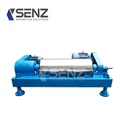

When it comes to industrial separation processes, the 2 - Phase Decanter Centrifuge stands out as a versatile and efficient piece of equipment. As a leading supplier of 2 - Phase Decanter Centrifuges, I often receive inquiries about the potential applications of our centrifuges, including the question: Can a 2 - Phase Decanter Centrifuge be used for separating different types of acids? In this blog post, I will delve into this topic, exploring the principles of the 2 - Phase Decanter Centrifuge, the nature of acid separation, and the feasibility of using our centrifuges for this purpose.
Understanding the 2 - Phase Decanter Centrifuge
A 2 - Phase Decanter Centrifuge operates on the principle of centrifugal force. It consists of a rotating bowl and a screw conveyor. When a mixture is fed into the centrifuge, the high - speed rotation of the bowl generates a centrifugal force that separates the mixture into two phases: a heavier phase and a lighter phase. The screw conveyor then transports the separated phases out of the centrifuge.
Our 2 - Phase Decanter Centrifuges are designed with high precision and advanced technology. They are capable of handling a wide range of materials and can achieve high separation efficiency. For example, in the Centrifuge For Heparin Sodium Process, our centrifuges are used to separate heparin sodium from other impurities in the production process. In the Centrifuge For Wastewater Treatment, they play a crucial role in separating solid particles from wastewater, making the water cleaner and more suitable for further treatment or discharge. And in the Decanter Centrifuge For Sludge Dewatering, they effectively reduce the moisture content of sludge, facilitating its disposal.


The Nature of Acid Separation
Acids are chemical substances that can donate protons or accept electron pairs. Different types of acids have different physical and chemical properties, such as density, viscosity, and reactivity. When separating different types of acids, these properties need to be taken into account.
For example, some acids may have a significant difference in density. In such cases, the difference in density can be utilized for separation. The heavier acid will settle at the bottom of the centrifuge bowl under the action of centrifugal force, while the lighter acid will form a separate layer on top. However, it is important to note that acids are often corrosive, which means that the materials used in the centrifuge must be resistant to corrosion.
Feasibility of Using a 2 - Phase Decanter Centrifuge for Acid Separation
Advantages
- Efficient Separation: The high - speed rotation of the 2 - Phase Decanter Centrifuge can generate a strong centrifugal force, which can quickly separate acids with different densities. This can significantly improve the separation efficiency compared to traditional separation methods.
- Continuous Operation: Our 2 - Phase Decanter Centrifuges are designed for continuous operation. This means that they can handle large volumes of acid mixtures over an extended period of time, which is very beneficial for industrial - scale acid separation processes.
- Customization: We can customize the 2 - Phase Decanter Centrifuge according to the specific requirements of acid separation. For example, we can select appropriate materials for the centrifuge components to ensure corrosion resistance. We can also adjust the operating parameters, such as the rotation speed and the feed rate, to optimize the separation effect.
Challenges
- Corrosion Resistance: As mentioned earlier, acids are corrosive. Therefore, the materials used in the centrifuge must be carefully selected. Common corrosion - resistant materials include stainless steel, titanium, and certain types of plastics. However, the choice of material depends on the specific type of acid and its concentration.
- Safety: Handling acids is a hazardous task. When using a 2 - Phase Decanter Centrifuge for acid separation, proper safety measures must be taken. This includes ensuring proper ventilation, using personal protective equipment, and following strict operating procedures.
- Compatibility: Some acids may react with each other or with the components of the centrifuge. Before using the centrifuge for acid separation, a compatibility test should be conducted to ensure that there are no adverse reactions.
Case Studies
Although there are challenges, there have been successful cases of using 2 - Phase Decanter Centrifuges for acid separation in some industries. For example, in the chemical industry, when separating a mixture of sulfuric acid and hydrochloric acid, a 2 - Phase Decanter Centrifuge was used. By carefully selecting the corrosion - resistant materials and adjusting the operating parameters, the centrifuge was able to effectively separate the two acids, achieving a high - purity separation result.
Conclusion
In conclusion, a 2 - Phase Decanter Centrifuge can be used for separating different types of acids. It offers advantages such as efficient separation, continuous operation, and customization. However, challenges such as corrosion resistance, safety, and compatibility need to be addressed. As a supplier of 2 - Phase Decanter Centrifuges, we have the expertise and experience to provide solutions for acid separation.
If you are interested in using our 2 - Phase Decanter Centrifuges for acid separation or other applications, we invite you to contact us for further discussion. Our team of experts will be happy to provide you with detailed information and technical support to help you make the right decision for your separation needs.
References
- Perry, R. H., & Green, D. W. (1997). Perry's Chemical Engineers' Handbook. McGraw - Hill.
- Separation Processes Principles: Chemical and Biochemical Operations. (2012). Wiley.