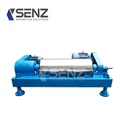

The separation of different types of adhesives is a complex and crucial process in various industries, such as chemical manufacturing, automotive, and electronics. As a supplier of 2 - Phase Decanter Centrifuges, I often receive inquiries about whether our equipment can be used for this specific application. In this blog, I will delve into the capabilities of a 2 - Phase Decanter Centrifuge in separating different types of adhesives, exploring the scientific principles, practical considerations, and potential benefits.


Understanding the 2 - Phase Decanter Centrifuge
A 2 - Phase Decanter Centrifuge is a high - performance separation device that utilizes centrifugal force to separate two immiscible phases in a liquid mixture. The basic principle behind its operation is the difference in density between the two phases. When the mixture is fed into the centrifuge, the high - speed rotation creates a centrifugal field, causing the heavier phase to move towards the outer wall of the centrifuge bowl, while the lighter phase remains closer to the center. These two phases are then discharged separately through different outlets.
The centrifuge consists of a rotating bowl, a screw conveyor, and a drive system. The screw conveyor rotates at a slightly different speed from the bowl, which helps to convey the separated solids (if present) towards the solids discharge port. The design of the centrifuge can be customized according to the specific requirements of the separation process, such as the type of materials, the desired separation efficiency, and the throughput.
Adhesive Separation Challenges
Adhesives come in a wide variety of types, including epoxy, acrylic, polyurethane, and silicone adhesives. Each type has its own unique chemical composition, viscosity, and physical properties. The separation of adhesives can be challenging due to several factors.
Firstly, adhesives often have high viscosities, which can make it difficult for the phases to separate quickly. High - viscosity liquids flow more slowly, and the centrifugal force may not be sufficient to overcome the internal resistance of the adhesive, resulting in incomplete separation. Secondly, some adhesives may contain fine particles or additives that can further complicate the separation process. These particles can agglomerate and form larger clusters, which may not be easily separated by the centrifuge. Additionally, the chemical stability of adhesives needs to be considered. Some adhesives may react with the centrifuge materials or undergo chemical changes during the separation process, which can affect the quality of the separated products.
Can a 2 - Phase Decanter Centrifuge be Used for Adhesive Separation?
The answer is yes, a 2 - Phase Decanter Centrifuge can be used for separating different types of adhesives, but certain conditions need to be met.
1. Viscosity Adjustment
As mentioned earlier, high viscosity is a major challenge in adhesive separation. To improve the separation efficiency, the viscosity of the adhesive can be adjusted. This can be achieved by heating the adhesive to reduce its viscosity or by adding suitable solvents or diluents. However, it is important to ensure that the addition of solvents or diluents does not affect the chemical properties of the adhesive or the performance of the centrifuge.
2. Particle Size and Distribution
If the adhesive contains particles, the particle size and distribution need to be carefully considered. For larger particles, the centrifuge can effectively separate them from the liquid phase. However, for fine particles, additional pre - treatment steps may be required, such as filtration or the use of Automatic Flocculant Dosing System. A flocculant can be added to the adhesive to agglomerate the fine particles into larger clusters, which are easier to separate by the centrifuge.
3. Chemical Compatibility
The materials used in the construction of the centrifuge must be chemically compatible with the adhesives. Stainless steel is a commonly used material for the centrifuge bowl and screw conveyor due to its corrosion resistance. However, for some aggressive adhesives, special coatings or materials may be required to prevent chemical reactions and ensure the long - term performance of the centrifuge.
Applications in Adhesive Separation
The use of a 2 - Phase Decanter Centrifuge in adhesive separation has several practical applications.
1. Recycling of Adhesives
In the adhesive manufacturing industry, there is often a need to recycle unused or waste adhesives. A 2 - Phase Decanter Centrifuge can be used to separate the different components of the adhesive, such as the resin, the hardener, and the solvent. The separated components can then be reused in the production process, which not only reduces waste but also saves costs.
2. Quality Control
During the production of adhesives, it is important to ensure the quality and consistency of the product. A centrifuge can be used to separate any impurities or unwanted phases from the adhesive, which helps to improve the purity and performance of the final product. For example, in the production of electronic adhesives, the removal of fine particles and air bubbles is crucial to ensure the reliability of the electronic components.
3. Wastewater Treatment
Adhesive manufacturing processes often generate wastewater that contains residual adhesives. Centrifuge For Wastewater Treatment can be used to separate the adhesive from the wastewater, reducing the organic load in the wastewater and making it easier to treat further. This can also help to meet the environmental regulations regarding wastewater discharge.
Advantages of Using a 2 - Phase Decanter Centrifuge for Adhesive Separation
There are several advantages of using a 2 - Phase Decanter Centrifuge for adhesive separation.
1. High Separation Efficiency
The centrifuge can achieve a high degree of separation between the different phases of the adhesive. The centrifugal force is much stronger than gravity, which allows for a more rapid and complete separation compared to other separation methods, such as sedimentation or filtration.
2. Continuous Operation
A 2 - Phase Decanter Centrifuge can operate continuously, which is suitable for large - scale adhesive production processes. The continuous feed and discharge of materials ensure a high throughput and a stable separation performance.
3. Customizability
As mentioned earlier, the centrifuge can be customized according to the specific requirements of the adhesive separation process. The design parameters, such as the bowl diameter, the length of the screw conveyor, and the speed ratio, can be adjusted to optimize the separation efficiency and the throughput.
Practical Considerations for Adhesive Separation
When using a 2 - Phase Decanter Centrifuge for adhesive separation, there are some practical considerations that need to be taken into account.
1. Maintenance
Regular maintenance is essential to ensure the proper operation of the centrifuge. The centrifuge should be cleaned regularly to remove any adhesive residues that may accumulate on the internal surfaces. The bearings, seals, and other moving parts need to be inspected and lubricated periodically to prevent wear and tear.
2. Safety
Adhesives can be hazardous materials, and proper safety measures should be taken during the separation process. The centrifuge should be installed in a well - ventilated area to prevent the accumulation of toxic fumes. Operators should wear appropriate personal protective equipment, such as gloves and goggles, to avoid contact with the adhesives.
3. Process Optimization
The separation process needs to be optimized to achieve the best results. This may involve adjusting the operating parameters of the centrifuge, such as the feed rate, the rotational speed, and the differential speed of the screw conveyor. It is also important to monitor the quality of the separated products and make adjustments as needed.
Conclusion
In conclusion, a 2 - Phase Decanter Centrifuge can be a viable solution for separating different types of adhesives. Although there are challenges associated with adhesive separation, such as high viscosity and the presence of particles, these challenges can be overcome through proper pre - treatment and process optimization. The centrifuge offers high separation efficiency, continuous operation, and customizability, which make it suitable for a wide range of adhesive separation applications, including recycling, quality control, and wastewater treatment.
If you are interested in using a 2 - Phase Decanter Centrifuge for your adhesive separation needs, or if you have any questions about our products, please feel free to contact us. We have a team of experts who can provide you with detailed technical advice and customized solutions. Our Chemical Wastewater Separation Centrifuge and other related products are designed to meet the highest standards of quality and performance. We look forward to working with you to achieve your separation goals.
References
- "Centrifugal Separation Technology" by Svarovsky, L.
- "Adhesive Technology Handbook" by Skeist, I.
- Technical literature from centrifuge manufacturers.