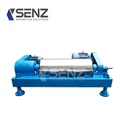

Hey there! As a supplier of soymilk decanter centrifuges, I often get asked about the operating cost of these machines. So, I thought I'd write a blog post to break it down for you.
First off, let's understand what a soymilk decanter centrifuge does. It's a crucial piece of equipment in the soymilk production process. It separates the solid particles from the liquid soymilk, ensuring a smooth and pure final product. Now, let's dig into the factors that contribute to its operating cost.
Energy Consumption
One of the major components of the operating cost is energy consumption. A soymilk decanter centrifuge typically runs on electricity. The power consumption depends on the size and capacity of the centrifuge. Larger centrifuges with higher processing capacities generally use more energy.
For example, a small - scale soymilk decanter centrifuge used in a local soy milk shop might consume around 2 - 5 kilowatts per hour. On the other hand, a large industrial - grade centrifuge used in a big soymilk manufacturing plant could use 10 - 20 kilowatts per hour or even more.
The cost of electricity varies from region to region. In some areas, it might be as low as $0.10 per kilowatt - hour, while in others, it could be $0.20 or higher. So, if you have a centrifuge that uses 10 kilowatts per hour and the electricity cost is $0.15 per kilowatt - hour, you're looking at an energy cost of $1.5 per hour of operation.
Maintenance and Repairs
Just like any other machinery, soymilk decanter centrifuges need regular maintenance to keep them running smoothly. This includes tasks like lubricating the moving parts, checking the seals for leaks, and inspecting the belts and motors.
The frequency of maintenance depends on how often the centrifuge is used. If it's running 24/7 in an industrial setting, it might need maintenance every few weeks. For a less - used centrifuge in a small business, monthly or quarterly maintenance might be sufficient.
The cost of maintenance can vary widely. Basic maintenance tasks like lubrication and belt checks might cost only a few dollars in terms of materials. However, if a major component like the motor or the bowl needs to be replaced, it can be quite expensive. A new motor for a soymilk decanter centrifuge could cost anywhere from a few hundred to a few thousand dollars, depending on the brand and specifications.
Consumable Parts
There are also consumable parts that need to be replaced regularly. For example, the filters in the centrifuge need to be changed periodically to ensure efficient separation. The cost of filters depends on their size and quality. A basic filter might cost around $20 - $50, while a high - performance filter could cost $100 or more.
Another consumable part is the O - rings. These are used to create a seal in the centrifuge and prevent leaks. They wear out over time and need to be replaced. O - rings are relatively inexpensive, usually costing a few dollars each.
Labor Costs
If you're operating a soymilk decanter centrifuge, you'll also need someone to run and monitor it. In a small business, the owner or an employee might handle this task. In a large industrial plant, there could be dedicated operators.
The labor cost depends on the wage rate in your area. If an operator is paid $15 per hour and the centrifuge needs to be monitored for 8 hours a day, that's an additional $120 per day in labor costs.
Comparison with Other Types of Centrifuges
There are different types of centrifuges available in the market, and it's worth comparing the operating costs of a soymilk decanter centrifuge with others. For instance, the Solid Bowl Decanter Centrifuge is another type of centrifuge that can be used in various industries. It has its own set of operating costs, which might be different from a soymilk decanter centrifuge.
The Protein Centrifuge is designed specifically for separating proteins. Its operating cost might be influenced by factors like the precision required in the separation process and the type of proteins being processed.
And then there's the Sludge Dewatering Technologies which uses centrifuges for dewatering sludge. The operating cost here is mainly related to the volume of sludge being processed and the energy required for the dewatering process.
Reducing Operating Costs
Now, you might be wondering how you can reduce the operating cost of a soymilk decanter centrifuge. Here are a few tips:


- Energy - efficient models: Look for centrifuges that are designed to be energy - efficient. Newer models often come with advanced technologies that can reduce power consumption without sacrificing performance.
- Regular maintenance: By keeping up with regular maintenance, you can prevent major breakdowns and costly repairs. A well - maintained centrifuge also runs more efficiently, which can save on energy costs.
- Optimize usage: Don't run the centrifuge more than necessary. If you can batch your soymilk production to minimize the number of start - stop cycles, it can reduce wear and tear on the machine and save energy.
Conclusion
The operating cost of a soymilk decanter centrifuge is made up of several factors, including energy consumption, maintenance and repairs, consumable parts, and labor costs. By understanding these factors, you can better manage your budget and make informed decisions about your soymilk production.
If you're in the market for a soymilk decanter centrifuge or want to learn more about reducing operating costs, feel free to reach out. We're here to help you find the best solution for your business.
References
- General knowledge of soymilk production and centrifuge technology.
- Industry reports on centrifuge operating costs.