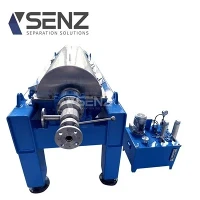

What is the maximum particle size that a coal tar decanter centrifuge can handle? That's a question I get asked a lot as a supplier of coal tar decanter centrifuges. So, let's dig into it and break it down in simple terms.
First off, let's understand what a coal tar decanter centrifuge does. Coal tar is a thick, black liquid that's a by - product of coal carbonization. It contains all sorts of things like dust, solid particles, and other impurities. A coal tar decanter centrifuge is a piece of equipment that uses centrifugal force to separate the solid particles from the liquid coal tar.
Now, the maximum particle size that a coal tar decanter centrifuge can handle isn't a one - size - fits - all answer. It depends on several factors.


One of the big factors is the design of the centrifuge. Different models have different internal configurations. For example, some centrifuges have a larger bowl diameter. A larger bowl diameter can generally handle larger particles. That's because the increased diameter creates more space for the particles to move and get separated. On the other hand, a centrifuge with a smaller bowl might have limitations in handling very large particles as there's less room for proper separation.
The speed of the centrifuge also plays a crucial role. Higher rotational speeds generate a stronger centrifugal force. This force is what pushes the solid particles towards the wall of the centrifuge bowl. If the speed is high enough, even relatively large particles can be separated from the liquid. But there's a catch. Running the centrifuge at extremely high speeds all the time can cause excessive wear and tear on the machine. So, it's a balancing act between getting the right separation and keeping the centrifuge in good working condition.
The shape and density of the particles also matter. Irregularly shaped particles can be more difficult to separate compared to round ones. And if the density of the particles is close to that of the coal tar, separation becomes more challenging. For instance, if the particles have a very low density difference with the coal tar, they might not be pushed to the wall of the centrifuge bowl as effectively, regardless of the centrifuge's size or speed.
In general, most standard coal tar decanter centrifuges can handle particles up to around 1 - 2 millimeters in size. But in some high - end, specially designed centrifuges, we can see an ability to handle particles up to 5 millimeters or more. However, these advanced models come with a higher price tag and more complex operating requirements.
Let me share an example to give you a better idea. A client of mine had a coal tar processing plant. They were dealing with a lot of solid impurities in their coal tar supply. When they first started using a basic centrifuge, they noticed that particles larger than 1 millimeter were causing issues. The centrifuge wasn't able to fully separate them, and it was leading to a decrease in the quality of their final coal tar product. We recommended upgrading to a more heavy - duty centrifuge with a larger bowl and higher - speed capabilities. After the upgrade, they were able to handle particles up to 3 millimeters easily, and their product quality improved significantly.
Now, if you're in the coal tar processing business, you might be wondering about other types of centrifuges that could be useful. Check out the DDGS Dewatering Centrifuge for dewatering applications in the feed industry. The Mud Centrifuge is great for separating solids from mud in drilling operations. And if you're interested in the latest Sludge Dewatering Technologies, we've got you covered too.
When it comes to choosing a coal tar decanter centrifuge, it's important to consider your specific needs. Think about the average particle size in your coal tar, the volume of coal tar you need to process, and your budget. If you're not sure what's the best fit for you, don't hesitate to reach out. We've got a team of experts who can help you make the right decision.
Whether you're a small - scale coal tar producer or a large industrial facility, having the right centrifuge can make a huge difference in your operations. It can improve the quality of your product, increase efficiency, and save you money in the long run. So, why not take the next step and find out which coal tar decanter centrifuge is perfect for your business? We're here to assist you every step of the way, from choosing the right model to providing after - sales support.
Start the conversation today and let's work together to optimize your coal tar processing with the best - suited centrifuge for your requirements.
References
- "Centrifuge Technology Handbook" - General publication on centrifuge design and performance.
- "Coal Tar Processing Intricacies" - Industry - specific resource on coal tar handling and separation.