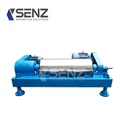

What is the capacity of a typical soymilk decanter centrifuge?
As a supplier of soymilk decanter centrifuges, I often encounter inquiries from customers about the capacity of these machines. Understanding the capacity of a soymilk decanter centrifuge is crucial for businesses in the soy - based food industry, as it directly impacts production efficiency, quality, and overall profitability.
Factors Affecting the Capacity of a Soymilk Decanter Centrifuge
The capacity of a soymilk decanter centrifuge is not a fixed value and is influenced by several key factors.
1. Bowl Diameter and Length
The size of the centrifuge bowl plays a significant role in determining its capacity. Generally, a larger bowl diameter allows for a greater volume of soymilk to be processed at once. The length of the bowl also matters; a longer bowl provides more separation distance, which can enhance the separation efficiency and potentially increase the overall capacity. For example, a decanter centrifuge with a bowl diameter of 450mm may have a lower capacity compared to one with a 650mm diameter, assuming other factors are equal.


2. Rotational Speed
The rotational speed of the centrifuge is another critical factor. Higher rotational speeds generate stronger centrifugal forces, which can more effectively separate the solid and liquid components in soymilk. However, there is a limit to how fast the centrifuge can spin. Excessive speeds may cause damage to the equipment or affect the quality of the separated products. A centrifuge operating at 3000 RPM (revolutions per minute) will have a different capacity than one operating at 4500 RPM.
3. Feed Rate
The rate at which soymilk is fed into the centrifuge also impacts its capacity. If the feed rate is too high, the centrifuge may not be able to separate the components effectively, leading to a decrease in separation quality and potentially reducing the overall capacity. On the other hand, a very low feed rate may result in under - utilization of the centrifuge's capabilities. Operators need to find the optimal feed rate for their specific centrifuge model to achieve the best capacity and separation results.
4. Soymilk Characteristics
The properties of the soymilk itself, such as its viscosity, solid content, and particle size distribution, can affect the centrifuge's capacity. Soymilk with a high solid content or high viscosity will be more difficult to separate, which may require a lower feed rate and thus reduce the overall capacity. For instance, freshly made soymilk with a large amount of豆渣 (okara, the solid residue) may need a slower processing speed compared to refined soymilk with a lower solid content.
Typical Capacity Ranges
Based on our experience and industry standards, the capacity of a typical soymilk decanter centrifuge can vary widely.
Small - Scale Centrifuges
For small - scale soy - based food producers or laboratories, we offer decanter centrifuges with capacities ranging from 50 to 500 liters per hour. These centrifuges are compact, easy to operate, and suitable for businesses with limited production requirements. They are often used in small tofu shops, soy yogurt producers, or research facilities where the production volume is relatively low.
Medium - Scale Centrifuges
Medium - scale soymilk decanter centrifuges typically have capacities between 500 and 3000 liters per hour. These machines are suitable for medium - sized soy food manufacturers, such as regional tofu factories or soy milk bottling plants. They offer a good balance between production capacity and cost - effectiveness, and can meet the daily production needs of many medium - sized enterprises.
Large - Scale Centrifuges
Large - scale soymilk decanter centrifuges can have capacities of 3000 liters per hour or more. These high - capacity machines are designed for large - scale industrial production, such as national - level soy milk producers or large - scale tofu manufacturing plants. They are often equipped with advanced control systems and high - performance components to ensure continuous and efficient operation.
Applications and Benefits of Different Capacity Centrifuges
Small - Scale Centrifuges
Small - scale soymilk decanter centrifuges are ideal for start - up businesses or those with niche markets. They require less floor space, have lower energy consumption, and are more affordable. For example, a small artisanal tofu shop can use a small - capacity centrifuge to separate the okara from the soymilk, producing high - quality tofu for local customers. The simplicity of operation also makes it easy for small business owners to manage the production process.
Medium - Scale Centrifuges
Medium - scale centrifuges offer increased production capacity while still being relatively easy to maintain. They are suitable for expanding businesses that need to meet growing market demand. For instance, a medium - sized soy milk bottling plant can use a medium - capacity centrifuge to ensure a consistent supply of high - quality soy milk to local supermarkets and convenience stores. The ability to process a larger volume of soymilk also allows for more efficient production planning and cost control.
Large - Scale Centrifuges
Large - scale soymilk decanter centrifuges are essential for large - scale industrial production. They can handle high - volume production requirements, ensuring a stable supply of soy - based products to the market. These centrifuges are often integrated into automated production lines, which can significantly improve production efficiency and reduce labor costs. For example, a large - scale tofu manufacturing plant can use a large - capacity centrifuge to process a large amount of soymilk in a short period, meeting the demand of a wide range of customers across the country.
Related Products and Their Roles
In addition to soymilk decanter centrifuges, we also offer other related products that can complement the soymilk production process.
Decanter Centrifuge Separator
The decanter centrifuge separator can be used for more complex separation tasks in the soy - based food industry. It can separate different components in soymilk more precisely, such as separating different types of proteins or fats. This can be useful for producing high - value soy products, such as soy protein isolates or specialty soy oils.
Centrifuge For Oil Water Separation
In the soy - based food production process, there may be situations where oil and water need to be separated. The centrifuge for oil - water separation can effectively remove oil from soymilk or other soy - based liquids, improving the quality and purity of the final products.
Volute Screw Press
The volute screw press can be used in conjunction with the soymilk decanter centrifuge to further dewater the okara. It can reduce the moisture content of the okara, making it easier to handle and potentially increasing its value as a by - product, such as for animal feed or compost.
Conclusion
In conclusion, the capacity of a typical soymilk decanter centrifuge depends on various factors, including bowl size, rotational speed, feed rate, and soymilk characteristics. Different capacity centrifuges are suitable for different scales of soy - based food production, from small - scale artisanal operations to large - scale industrial plants. By understanding these factors and choosing the right centrifuge for their specific needs, soy food producers can improve production efficiency, product quality, and overall profitability.
If you are in the soy - based food industry and are interested in learning more about our soymilk decanter centrifuges or other related products, we encourage you to contact us for a detailed consultation. Our team of experts is ready to assist you in selecting the most suitable equipment for your production requirements and to provide professional after - sales service.
References
- "Centrifugation Technology in Food Processing" - A comprehensive guide on the application of centrifuges in the food industry.
- Industry reports on soy - based food production and equipment requirements.
- Technical manuals of our soymilk decanter centrifuges and related products.