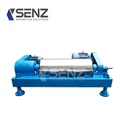

In the field of industrial waste management and environmental protection, sludge decanter centrifuges play a pivotal role. These machines are designed to separate solids from liquids in sludge, effectively reducing the volume of waste and facilitating proper disposal or reuse. As a leading supplier of sludge decanter centrifuges, I understand the importance of having efficient control systems to ensure optimal performance. In this blog post, I will explore the various control systems available for sludge decanter centrifuges and their benefits.
1. Basic Control Systems
Manual Control
Manual control systems are the simplest form of control for sludge decanter centrifuges. Operators adjust the centrifuge's parameters, such as rotational speed, feed rate, and differential speed, based on their experience and visual observations. While manual control provides a high degree of flexibility, it also requires skilled operators and is prone to human error. For instance, inconsistent feed rates can lead to uneven separation and reduced efficiency.
Semi - Automatic Control
Semi - automatic control systems offer a middle ground between manual and fully automatic control. These systems allow operators to set certain parameters, such as the desired rotational speed and feed rate, while the centrifuge automatically maintains these settings within a certain range. Sensors are used to monitor key variables, and the control system adjusts the machine's operation accordingly. This type of control system reduces the need for constant operator intervention and improves the consistency of the separation process.
2. Advanced Control Systems
Programmable Logic Controller (PLC)
PLCs are widely used in industrial applications, including sludge decanter centrifuges. A PLC is a digital computer that can be programmed to control various functions of the centrifuge. It can monitor multiple sensors, such as temperature, pressure, and level sensors, and make real - time adjustments to the centrifuge's operation. For example, if the temperature of the centrifuge exceeds a certain limit, the PLC can automatically reduce the rotational speed or shut down the machine to prevent damage.
PLC - based control systems offer several advantages. They are highly flexible and can be easily reprogrammed to adapt to different operating conditions or process requirements. They also provide accurate and reliable control, reducing the risk of mechanical failures and improving the overall efficiency of the centrifuge. Additionally, PLCs can store historical data, which can be used for process optimization and troubleshooting.
Variable Frequency Drive (VFD)
A Variable Frequency Drive is another important control system for sludge decanter centrifuges. A VFD allows the centrifuge's motor to operate at different speeds by adjusting the frequency of the electrical power supplied to the motor. This enables precise control of the centrifuge's rotational speed, which is crucial for achieving optimal separation.
By using a VFD, the centrifuge can start and stop smoothly, reducing mechanical stress on the machine and extending its lifespan. It also allows the centrifuge to operate at different speeds depending on the characteristics of the sludge being processed. For example, thicker sludge may require a higher rotational speed for effective separation, while thinner sludge may require a lower speed.
Advanced Process Control (APC)
Advanced Process Control systems use mathematical models and algorithms to optimize the operation of the sludge decanter centrifuge. These systems take into account multiple variables, such as the properties of the sludge, the desired separation efficiency, and the energy consumption of the centrifuge. By continuously analyzing and adjusting the centrifuge's operation, APC systems can achieve higher levels of efficiency and productivity.
For example, an APC system can adjust the feed rate and differential speed of the centrifuge based on the real - time properties of the sludge, such as its density and viscosity. This ensures that the centrifuge operates at its optimal performance point, reducing the amount of energy consumed and improving the quality of the separated solids and liquids.
3. Integration with Other Systems
Integration with Monitoring Systems
Modern sludge decanter centrifuges can be integrated with monitoring systems that provide real - time information about the centrifuge's performance. These monitoring systems can include sensors for measuring variables such as vibration, noise, and power consumption. By analyzing this data, operators can detect potential problems early and take preventive measures to avoid breakdowns.
For example, an increase in vibration levels may indicate a misalignment or imbalance in the centrifuge's rotating parts. By monitoring the vibration data, the control system can alert the operator and suggest corrective actions, such as adjusting the centrifuge's position or replacing worn - out components.
Integration with Other Process Equipment
Sludge decanter centrifuges can also be integrated with other process equipment, such as Clarifying Decanter Centrifuge, Oil Water Separator, and Decanter Machine. This integration allows for a more seamless and efficient overall process. For example, the output from a sludge decanter centrifuge can be directly fed into an oil - water separator for further treatment. The control systems of these different pieces of equipment can be coordinated to ensure that the entire process operates smoothly and efficiently.
4. Benefits of Using Advanced Control Systems
Improved Efficiency
Advanced control systems can significantly improve the efficiency of sludge decanter centrifuges. By optimizing the centrifuge's operation, these systems can reduce the amount of energy consumed, increase the throughput of the machine, and improve the quality of the separated solids and liquids. This leads to cost savings and a more sustainable waste management process.


Enhanced Reliability
With advanced control systems, the risk of mechanical failures and breakdowns is reduced. The ability to monitor key variables in real - time and make automatic adjustments ensures that the centrifuge operates within its safe operating limits. This increases the reliability of the centrifuge and reduces the downtime associated with maintenance and repairs.
Better Process Control
Advanced control systems provide more precise and consistent control of the centrifuge's operation. This results in a more stable separation process, which is particularly important for applications where the quality of the separated products is critical. For example, in the food and beverage industry, strict quality standards must be met, and advanced control systems can help ensure that these standards are achieved.
5. Conclusion and Call to Action
In conclusion, the choice of control system for a sludge decanter centrifuge is crucial for achieving optimal performance. From basic manual control to advanced PLC - based and APC systems, there are a variety of options available to suit different needs and budgets. As a supplier of sludge decanter centrifuges, we offer a range of control systems that can be customized to meet your specific requirements.
If you are in the market for a sludge decanter centrifuge or looking to upgrade your existing control system, we invite you to contact us for a detailed consultation. Our team of experts can help you select the most suitable control system for your application and provide you with all the support you need for installation, operation, and maintenance.
References
- "Industrial Centrifuges: Principles, Design, and Applications" by Peter A. Schweitzer
- "Control Systems Engineering" by Norman S. Nise
- Technical literature from leading centrifuge manufacturers