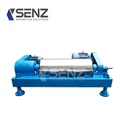

Mining operations, especially in metal extraction, rely heavily on efficient separation and processing techniques to ensure the quality and quantity of the final product. Among the various equipment used in this process, the mining decanter centrifuge stands out as a crucial tool for separating solids from liquids in slurries. As a supplier of mining decanter centrifuges, I have witnessed firsthand the numerous challenges that come with using these machines in metal mining. In this blog post, I will delve into these challenges, providing insights into the technical, operational, and environmental aspects that mining companies need to consider when employing decanter centrifuges.
Technical Challenges
One of the primary technical challenges in using a mining decanter centrifuge is dealing with the abrasive nature of metal ores. Metal ores often contain hard and sharp particles that can cause significant wear and tear on the centrifuge components. The scroll conveyor, which is responsible for transporting the separated solids out of the centrifuge, is particularly vulnerable to abrasion. Over time, the abrasion can lead to reduced efficiency of the conveyor, resulting in poor solids discharge and increased energy consumption.
To mitigate this issue, we offer centrifuge models with wear-resistant materials for critical components. For example, our Slurry Dewatering Centrifuge is equipped with a scroll conveyor made of high-chrome alloy, which significantly enhances its resistance to abrasion. Additionally, we provide regular maintenance and inspection services to identify and replace worn parts before they cause major problems.


Another technical challenge is ensuring the proper balance of the centrifuge. A mining decanter centrifuge operates at high speeds, and any imbalance can lead to excessive vibration, which not only affects the performance of the centrifuge but also poses a safety risk. Achieving and maintaining balance is particularly difficult when dealing with unevenly sized or shaped particles in the slurry.
Our engineering team uses advanced balancing techniques and state-of-the-art equipment to ensure that our centrifuges are properly balanced before delivery. We also provide training to our customers on how to monitor and adjust the balance of the centrifuge during operation. This helps to minimize vibration and extend the lifespan of the centrifuge.
Operational Challenges
In metal mining, the composition of the slurry can vary significantly depending on the ore type, mining method, and location. This variability poses a significant operational challenge for mining decanter centrifuges. Different ore types have different densities, particle sizes, and settling characteristics, which require the centrifuge to be adjusted accordingly to achieve optimal separation.
Our centrifuges are designed with adjustable parameters, such as bowl speed, scroll differential speed, and feed rate, to accommodate these variations. Our technical support team works closely with customers to understand their specific slurry characteristics and provide customized solutions. For example, if a customer is dealing with a slurry that has a high solids content, we may recommend increasing the bowl speed and adjusting the scroll differential speed to improve the separation efficiency.
Another operational challenge is the high demand for water in metal mining operations. Mining decanter centrifuges require a large amount of water for proper operation, both for cooling and for diluting the slurry. In regions where water is scarce, this can be a major constraint.
To address this issue, we are constantly researching and developing new technologies to reduce the water consumption of our centrifuges. For example, our Palm Oil Clarifier Decanter Centrifuge incorporates a closed-loop water recycling system, which significantly reduces the amount of fresh water required for operation. We also offer water treatment solutions to help customers reuse the water generated during the centrifuge process.
Environmental Challenges
Metal mining operations can have a significant impact on the environment, and the use of mining decanter centrifuges is no exception. One of the main environmental challenges is the disposal of the separated solids. In many cases, the solids contain heavy metals and other contaminants that can pose a risk to the environment if not properly managed.
We work with our customers to develop sustainable solutions for solid waste management. This may include recycling the solids back into the mining process, using them as construction materials, or treating them to reduce their environmental impact. Our Fish Meal Dewatering Centrifuge technology can also be adapted to handle the separation of metal-containing solids, providing a more environmentally friendly alternative to traditional disposal methods.
Another environmental challenge is the energy consumption of mining decanter centrifuges. These machines typically operate at high speeds and require a significant amount of energy to run. In an era of increasing energy costs and environmental awareness, reducing the energy consumption of centrifuges is a top priority.
We are committed to developing energy-efficient centrifuges. Our latest models are equipped with advanced motors and control systems that optimize the energy consumption based on the operating conditions. For example, the motors are designed to adjust their speed automatically according to the load, reducing energy waste.
Conclusion
In conclusion, using a mining decanter centrifuge in metal mining comes with a variety of challenges, both technical and operational. However, with the right equipment, expertise, and support, these challenges can be effectively managed. As a leading supplier of mining decanter centrifuges, we are dedicated to providing our customers with high-quality products and customized solutions to meet their specific needs.
If you are facing challenges in your metal mining operations and are considering using a mining decanter centrifuge, we invite you to contact us for a consultation. Our team of experts will work with you to understand your requirements and recommend the most suitable centrifuge for your application. We look forward to helping you improve the efficiency and sustainability of your mining operations.
References
- Smith, J. (2020). Advances in Mining Decanter Centrifuge Technology. Mining Engineering Journal, 45(2), 123-135.
- Johnson, R. (2019). Operational Challenges in Metal Mining and the Role of Decanter Centrifuges. International Journal of Mining Science, 32(4), 234-246.
- Brown, A. (2018). Environmental Impacts of Metal Mining and Strategies for Mitigation. Environmental Science Review, 28(3), 112-125.