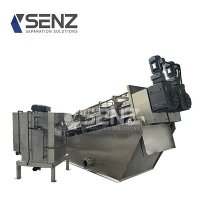

In the realm of industrial machinery, the versatility of equipment often determines its value and applicability across various sectors. One such piece of machinery that has garnered significant attention for its potential multi - use is the decanter machine. As a decanter machine supplier, I am frequently asked about the feasibility of using these machines for chemical processing. This blog post aims to delve into this topic, exploring the technical aspects, potential applications, and limitations of using a decanter machine in chemical processing.
Understanding the Decanter Machine
Before we discuss its use in chemical processing, it is essential to understand what a decanter machine is. A decanter centrifuge is a continuous - flow device that separates components of a liquid - solid or liquid - liquid mixture through the application of centrifugal force. The basic principle behind its operation is that the denser components of the mixture are forced to the outer wall of the rotating drum, while the less dense components remain closer to the center. This separation process is highly efficient and can handle large volumes of material.


Decanter machines come in various sizes and configurations, each designed to meet specific separation requirements. They are commonly used in industries such as wastewater treatment, food and beverage processing, and oil and gas recovery. The key components of a decanter machine include a rotating bowl, a screw conveyor, and a drive system. The rotating bowl creates the centrifugal force, while the screw conveyor moves the separated solids out of the machine.
Technical Feasibility in Chemical Processing
From a technical perspective, decanter machines have several features that make them suitable for chemical processing. First, the high - speed rotation of the bowl generates a strong centrifugal force, which can effectively separate different chemical substances based on their density differences. This is crucial in chemical processes where the separation of components is often a critical step.
For example, in the production of certain chemicals, there may be a need to separate a solid catalyst from a liquid reaction mixture. A decanter machine can quickly and efficiently perform this separation, allowing for the reuse of the catalyst and the purification of the product. Additionally, the continuous - flow nature of decanter machines makes them ideal for large - scale chemical production, where a high throughput is required.
Another advantage of using decanter machines in chemical processing is their ability to handle a wide range of viscosities. Chemical substances can have varying viscosities, from thin liquids to thick slurries. Decanter machines can be adjusted to accommodate these different viscosities, ensuring optimal separation performance.
Potential Applications in Chemical Processing
There are numerous potential applications of decanter machines in chemical processing. One such application is in the purification of chemical products. Many chemical reactions produce a mixture of products and by - products, as well as unreacted starting materials. A decanter machine can be used to separate these components, resulting in a purer final product.
In the pharmaceutical industry, for instance, decanter machines can be used to separate active pharmaceutical ingredients (APIs) from reaction mixtures. This separation process is crucial for ensuring the quality and safety of pharmaceutical products. The high - precision separation capabilities of decanter machines can help to remove impurities and unwanted substances, meeting the strict quality standards of the pharmaceutical industry.
Another application is in the recovery of valuable chemicals from waste streams. Chemical manufacturing processes often generate waste materials that contain valuable substances. By using a decanter machine, these valuable chemicals can be recovered and reused, reducing waste and saving costs. For example, in the production of plastics, there may be waste streams containing unreacted monomers. A decanter machine can separate these monomers from the waste, allowing them to be recycled back into the production process.
Decanter machines can also be used in the Centrifugal Thickening Of Sludge in chemical plants. Sludge is a common by - product of many chemical processes, and its proper disposal or treatment is essential. A decanter machine can thicken the sludge, reducing its volume and making it easier to handle and transport. This not only saves on disposal costs but also helps to minimize the environmental impact of chemical waste.
Limitations and Considerations
While decanter machines offer many advantages for chemical processing, there are also some limitations and considerations that need to be taken into account. One of the main limitations is the sensitivity of the separation process to the physical and chemical properties of the mixture. For example, if the components of the mixture have very similar densities, it may be difficult to achieve a complete separation using a decanter machine.
Another consideration is the potential for chemical corrosion. Chemical substances can be highly corrosive, and the materials used in the construction of the decanter machine need to be carefully selected to withstand the corrosive environment. Special coatings or materials such as stainless steel or titanium may be required to ensure the longevity of the machine.
In addition, the operation and maintenance of decanter machines require a certain level of technical expertise. Incorrect operation can lead to poor separation performance or even damage to the machine. Therefore, proper training and support are essential for ensuring the efficient and reliable operation of decanter machines in chemical processing.
Other Related Applications
Apart from the applications directly related to chemical processing, decanter machines also have other important uses. For example, they are widely used in Sand & Gravel Washing Water Treatment. In the sand and gravel industry, large amounts of water are used for washing the materials. The wastewater generated from this process contains suspended solids, which need to be removed before the water can be reused or discharged. A decanter machine can effectively separate the solids from the water, allowing for the recycling of the water and reducing the environmental impact of the industry.
Another interesting application is the Humic Acid Potassium Extraction Machine. Humic acid potassium is a valuable agricultural fertilizer, and its extraction from raw materials often involves a separation process. A decanter machine can be used to separate the humic acid potassium from the extraction mixture, ensuring a high - quality product.
Conclusion
In conclusion, decanter machines can indeed be used for chemical processing. Their technical features, such as high - speed rotation, continuous - flow operation, and ability to handle different viscosities, make them suitable for a wide range of chemical separation tasks. They have numerous potential applications in chemical purification, waste recovery, and sludge thickening. However, it is important to be aware of the limitations and considerations, such as the sensitivity to mixture properties and the potential for chemical corrosion.
As a decanter machine supplier, we are committed to providing high - quality machines and comprehensive support to our customers in the chemical processing industry. If you are interested in exploring the use of decanter machines for your chemical processing needs, we encourage you to contact us for further information and to discuss your specific requirements. We can help you select the most suitable machine for your application and provide training and maintenance services to ensure its optimal performance.
References
- Perry, R. H., & Green, D. W. (1997). Perry's Chemical Engineers' Handbook. McGraw - Hill.
- Svarovsky, L. (1990). Solid - Liquid Separation. Butterworth - Heinemann.