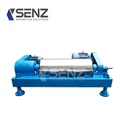

In the world of industrial separation processes, the 2 - Phase Decanter Centrifuge stands as a critical piece of equipment. Its ability to separate two immiscible phases, such as solids and liquids, has made it indispensable in various industries, including wastewater treatment, food processing, and chemical manufacturing. A question that often arises among our clients and industry professionals is: "Is it possible to adjust the separation parameters of a 2 - Phase Decanter Centrifuge?" In this blog, as a 2 - Phase Decanter Centrifuge supplier, I will delve into this topic in detail.
Understanding the 2 - Phase Decanter Centrifuge
Before we discuss parameter adjustment, it's essential to understand how a 2 - Phase Decanter Centrifuge works. This machine operates on the principle of centrifugal force. When a mixture of two phases is introduced into the centrifuge, the high - speed rotation generates a centrifugal field. Due to the difference in density between the two phases, the heavier phase (usually solids) migrates towards the outer wall of the centrifuge bowl, while the lighter phase (usually liquid) remains closer to the center. A screw conveyor then transports the separated solids towards the discharge port, and the liquid is discharged through a separate outlet.
Key Separation Parameters
There are several key parameters that influence the separation efficiency of a 2 - Phase Decanter Centrifuge. These include the rotational speed of the centrifuge bowl, the differential speed between the bowl and the screw conveyor, the feed rate of the mixture, and the back pressure in the liquid outlet.
Rotational Speed
The rotational speed of the centrifuge bowl directly affects the centrifugal force. A higher rotational speed generates a stronger centrifugal force, which can improve the separation of fine particles and increase the clarity of the separated liquid. However, increasing the rotational speed also has its limitations. Excessive speed can cause mechanical stress on the centrifuge components, leading to increased wear and tear and potentially reducing the lifespan of the machine. Additionally, very high speeds may cause the liquid to become turbulent, which can disrupt the separation process.
Differential Speed
The differential speed between the bowl and the screw conveyor determines the rate at which the separated solids are transported out of the centrifuge. A higher differential speed means that the solids are removed more quickly, which can prevent the build - up of solids in the bowl. However, if the differential speed is too high, it may not allow enough time for the solids to fully settle, resulting in a higher solids content in the separated liquid. On the other hand, a very low differential speed can cause the solids to accumulate in the bowl, leading to blockages and reduced separation efficiency.
Feed Rate
The feed rate of the mixture into the centrifuge is another crucial parameter. If the feed rate is too high, the centrifuge may not have enough time to separate the two phases effectively, resulting in poor separation quality. Conversely, a very low feed rate may lead to under - utilization of the centrifuge's capacity, increasing operating costs.
Back Pressure
The back pressure in the liquid outlet affects the level of liquid in the centrifuge bowl. By adjusting the back pressure, we can control the residence time of the liquid in the bowl, which in turn affects the separation efficiency. A higher back pressure increases the liquid level in the bowl, allowing more time for the solids to settle. However, excessive back pressure can cause the liquid to overflow or may lead to the entrainment of solids in the liquid discharge.
Adjustability of Separation Parameters
The good news is that all of these key separation parameters can be adjusted. Most modern 2 - Phase Decanter Centrifuges are equipped with variable frequency drives (VFDs) for the centrifuge bowl and the screw conveyor, which allow for precise control of the rotational speed and the differential speed. The feed rate can be adjusted using a flow control valve on the feed line, and the back pressure can be regulated by adjusting the valve at the liquid outlet.
Practical Considerations for Parameter Adjustment
When adjusting the separation parameters, it's important to take into account the characteristics of the feed mixture. For example, if the feed contains a high concentration of fine particles, a higher rotational speed and a lower differential speed may be required to achieve a good separation. On the other hand, if the feed has a low solids content, a lower rotational speed and a higher differential speed may be sufficient.
It's also crucial to make adjustments gradually and monitor the separation results. Sudden and large - scale parameter changes can disrupt the separation process and may lead to unexpected problems. Regularly analyzing the quality of the separated solids and liquid can help determine whether the parameter adjustments are having the desired effect.
Case Studies
Let's look at some real - world examples to illustrate the importance of parameter adjustment.
Dewatering Of Sludge in Water Treatment
In water treatment plants, 2 - Phase Decanter Centrifuges are commonly used for sludge dewatering. The characteristics of the sludge can vary significantly depending on the source and the treatment process. By adjusting the separation parameters, such as increasing the rotational speed and reducing the feed rate, we can improve the dewatering efficiency, resulting in drier sludge and clearer effluent.
Centrifugal Decanter Applied To Soy Protein
In the food industry, 2 - Phase Decanter Centrifuges are used to separate soy protein from the liquid phase during the production process. The quality of the separated soy protein is highly dependent on the separation parameters. By optimizing the differential speed and the back pressure, we can ensure that the soy protein has the desired purity and particle size distribution.


Thickening Centrifuge
In the mining and mineral processing industry, thickening centrifuges are used to increase the solids concentration in slurries. Adjusting the separation parameters can help achieve the desired thickening ratio, which is crucial for downstream processing operations.
Conclusion
In conclusion, it is indeed possible to adjust the separation parameters of a 2 - Phase Decanter Centrifuge. By carefully controlling the rotational speed, differential speed, feed rate, and back pressure, we can optimize the separation efficiency and meet the specific requirements of different applications. However, parameter adjustment should be carried out with caution, taking into account the characteristics of the feed mixture and the mechanical limitations of the centrifuge.
If you are in need of a 2 - Phase Decanter Centrifuge or have questions about parameter adjustment and optimization, we are here to help. Our team of experts has extensive experience in the field and can provide you with professional advice and solutions. Contact us to start a discussion about your specific needs and explore how our 2 - Phase Decanter Centrifuges can improve your separation processes.
References
- "Centrifugal Separation Technology" by Peter A. Schweitzer
- "Industrial Centrifugation Technology" by J. Paul Guyer