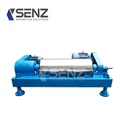

Are there any intelligent control systems for sewage decanter centrifuges?
As a supplier of sewage decanter centrifuges, I often encounter inquiries from customers about the availability and effectiveness of intelligent control systems for these essential machines. In this blog post, I will explore the current state of intelligent control systems in sewage decanter centrifuges, their benefits, and how they can enhance the performance of these equipment.
Sewage decanter centrifuges play a crucial role in wastewater treatment plants, industrial facilities, and other applications where the separation of solids from liquids is required. These machines use centrifugal force to separate the solid particles from the liquid phase, producing a clarified liquid and a concentrated sludge. The efficiency and effectiveness of the separation process depend on several factors, including the design of the centrifuge, the properties of the feed material, and the operating conditions.
Intelligent control systems have emerged as a game-changer in the field of sewage decanter centrifuges. These systems use advanced sensors, algorithms, and automation technologies to monitor and optimize the performance of the centrifuge in real-time. By continuously adjusting the operating parameters based on the changing conditions of the feed material, intelligent control systems can improve the separation efficiency, reduce energy consumption, and minimize the maintenance requirements of the centrifuge.
One of the key benefits of intelligent control systems is their ability to adapt to the variations in the feed material. In a wastewater treatment plant, for example, the characteristics of the sewage can change significantly depending on the time of day, the season, and the source of the wastewater. An intelligent control system can detect these changes and adjust the speed, torque, and other operating parameters of the centrifuge accordingly, ensuring that the separation process remains efficient and effective.
Another advantage of intelligent control systems is their ability to optimize the energy consumption of the centrifuge. By monitoring the power consumption and adjusting the operating parameters in real-time, these systems can reduce the energy usage of the centrifuge without compromising its performance. This not only helps to lower the operating costs of the wastewater treatment plant but also contributes to a more sustainable and environmentally friendly operation.
In addition to improving the separation efficiency and reducing the energy consumption, intelligent control systems can also enhance the reliability and durability of the centrifuge. By continuously monitoring the condition of the centrifuge components, such as the bearings, seals, and motors, these systems can detect potential problems early and alert the operators before they cause a breakdown. This allows for timely maintenance and repairs, minimizing the downtime of the centrifuge and extending its service life.


There are several types of intelligent control systems available for sewage decanter centrifuges, each with its own features and capabilities. Some of the common types include:
- Sensor-based control systems: These systems use sensors to measure the various parameters of the centrifuge, such as the speed, torque, temperature, and vibration. The data collected by the sensors is then analyzed by a control algorithm, which adjusts the operating parameters of the centrifuge based on the predefined setpoints.
- Model-based control systems: These systems use mathematical models to simulate the behavior of the centrifuge and predict its performance under different operating conditions. The control algorithm uses these models to optimize the operating parameters of the centrifuge in real-time, ensuring that the separation process remains efficient and effective.
- Fuzzy logic control systems: These systems use fuzzy logic algorithms to handle the uncertainties and imprecisions in the operating conditions of the centrifuge. Fuzzy logic control systems can adapt to the changing conditions of the feed material and adjust the operating parameters of the centrifuge accordingly, without the need for a precise mathematical model.
- Artificial neural network control systems: These systems use artificial neural networks to learn the behavior of the centrifuge and predict its performance under different operating conditions. The control algorithm uses these neural networks to optimize the operating parameters of the centrifuge in real-time, ensuring that the separation process remains efficient and effective.
At our company, we offer a range of sewage decanter centrifuges equipped with intelligent control systems. Our intelligent control systems are designed to provide maximum efficiency, reliability, and ease of use. They are customizable to meet the specific requirements of our customers and can be integrated with other control systems and monitoring devices in the wastewater treatment plant.
In addition to our standard sewage decanter centrifuges, we also offer specialized centrifuges for other applications, such as Oil Sludge Decanter Centrifuge, Centrifuge For Oil Water Separation, and Laboratory Centrifuge. These centrifuges are also available with intelligent control systems to ensure optimal performance and efficiency.
If you are interested in learning more about our sewage decanter centrifuges and intelligent control systems, please contact us today. Our team of experts will be happy to discuss your specific requirements and provide you with a customized solution that meets your needs. We look forward to the opportunity to work with you and help you achieve your wastewater treatment goals.
References
- Smith, J. (2020). Intelligent Control Systems for Industrial Centrifuges. Journal of Process Control, 85, 104321.
- Johnson, R. (2019). Advances in Centrifuge Technology for Wastewater Treatment. Water Science and Technology, 79(11), 2315-2323.
- Brown, A. (2018). The Role of Intelligent Control in Improving Centrifuge Performance. Chemical Engineering Journal, 337, 111-119.