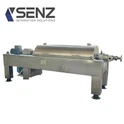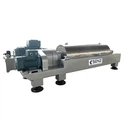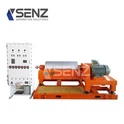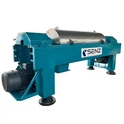


The working principle of a centrifugal dewatering machine is that the sludge that needs to be dehydrated enters the rotor of the dewatering machine from the central pipe, and is thrown to the surrounding wall under the action of centrifugal force, forming a circular shallow pool. Due to the different relative densities of the components contained in the sludge, stratification occurs within the rotor, with heavier inorganic particles located at the outermost layer of the ring. Solid particles are heavier than water and settle on the inner wall of the rotor, located at the outermost layer of the ring. Lighter water forms the inner ring. At one end of this centrifugal dewatering machine is a circular ring shaped weir plate with adjustable height. The concentration of the circular shallow pool inside the rotor depends on the height of the weir plate. As the amount of mud entering increases, the water in the inner layer, located at the center of the rotor, accumulates to a certain thickness, and after exceeding the height of the weir plate, it is flipped out and discharged. The height of the weir plate directly affects the settling time and dehydration effect after clarification. The inner diameter of the general weir plate should be greater than the diameter of the cone. On the other side of the weir plate, there is a screw conveyor. The sludge solids that settle on the inner wall of the rotor are transported to the cone end of the rotor by the speed difference between the rotor and the screw conveyor, and are further dehydrated before being discharged. The speed of a general screw conveyor is slightly higher than the speed of the rotor. By adjusting the speed of the screw conveyor and adjusting the height of the weir plate, the optimal dewatering effect can be achieved.
According to the flow direction of the settled sludge solids and the sludge water entering the rotor inside the rotor. The rotary drum centrifugal dehydrator can be divided into two types: reverse flow and co flow. The same direction flow drum centrifugal dehydrator has the same flow direction of the raw liquid as the sludge flow direction. The sediment after sedimentation is further concentrated and dehydrated from the cone end before being discharged. There are two main differences between the centrifugal dewatering machine with opposite flow tube and the centrifugal dewatering machine with same flow tube: firstly, the same flow raw liquid directly enters from the end of the column, while the opposite flow also enters from the end of the column, the raw liquid is extended into the rotor for a long distance through the end of the column using a mud inlet pipe. The second is that the supernatant of the same flow drum centrifugal dehydrator is collected by a pipe at its end and led out from the end of the column, while the opposite flow is directly led out from the end, and the supernatant is easy to wash up the sediment and mix. Therefore, in terms of solid recovery rate and separation effect, the same flow is better than the opposite flow sulfur.