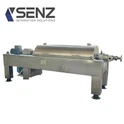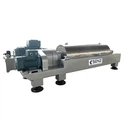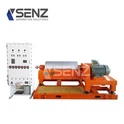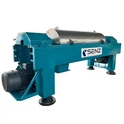


Slurries may be separated into solid and liquid phases by a process known as sedimentation, where gravity forces cause the heavier solid particles to settle out from the less dense liquid. The rate of sedimentation can be greatly increased by Decanter Centrifuges, which use centrifugal sedimentation to continuously separate slurries quickly and effectively.

The slurry is fed, along with polymer to aid in sedimentation, into the inside of a helical screw conveyor that is fitted inside and closely conforming to a bowl that rotates at high speed. A gearbox rotates the conveyor at a slightly lower speed than the bowl. The slurry emerges into the region between the conveyor and the bowl through feed ports cut through the conveyor.
Centrifugal forces cause the solid particles to sediment outward toward the inside surface of the bowl, while the lighter liquids float on the inside of this solids cake. The conveyor pushes the sedimented solids toward one end of the bowl, while the liquid flows freely toward the other end.
At the solids discharge end, the bowl and conveyor are conically tapered inward so that the conveyor lifts the solids out of the pool of liquid and ejects them out of the bowl through the radial discharge ports, while still retaining the liquid. The liquid exits the bowl from ports with adjustable weirs at the other end of the machine.
The solids and liquid ejected from the bowl discharge ports are collected into a stationary casing, which incorporates baffle plates to prevent remixing. Discharge chutes or hoppers are attached under the casing to collect the separated material. The solids are usually collected on a conveyor, and the liquid is piped away.