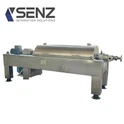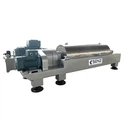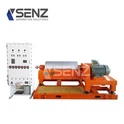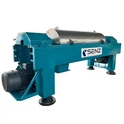


Decanter centrifuges handle liquid-solid mixtures. Three-phase mixture refers to a mixture of liquid and solid. This mixture can be divided into three categories according to its density: first, the density of the solid is greater than the density of the two liquids; Second, the density of the solid is smaller than that of the two liquids; Third, the density of the solid is between the two liquids. When the first mixture is treated with a decanter centrifuge of general structure, the separation process is slow because the density difference between the two phases is small. When the slurry is added to the liquid pool, it causes liquid splashing, which has a scouring effect on the sediment of the drum wall, and makes the fine product that has settled on the drum wall float again, reducing the settling separation effect. The spiral agitation produces turbulence; The mixing of the two phases is intensified when the heavy phase liquid passes through the light phase liquid. It is also difficult to push the screw to the slimy sediment with small solid particles and large adhesion, so a decanter centrifuge with special structure is needed to treat it. The second mixture is suitable for treatment with a filter centrifuge. The third uses a specially designed centrifuge for separation.
Taking the separation of triglycerides as an example, triglycerides are composed of light phase liquid glycerin, viscous soap heavy phase liquid and a small amount of solid impurities. High purity glycerin and soap containing trace suspended matter can be obtained when the decanter centrifuge is used. The features of this machine are:
(1) The feed liquid entering through the feed pipe is first accelerated in the silo of the spiral inner cylinder;
(2) An acceleration cone is arranged outside the spiral cylinder corresponding to the drum cone section, and the inner wall is provided with a number of reinforcement plates along the axis direction. The pre-accelerated material liquid in the bin enters the acceleration cone through the hole for separation. The separated light phase in the inner layer and the heavy phase in the outer layer flow into the liquid pool in the cylinder section along the axis through the big end of the acceleration cone. This reduces the entrainment of the heavy phase liquid through the light phase liquid during the separation process;
(3) The light phase separated from the drum spills from the hole of the overflow weir plate at the big end of the drum, and the weir plate is adjustable to adjust the depth of the light phase liquid in the drum liquid pool;
(4) The heavy phase liquid containing a small amount of solid is discharged to the slag outlet by means of the spiral through the annular channel between the acceleration cone and the inner wall of the drum;
(5) The size of the annular channel is determined by the specific gravity of the two-phase liquid, the percentage of volume and the rate of adding the liquid. In order to ensure that the light phase liquid does not enter the small end of the drum from the channel, the perimeter of the large end of the acceleration cone should be immersed in the heavy phase liquid, and the radius of the slag discharge port in the drum cone section (indicated by the X-ray) should be greater than the radius of the inner surface line of the light phase liquid.
An improved model of the machine is characterized by: a ring baffle is installed on the right side of the spiral simplified feeding hole, its diameter is determined by the light and heavy liquid phase of the specific gravity, volume percentage and feeding speed and other factors, in order to light phase liquid does not enter the restricted channel formed by the outer edge of the ring baffle and the drum wall as the principle, the heavy phase through the channel, from the drum small end of the slag outlet.
In order to facilitate the discharge of heavy phase, a tube is installed in the feed pipe, through which compressed air is sent to the drum tank. In order to prevent the air from running away directly from the overflow port, baffle plates are respectively installed on the large end of the drum and the spiral cylinder to form a light phase liquid channel of appropriate width. The diameter of the outer edge should be greater than the diameter of the inner surface line of the heavy phase liquid, and the inner edge should be extended into the light phase liquid. It is a decanter centrifuge with a simpler structure for separating a three-phase mixture (decanter sedimentation centrifuge). A fixed or adjustable baffle plate is installed between two adjacent spiral blades on the right side of the feeding hole of the spiral cylinder body, which can be perpendicular to the sub-spiral blade surface, or perpendicular to the drum wall, or other angles. A restricted annular channel is formed between the outer edge of the baffle plate and the drum wall, through which the heavy phase liquid containing a small amount of solid is discharged from the slag discharge port along the drum wall. The light phase spills from the overflow port at the large end of the drum.
If the solids in the heavy phase liquid need to be separated and discharged from the slag discharge port at the small end of the drum, the discharge channels of the light phase liquid and the heavy phase liquid need to be set up respectively at the large end of the drum. The light phase liquid of the structure is discharged through the overflow channel at the inner edge of the overflow weir, while the heavy phase liquid enters the annular space from the channel and is drawn out by the skimmer pipe.
May 14, 2023
Decanter centrifuges handle liquid-solid mixtures
Send Inquiry
Product Categories
Latest Products