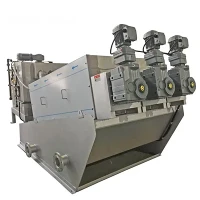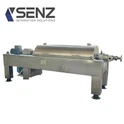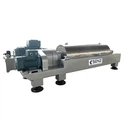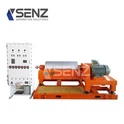


No matter what kind of process or comprehensive measures are used to treat livestock and poultry breeding wastewater, certain pretreatment measures should be taken. The pretreatment can reduce the waste water pollutant load, and prevent large solids or debris from entering the subsequent treatment link, causing equipment blockage or damage.
1. Pretreatment (centrifuge)
In view of the large particulate matter or the matter that is easy to settle in the wastewater, the livestock and poultry industry adopts centrifuge solid-liquid separation technology for pretreatment, and the commonly used equipment is grid, sedimentation tank and so on. Grilles are an essential part of the sewage treatment process, and their role is to block the coarse floating and suspended solids in the sewage, so as not to block holes, gates and pipes, and to protect mechanical equipment such as pumps.
At present, all farms with wastewater treatment facilities are basically connected to 2 to 3 sedimentation tanks outside the house, and the fecal water is treated through filtration, precipitation and oxidation decomposition.
2. Anaerobic treatment technology
In the 1950s, the anaerobic contact process appeared, and then with the invention of anaerobic filter AF and upflow anaerobic sludge bed UASB, promoted the development of a series of high-load anaerobic reactors based on improving the sludge concentration and improving the mixing effect of wastewater and sludge, and gradually applied to livestock sewage treatment.
Anaerobic treatment is characterized by low cost, small footprint, low energy demand, and can also produce biogas; Moreover, the treatment process does not require oxygen and is not limited by oxygen transfer capacity, so it has a high organic load potential and can degrade organic matter in some parts that cannot be degraded by aerobic microorganisms. Commonly used methods are: completely mixed anaerobic digester, anaerobic contact reactor, anaerobic filter, upflow anaerobic sludge bed, anaerobic fluidized bed, upflow solid reactor and so on.
The upflow anaerobic sludge bed and upflow solid reactor are the main processes used in domestic aquaculture wastewater treatment. In recent years, many researches have been made on various anaerobic reactors, and it is believed that the new ultra-efficient anaerobic reactors have broad prospects for treating organic pollutants in pig farm wastewater.
3. Aerobic treatment technology
The basic principle of aerobic treatment is to use microorganisms to decompose organic matter under aerobic conditions, while synthesizing their own cells (activated sludge). In aerobic treatment, biodegradable organic matter can eventually be completely oxidized to simple inorganic matter. The method mainly includes activated sludge process and biological filter, biological turntable, biological contact oxidation, sequencing batch activated sludge, A/O and oxidation ditch, etc. In the biological treatment of livestock and poultry wastewater by aerobic technology, the process combining hydrolysis and SBR is the most studied.
SBR process, that is, sequential batch activated sludge process, is an intermittent activated sludge process improved and developed based on the traditional Fill-Draw system, which transforms the sewage treatment structure from a space series to a time series, and conducts a cycle of inlet, reaction, precipitation, drainage and idle in the same structure. When SBR is combined with hydrolysis, the hydrolysis process has a high removal rate of CODCr, the total phosphorus removal rate of SBR is 74.1%, and the removal rate of high concentration ammonia nitrogen is more than 97%.
In addition, other aerobic treatment technologies have gradually been applied to livestock wastewater treatment, such as intermittent drainage delayed aeration (IDEA), circulating activated sludge system (CASS), intermittent circulation delayed aerated activated sludge method (ICEAS).
4. Mixed treatment method
The above natural treatment method, anaerobic method and aerobic method have advantages and disadvantages and scope of application for the treatment of livestock and poultry breeding wastewater. In order to learn from each other and obtain good and stable effluent water quality, other treatment units are added in practical application. Mixed treatment is based on the amount and specific conditions of livestock waste water, designed by the above three, or to them as the main body and combined with other treatment methods to optimize the combination of livestock waste water. This method can achieve better results with lower processing cost.