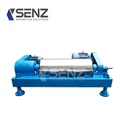

A 3 - Phase Decanter Centrifuge is a highly efficient piece of equipment used in various industries for separating different phases of a mixture, such as solid - liquid - liquid or solid - liquid separation. As a supplier of 3 - Phase Decanter Centrifuges, understanding the power source requirements of these machines is crucial for both us and our customers. In this blog, we will delve into the types of power sources that a 3 - Phase Decanter Centrifuge requires.
Electrical Power: The Primary Source
The most common power source for a 3 - Phase Decanter Centrifuge is electrical power. This is because electrical power offers several advantages, including precise control, ease of use, and the ability to integrate with modern control systems.
Three - Phase Electrical Supply
A 3 - Phase Decanter Centrifuge typically requires a three - phase electrical supply. Three - phase power is a type of polyphase system that consists of three alternating currents with a phase difference of 120 degrees between each other. This type of power supply provides a more constant and smoother power flow compared to single - phase power, which is essential for the high - speed rotation of the centrifuge's bowl.
The advantage of using a three - phase power supply is that it can deliver a large amount of power with relatively low current. This reduces the power losses in the electrical cables and allows for more efficient operation of the centrifuge. Three - phase motors are also more compact and have a higher power - to - weight ratio than single - phase motors, making them ideal for use in 3 - Phase Decanter Centrifuges.
Voltage and Frequency Requirements
The voltage and frequency requirements of a 3 - Phase Decanter Centrifuge can vary depending on the specific model and the region where it will be used. In North America, the standard three - phase voltage is 208V, 230V, or 480V, with a frequency of 60Hz. In Europe and many other parts of the world, the standard three - phase voltage is 380V, 400V, or 415V, with a frequency of 50Hz.
It is important to ensure that the electrical supply at the installation site matches the voltage and frequency requirements of the centrifuge. Using an incorrect voltage or frequency can lead to improper operation of the centrifuge, reduced efficiency, and even damage to the motor.
Power Rating
The power rating of a 3 - Phase Decanter Centrifuge is determined by several factors, including the size of the centrifuge, the speed of rotation, and the load capacity. Larger centrifuges with higher rotational speeds and greater load capacities will generally require more power.
The power rating is usually specified in kilowatts (kW). For example, a small - to - medium - sized 3 - Phase Decanter Centrifuge may have a power rating of 10 - 30 kW, while a large industrial - grade centrifuge can have a power rating of 100 kW or more.
Starting and Running Power
When a 3 - Phase Decanter Centrifuge starts up, it requires a higher amount of power than when it is running at its normal operating speed. This is because the motor needs to overcome the inertia of the rotating parts, such as the bowl and the conveyor.
The starting power, also known as the inrush current, can be several times higher than the running power. To handle this inrush current, the electrical supply system needs to be properly sized. Some centrifuges are equipped with soft - start devices, which gradually increase the voltage and current to the motor, reducing the inrush current and minimizing the stress on the electrical system.
Other Considerations
Power Quality
In addition to the voltage, frequency, and power rating, the quality of the electrical power is also important. Power quality issues such as voltage sags, surges, and harmonics can affect the performance and lifespan of the centrifuge.
Voltage sags can cause the centrifuge to slow down or even stop, while voltage surges can damage the electrical components. Harmonics, which are multiples of the fundamental frequency, can cause overheating of the motor and other electrical equipment.
To ensure good power quality, it may be necessary to install power conditioning equipment such as voltage regulators, surge protectors, and harmonic filters.
Backup Power
In some industries, such as the food and pharmaceutical industries, it is essential to have a continuous supply of power to the 3 - Phase Decanter Centrifuge to avoid product loss and ensure quality control. In these cases, a backup power source, such as an uninterruptible power supply (UPS) or a generator, may be required.
A UPS can provide short - term power during a power outage, allowing the centrifuge to shut down safely. A generator, on the other hand, can provide long - term power if the main power supply is interrupted for an extended period.
Application - Specific Power Requirements
Different applications of 3 - Phase Decanter Centrifuges may have specific power requirements. For example, Three-Phase Separation Decanter used in the oil and gas industry need to handle large volumes of high - viscosity fluids, which may require a more powerful motor and a higher torque.
In the food industry, 3 Phase Centrifuge are used for separating oil, water, and solids in processes such as olive oil extraction. Olive Oil Decanter Centrifuge need to operate at a specific speed and power to ensure the quality of the extracted oil.


As a leading supplier of 3 - Phase Decanter Centrifuges, we offer a wide range of models with different power requirements to meet the diverse needs of our customers. Our technical team can help you select the right centrifuge based on your specific application and the available power supply at your site.
If you are interested in purchasing a 3 - Phase Decanter Centrifuge or have any questions about the power source requirements, please do not hesitate to contact us for a detailed consultation. We are committed to providing you with high - quality products and professional services to ensure the success of your operations.
References
- Perry, R. H., & Green, D. W. (1997). Perry's Chemical Engineers' Handbook. McGraw - Hill.
- Cengel, Y. A., & Boles, M. A. (2010). Thermodynamics: An Engineering Approach. McGraw - Hill.
- Purohit, P. S., & Purohit, P. N. (2017). Mechanical Engineering Handbook. Pearson.