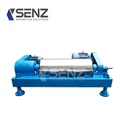

Hey there! As a supplier of small decanter centrifuges, I've spent a good amount of time getting to know these nifty machines inside out. They're super useful in a bunch of industries, but like any piece of equipment, they've got their limitations. In this blog, I'll spill the beans on what those limitations are, so you can make an informed decision when it comes to using or buying a small decanter centrifuge.
Capacity Constraints
One of the most obvious limitations of a small decanter centrifuge is its capacity. These bad boys are, well, small, and that means they can't handle as much volume as their larger counterparts. If you're dealing with a high - throughput operation, a small decanter centrifuge might quickly become a bottleneck.
Let's say you're running a food processing plant. You're churning out large quantities of Soymilk Decanter Centrifuge every day. A small decanter centrifuge would have to work round - the - clock just to keep up with the production, and even then, it might not be able to handle the full load. This can lead to longer processing times, which in turn can increase your production costs.
In industries where time is money, such as oil and gas or chemical processing, the limited capacity of a small decanter centrifuge can be a real deal - breaker. For example, in a Used Cooking Oil Separator application, if you have a large amount of used cooking oil to process, a small centrifuge will take ages to separate the oil from the impurities. This not only slows down the recycling process but also means you can't get the recycled oil back into the market as quickly as you'd like.
Separation Efficiency
Another limitation is the separation efficiency. Small decanter centrifuges often have a harder time achieving the same level of separation as larger ones. The smaller size means there's less space for the separation process to take place, which can result in less - than - optimal separation of the different components in a mixture.
Take a wastewater treatment plant as an example. The goal is to separate solids from liquids as effectively as possible. A small decanter centrifuge might not be able to separate all the fine particles from the water, leaving behind some impurities. This can be a problem if the treated water needs to meet strict environmental standards.
In the pharmaceutical industry, where purity is of the utmost importance, the limited separation efficiency of a small decanter centrifuge can be a major issue. Even a small amount of contamination can render a batch of medicine unusable. So, while a small centrifuge might be suitable for some preliminary separation steps, it might not be sufficient for the final, high - precision separation required.
Maintenance and Durability
Small decanter centrifuges also tend to have more maintenance requirements and may not be as durable as larger models. The smaller components are often more delicate and can wear out more quickly. This means you'll have to spend more time and money on maintenance and replacement parts.
For instance, the seals and bearings in a small decanter centrifuge are under a lot of stress during operation. Over time, they can start to leak or fail, which can lead to downtime and costly repairs. And because these parts are often specific to the small centrifuge model, they can be more expensive to replace than the parts for a larger, more common centrifuge.
In addition, the smaller size of the centrifuge can make it more difficult to access certain components for maintenance. You might have to disassemble a large part of the machine just to get to a single worn - out part, which can be time - consuming and frustrating.


Cost - Benefit Ratio
When it comes to the cost - benefit ratio, small decanter centrifuges can be a bit of a mixed bag. On the one hand, they're generally cheaper to buy than larger centrifuges, which can be appealing for small businesses or startups with limited budgets. But on the other hand, when you factor in the limitations we've discussed - like the lower capacity, lower separation efficiency, and higher maintenance costs - the overall cost - effectiveness might not be as high as you'd expect.
Let's say you're a small winery. You're thinking about buying a small decanter centrifuge to clarify your wine. The upfront cost might seem reasonable, but when you realize that it can't handle a large batch of wine at once and that you'll have to spend a lot on maintenance, you might start to question whether it's really the best investment.
Limited Customization
Small decanter centrifuges also offer less room for customization compared to larger models. Larger centrifuges can often be tailored to specific industry needs and process requirements. But with a small centrifuge, you're usually stuck with the standard features and configurations.
For example, if you're in the mining industry and you need a centrifuge with specific settings to separate different types of ores, a small Decanter Machine might not be able to be customized to meet those exact needs. This can limit its usefulness in specialized applications.
Conclusion
So, there you have it - the main limitations of a small decanter centrifuge. Don't get me wrong, these machines still have their place. They're great for small - scale operations, research and development, or as a secondary centrifuge for backup or specialized tasks. But if you're looking for a high - capacity, high - efficiency solution for a large - scale operation, you might want to consider a larger model.
If you're still thinking a small decanter centrifuge could be the right fit for your business, I'd love to chat with you. We can go over your specific requirements and see if our products can meet your needs. Whether you're in the food, beverage, pharmaceutical, or any other industry, we're here to help you make the best decision for your operation. Get in touch with us to start the conversation about how our small decanter centrifuges can work for you.
References
- Smith, J. (2020). Centrifuge Technology in Modern Industries. Industrial Press.
- Johnson, A. (2019). Separation Processes: Principles and Applications. Chemical Engineering Journal.