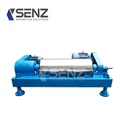

A small decanter centrifuge is an essential piece of equipment in various industries, known for its efficiency in separating solids from liquids. As a supplier of small decanter centrifuges, I am often asked about the working principle of these remarkable machines. In this blog post, I will delve into the details of how a small decanter centrifuge operates, its key components, and its wide - ranging applications.
1. Basic Concept of Centrifugation
Centrifugation is a process that uses centrifugal force to separate substances of different densities. In a small decanter centrifuge, this basic principle is harnessed to separate solids and liquids effectively. When a mixture of solids and liquids is rotated at high speed, the centrifugal force causes the denser solid particles to move towards the outer periphery of the rotating chamber, while the less - dense liquid stays closer to the center.
2. Key Components of a Small Decanter Centrifuge
2.1. Bowl
The bowl is the main rotating component of the decanter centrifuge. It is typically cylindrical or conical in shape and rotates at high speeds, often ranging from a few thousand to over ten thousand revolutions per minute (RPM). The high - speed rotation generates the centrifugal force necessary for separation. The bowl's design, including its diameter, length, and shape, can significantly affect the separation performance. For example, a longer bowl provides a greater settling area for the solids, allowing for more efficient separation.


2.2. Screw Conveyor
Inside the bowl, there is a screw conveyor. The screw conveyor rotates at a slightly different speed from the bowl, which creates a relative motion between the two components. As the solid particles accumulate on the inner wall of the bowl due to centrifugal force, the screw conveyor moves these solids towards the smaller end of the conical part of the bowl, eventually discharging them from the machine.
2.3. Feed Inlet
The feed inlet is where the mixture of solids and liquids (the feed) is introduced into the centrifuge. The feed is carefully directed into the bowl in a way that ensures a uniform distribution within the rotating chamber. This is crucial for achieving optimal separation efficiency.
2.4. Liquid Discharge Port
Once the separation process is complete, the clarified liquid is discharged from the centrifuge through the liquid discharge port. The position and design of this port can be adjusted to control the level of the liquid in the bowl, which in turn affects the separation performance.
2.5. Solids Discharge Port
The solids that have been separated from the liquid are discharged through the solids discharge port. This port is located at the end of the conical section of the bowl where the screw conveyor pushes the solids.
3. Working Process of a Small Decanter Centrifuge
3.1. Feed Introduction
The process starts with the introduction of the feed mixture into the centrifuge through the feed inlet. The feed can be a variety of mixtures, such as industrial slurries, wastewater containing solids, or biological suspensions.
3.2. Centrifugal Separation
As the bowl rotates at high speed, the centrifugal force acts on the feed mixture. The denser solid particles are forced towards the inner wall of the bowl, forming a layer of sediment. The less - dense liquid remains in the central part of the bowl.
3.3. Solids Conveyance
The screw conveyor, rotating at a slightly different speed from the bowl, moves the accumulated solid particles along the inner wall of the bowl towards the solids discharge port. The relative motion between the screw conveyor and the bowl ensures continuous removal of the solids.
3.4. Liquid Discharge
The clarified liquid, free from most of the solid particles, is discharged through the liquid discharge port. The clarity of the discharged liquid can be controlled by adjusting the operating parameters of the centrifuge, such as the rotation speed of the bowl and the flow rate of the feed.
4. Applications of Small Decanter Centrifuges
4.1. Petroleum Industry
In the petroleum industry, small decanter centrifuges are used for Petrole Oil Sludge Dewatering Machine. Oil sludge often contains a mixture of oil, water, and solid particles. The centrifuge can effectively separate the oil from the sludge, allowing for the recovery of valuable oil resources and reducing environmental pollution.
4.2. Aquaculture
For the production of fish meal, Fish Meal Dewatering Centrifuge is an important step. Small decanter centrifuges can rapidly separate the liquid component from the fish meal, increasing its dry matter content and improving the quality of the final product.
4.3. Food Industry
In the food industry, small decanter centrifuges are used for separating solids from liquids in various food processing applications, such as juice clarification and the separation of milk fat from milk.
4.4. Wastewater Treatment
In the field of wastewater treatment, especially in Slaughterhouse Wastewater Treatment, small decanter centrifuges play a crucial role. They can separate suspended solids from the wastewater, reducing the pollution load and making the wastewater easier to treat further.
5. Advantages of Our Small Decanter Centrifuges
As a supplier of small decanter centrifuges, we are proud to offer products with several advantages. Our centrifuges are designed with high - quality materials, ensuring long - term durability and reliable performance. They are also equipped with advanced control systems that allow for easy adjustment of operating parameters, ensuring optimal separation efficiency for different types of feeds. Additionally, our small decanter centrifuges are compact in size, making them suitable for applications where space is limited.
6. Contact Us for Purchase and Negotiation
If you are in need of a small decanter centrifuge for your industry, we are here to help. Our expert team can provide you with detailed product information, technical support, and customized solutions based on your specific requirements. We invite you to contact us to start the purchase negotiation process and find the best centrifuge solution for your business.
References
- Coulson, J. M., & Richardson, J. F. (1999). Chemical Engineering Volume 2: Particle Technology and Separation Processes. Butterworth - Heinemann.
- Karabelas, A. J. (2007). Centrifugal separation. In Encyclopedia of Separation Science. Elsevier.