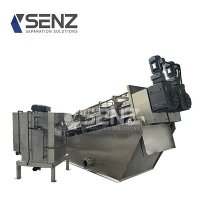
Hey there! As a supplier of Fish Oil Decanter Centrifuges, I often get asked about the capacity of a typical fish oil decanter centrifuge. It's a great question, and I'm here to break it down for you in a way that's easy to understand.
First things first, let's talk about what a fish oil decanter centrifuge actually does. In simple terms, it's a machine that separates the fish oil from other components in the fish, like water, solids, and impurities. This is done through the process of centrifugation, where the centrifuge spins at high speeds, causing the different substances to separate based on their density.
Now, when it comes to the capacity of a typical fish oil decanter centrifuge, there's no one - size - fits - all answer. The capacity can vary widely depending on several factors.
Factors Affecting Capacity
1. Design and Model
Different manufacturers design their decanter centrifuges with various capacities in mind. Some smaller, more basic models might be designed for small - scale fish oil production, like a local fish processing plant or a research laboratory. These could have a capacity ranging from as low as 100 liters per hour (LPH) to around 500 LPH.
On the other hand, large - scale industrial models are built to handle high - volume production. These can have capacities of 5,000 LPH or even more. For example, if you're running a big fish oil manufacturing facility that supplies to major health supplement companies, you'll likely need one of these high - capacity centrifuges.
2. Type of Fish
The type of fish being processed also plays a role. Some fish have a higher oil content than others. For instance, fatty fish like salmon, mackerel, and herring have more oil compared to leaner fish. If you're processing fatty fish, the centrifuge might be able to handle a larger volume because there's more oil to separate. But if you're working with lean fish, the capacity might be a bit lower as there's less oil to extract.
3. Desired Purity Level
The purity level of the fish oil you want to achieve can affect the centrifuge's capacity. If you're aiming for a very high - purity fish oil, the centrifuge might need to run at a slower speed or go through multiple separation cycles. This means that the overall capacity in terms of volume per hour will be reduced. However, if you're okay with a slightly lower purity level, the centrifuge can operate at a higher speed and process a larger volume.
Common Capacity Ranges
Let's take a look at some common capacity ranges for different types of fish oil decanter centrifuge users:
Small - scale Producers
For small - scale fish oil producers, such as artisanal health food manufacturers or small fishing communities that want to make their own fish oil supplements, a centrifuge with a capacity of 100 - 500 LPH is usually sufficient. These machines are more compact and affordable, making them a great choice for those just starting out or with limited production needs.
Medium - scale Producers
Medium - scale producers, like regional fish oil companies that supply to local stores and some national distributors, typically use centrifuges with a capacity between 500 - 2,000 LPH. These machines offer a good balance between cost and production volume, allowing them to meet the growing demand for their products.
Large - scale Producers
Large - scale fish oil manufacturers that supply to the global market need centrifuges with capacities of 2,000 LPH or more. These industrial - grade machines are designed for continuous, high - volume operation and can handle the large quantities of fish required to meet international demand.
Other Considerations
It's not just about the capacity number. When choosing a fish oil decanter centrifuge, you also need to consider other features. For example, the efficiency of the separation process is crucial. A more efficient centrifuge will be able to extract more oil from the fish, even at a lower capacity, which can save you money in the long run.
Also, the maintenance requirements of the centrifuge are important. Some models are easier to clean and maintain than others. A centrifuge that's difficult to maintain can lead to downtime and increased costs.


Related Centrifuge Products
If you're in the market for other types of centrifuges, we also have some great options. Check out our Beer Yeast Centrifuge Separator, which is designed for separating yeast from beer during the brewing process. It's a high - performance machine that can improve the quality of your beer.
We also offer the Oil Field Centrifuge. This centrifuge is used in the oil and gas industry to separate solids from drilling fluids. It's a reliable and durable machine that can handle the tough conditions in the oil field.
And for those interested in tea extraction, we have the Tea Extraction Decanter Centrifuge. It's designed to separate the tea solids from the liquid extract, producing a high - quality tea product.
Conclusion
So, as you can see, the capacity of a typical fish oil decanter centrifuge can vary greatly depending on your specific needs. Whether you're a small - scale producer or a large - scale manufacturer, there's a centrifuge out there that's right for you.
If you're interested in learning more about our fish oil decanter centrifuges or any of our other centrifuge products, don't hesitate to reach out. We're here to help you find the perfect solution for your production needs, and we can assist you in choosing the right centrifuge based on your capacity requirements and other factors. Let's have a chat and start a great partnership in the world of centrifugation!
References
- "Centrifuge Technology and Applications" by [Author's Name]. [Publisher], [Year].
- "Fish Oil Processing and Quality Control" by [Another Author's Name]. [Another Publisher], [Another Year].