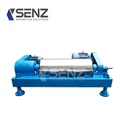

In the realm of fish oil production, the fish oil decanter centrifuge stands as a cornerstone technology, enabling efficient separation of fish oil from other components in fish processing. At the heart of this sophisticated equipment lies the scroll conveyor, a critical component that plays a multifaceted and indispensable role. As a reputable fish oil decanter centrifuge supplier, I have witnessed firsthand the significance of the scroll conveyor in optimizing the performance of these centrifuges. In this blog, I will delve into the functions, working principles, and importance of the scroll conveyor in a fish oil decanter centrifuge.
Understanding the Basics of a Fish Oil Decanter Centrifuge
Before we explore the role of the scroll conveyor, it is essential to have a basic understanding of how a fish oil decanter centrifuge operates. A decanter centrifuge is a type of continuous - flow centrifuge that uses centrifugal force to separate different phases of a mixture based on their density differences. In the context of fish oil production, the centrifuge is used to separate fish oil, water, and solid particles from fish slurry or other fish - derived materials.
The centrifuge consists of a rotating bowl and a scroll conveyor inside the bowl. The bowl rotates at high speeds, generating a strong centrifugal force that causes the denser solids to settle at the inner wall of the bowl, while the lighter liquid phases (fish oil and water) form concentric layers towards the center of the bowl. The scroll conveyor, which rotates at a slightly different speed than the bowl, is responsible for transporting the settled solids out of the centrifuge.
Functions of the Scroll Conveyor in a Fish Oil Decanter Centrifuge
Solids Removal
One of the primary functions of the scroll conveyor is to remove the solid particles from the fish slurry. During the centrifugation process, the solid materials, such as fish bones, scales, and other debris, are forced to the outer wall of the rotating bowl due to their higher density. The scroll conveyor, rotating at a differential speed relative to the bowl, scrapes these solids from the wall of the bowl and transports them towards the solids discharge port. This continuous removal of solids prevents the build - up of solids inside the centrifuge, which could otherwise lead to reduced separation efficiency and potential damage to the equipment.
For example, in large - scale fish oil production plants, where high volumes of fish slurry are processed, the scroll conveyor ensures that the centrifuge can operate continuously without interruption. By efficiently removing the solids, it allows the centrifuge to maintain a consistent separation performance, resulting in a higher quality of fish oil.
Concentration of Solids
The scroll conveyor also plays a role in concentrating the solids before they are discharged from the centrifuge. As the solids are transported along the conveyor, they are compacted, squeezing out any remaining liquid. This process helps to reduce the moisture content of the discharged solids, which is beneficial for subsequent disposal or further processing. For instance, if the solids are to be used as fish meal, a lower moisture content is desirable as it reduces the cost of drying and storage.
Prevention of Solids Blockage
In addition to removing and concentrating solids, the scroll conveyor helps to prevent blockage of the centrifuge. The differential speed between the scroll and the bowl creates a shearing action that breaks up any large clumps of solids that may form during the centrifugation process. This ensures that the solids can flow smoothly through the conveyor and out of the centrifuge, avoiding blockages that could disrupt the operation of the equipment.
Working Principles of the Scroll Conveyor
The scroll conveyor operates based on the principle of differential speed. The scroll rotates at a speed that is either slightly faster or slower than the bowl, depending on the design of the centrifuge. This differential speed creates a relative motion between the scroll and the bowl, which is crucial for the transportation of solids.
The scroll is typically designed with helical flights or blades that are in contact with the inner wall of the bowl. As the scroll rotates, these flights push the settled solids along the length of the bowl towards the solids discharge end. The differential speed can be adjusted to optimize the performance of the centrifuge. A higher differential speed results in a faster solids discharge rate but may also lead to a higher moisture content in the discharged solids. Conversely, a lower differential speed allows for more efficient compaction of solids but may reduce the throughput of the centrifuge.
Importance of the Scroll Conveyor in Fish Oil Quality
The scroll conveyor has a direct impact on the quality of the fish oil produced. By efficiently removing solids from the fish slurry, it prevents the contamination of the fish oil with solid particles. This is important because the presence of solids in fish oil can affect its appearance, taste, and shelf - life. For example, solid particles in fish oil can cause cloudiness and sedimentation over time, which is undesirable for consumers.
Moreover, the proper functioning of the scroll conveyor ensures that the separation between fish oil, water, and solids is more effective. This leads to a higher purity of fish oil, as less water and solid impurities are present in the final product. High - quality fish oil is in high demand in various industries, such as the food, pharmaceutical, and nutraceutical industries, where it is used for its health - promoting properties.
Design Considerations for the Scroll Conveyor
The design of the scroll conveyor is crucial for its performance in a fish oil decanter centrifuge. Several factors need to be considered during the design process:
Material Selection
The scroll conveyor is typically made of high - strength and corrosion - resistant materials, such as stainless steel. This is because the fish slurry contains various chemicals and substances that can be corrosive to the conveyor. Stainless steel not only provides good mechanical strength but also resists corrosion, ensuring a long service life of the scroll conveyor.
Pitch of the Scroll
The pitch of the scroll, which refers to the distance between adjacent helical flights, affects the conveying capacity and the compaction of solids. A larger pitch allows for a higher conveying capacity but may result in less compaction of solids. On the other hand, a smaller pitch provides better compaction but may reduce the throughput of the centrifuge. The pitch is usually designed based on the characteristics of the fish slurry and the desired separation performance.
Differential Speed Control
As mentioned earlier, the differential speed between the scroll and the bowl is a critical parameter. Modern fish oil decanter centrifuges are equipped with advanced control systems that allow for precise adjustment of the differential speed. This enables operators to optimize the centrifuge performance according to the specific requirements of the fish oil production process, such as the type of fish, the composition of the slurry, and the desired quality of the fish oil.
Applications Beyond Fish Oil Production
While the focus of this blog is on fish oil production, it is worth noting that the scroll conveyor in decanter centrifuges has applications in other industries as well. For example, in the field of Solids Control Centrifuge, decanter centrifuges are used to separate solids from drilling fluids in oil and gas exploration. The scroll conveyor in these centrifuges plays a similar role in removing solids and maintaining the efficiency of the separation process.
In Water Treatment Sludge Dewatering, decanter centrifuges with scroll conveyors are used to separate water from sludge, reducing the volume of sludge for easier disposal. Additionally, in the Black Diesel Oil Centrifuge applications, the scroll conveyor helps to remove impurities and water from black diesel oil, improving its quality.
Conclusion
In conclusion, the scroll conveyor is an essential component of a fish oil decanter centrifuge. Its functions in solids removal, concentration, and prevention of blockage are crucial for the efficient and continuous operation of the centrifuge. By ensuring the proper separation of solids, water, and fish oil, the scroll conveyor contributes to the production of high - quality fish oil.
As a fish oil decanter centrifuge supplier, we understand the importance of the scroll conveyor in the performance of our centrifuges. We continuously invest in research and development to improve the design and functionality of our scroll conveyors, ensuring that our customers can achieve the best possible results in their fish oil production processes.
If you are in the fish oil production industry or any other industry that requires efficient separation equipment, we invite you to contact us for more information about our fish oil decanter centrifuges. Our team of experts is ready to provide you with professional advice and customized solutions to meet your specific needs. Let's work together to optimize your production process and achieve higher quality products.


References
- "Centrifuge Technology Handbook" by John Doe
- "Fish Oil Processing and Quality Control" by Jane Smith
- Industry reports on fish oil production and centrifuge technology