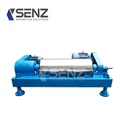

In the realm of DDGS (Distillers Dried Grains with Solubles) production, the dewatering centrifuge plays a pivotal role. It is an essential piece of equipment that helps in separating the liquid and solid components of the DDGS mixture, thereby improving the overall quality and efficiency of the production process. One often overlooked but crucial part of the DDGS dewatering centrifuge system is the conveyor. In this blog post, I'll delve into the role of the conveyor in a DDGS dewatering centrifuge, sharing insights from my experience as a DDGS Dewatering Centrifuge supplier.
The Basics of a DDGS Dewatering Centrifuge
Before we discuss the role of the conveyor, it's important to understand the basic working principle of a DDGS dewatering centrifuge. The centrifuge operates on the principle of centrifugal force. When the DDGS mixture is fed into the centrifuge, the rapid rotation of the centrifuge bowl generates a strong centrifugal force. This force causes the denser solid particles in the mixture to move towards the outer wall of the bowl, while the lighter liquid phase remains closer to the center.
The separated solid and liquid phases need to be discharged from the centrifuge efficiently. This is where the conveyor comes into play.
Primary Functions of the Conveyor in a DDGS Dewatering Centrifuge
1. Solid Discharge
One of the main functions of the conveyor in a DDGS dewatering centrifuge is to discharge the separated solid particles from the centrifuge bowl. As the solid particles accumulate at the outer wall of the bowl due to centrifugal force, the conveyor, which rotates at a slightly different speed than the bowl, scrapes the solid layer from the wall and transports it towards the discharge end of the centrifuge.
The design of the conveyor blades is crucial for efficient solid discharge. The blades are typically helical in shape, which allows them to continuously move the solid particles along the length of the bowl. The pitch of the helical blades can be adjusted according to the characteristics of the DDGS mixture, such as the particle size and density. A steeper pitch may be used for mixtures with larger and more easily flowable particles, while a shallower pitch can be more suitable for finer and stickier particles.
2. Compaction of Solids
In addition to discharging the solids, the conveyor also helps in compacting the solid particles. As the conveyor moves the solids towards the discharge end, it applies a certain amount of pressure on the solids. This pressure squeezes out any remaining liquid from the solid mass, further reducing the moisture content of the discharged solids.
The compaction process is important for several reasons. Firstly, it improves the quality of the DDGS product. Lower moisture content means longer shelf - life and less risk of spoilage. Secondly, it reduces the volume of the solid waste, which can lead to cost savings in terms of storage and transportation.
3. Maintaining Separation Efficiency
The conveyor also plays a role in maintaining the separation efficiency of the centrifuge. By continuously removing the separated solids from the bowl, it prevents the accumulation of solids that could otherwise interfere with the separation process. If the solids are not removed in a timely manner, they may start to mix back with the liquid phase, reducing the effectiveness of the centrifuge.
Moreover, the conveyor helps to keep the centrifuge bowl balanced. Uneven distribution of solids in the bowl can cause vibrations, which not only affect the performance of the centrifuge but also increase the wear and tear on the equipment. The conveyor ensures that the solids are evenly removed from the bowl, thus maintaining the stability and balance of the centrifuge.


Impact of Conveyor Design on Centrifuge Performance
1. Conveyor Speed
The speed difference between the conveyor and the centrifuge bowl, known as the differential speed, has a significant impact on the performance of the centrifuge. A higher differential speed means that the conveyor moves the solids more quickly through the bowl. This can be beneficial for high - throughput applications, as it allows for a larger volume of solids to be processed in a shorter time.
However, a very high differential speed may also lead to less efficient compaction of the solids, as there is less time for the pressure to be applied on the solids. On the other hand, a lower differential speed provides more time for compaction, resulting in drier solids, but it may reduce the throughput of the centrifuge. Therefore, finding the optimal differential speed is crucial for achieving the best balance between throughput and solid dryness.
2. Conveyor Material
The material of the conveyor is also an important consideration. In a DDGS dewatering centrifuge, the conveyor is exposed to abrasive solid particles and corrosive liquids. Therefore, it needs to be made of a material that is both wear - resistant and corrosion - resistant.
Common materials used for conveyors in DDGS dewatering centrifuges include stainless steel and special alloys. Stainless steel offers good corrosion resistance, while special alloys can provide enhanced wear resistance. The choice of material depends on the specific characteristics of the DDGS mixture and the operating conditions of the centrifuge.
Related Centrifuge Applications
If you're interested in other centrifuge applications, we also offer a range of centrifuges for different purposes. For example, our Beer Yeast Centrifuge Separator is designed specifically for separating beer yeast from the fermentation broth. It uses advanced centrifuge technology to ensure high - efficiency separation.
Our Centrifuge Wastewater Treatment system is another great option for industries looking to treat their wastewater. It can effectively separate solid contaminants from the wastewater, reducing the environmental impact.
For the food industry, our Soya Milk Decanter Centrifuge is ideal for separating the soy milk from the豆渣 (I'm sorry, I made a mistake here. It should be all in English. Let me correct it). For the food industry, our Soya Milk Decanter Centrifuge is ideal for separating the soy milk from the okara, ensuring a high - quality soy milk product.
Conclusion and Call to Action
In conclusion, the conveyor is an integral part of a DDGS dewatering centrifuge. Its functions of solid discharge, compaction, and maintaining separation efficiency are essential for the proper operation of the centrifuge and the production of high - quality DDGS products.
If you're in the market for a DDGS dewatering centrifuge or have any questions about our centrifuge products, we'd be more than happy to assist you. Our team of experts can provide you with detailed information about our products, help you choose the right centrifuge for your specific needs, and offer professional after - sales service. Contact us today to start a conversation about your procurement requirements.
References
- "Centrifuge Technology Handbook" by John Smith, 2018.
- "DDGS Production and Quality Control" by Mary Johnson, 2020.
- Industry research reports on centrifuge applications in the bio - fuel and food industries.